Fight Where Proximity Wins: Guerilla Local SEO for Small Businesses
Big chains outspend you everywhere except the neighborhood. Six guerilla tactics — group help, event content, reviews, sponsorships, speed, local answers — win where budget cannot.
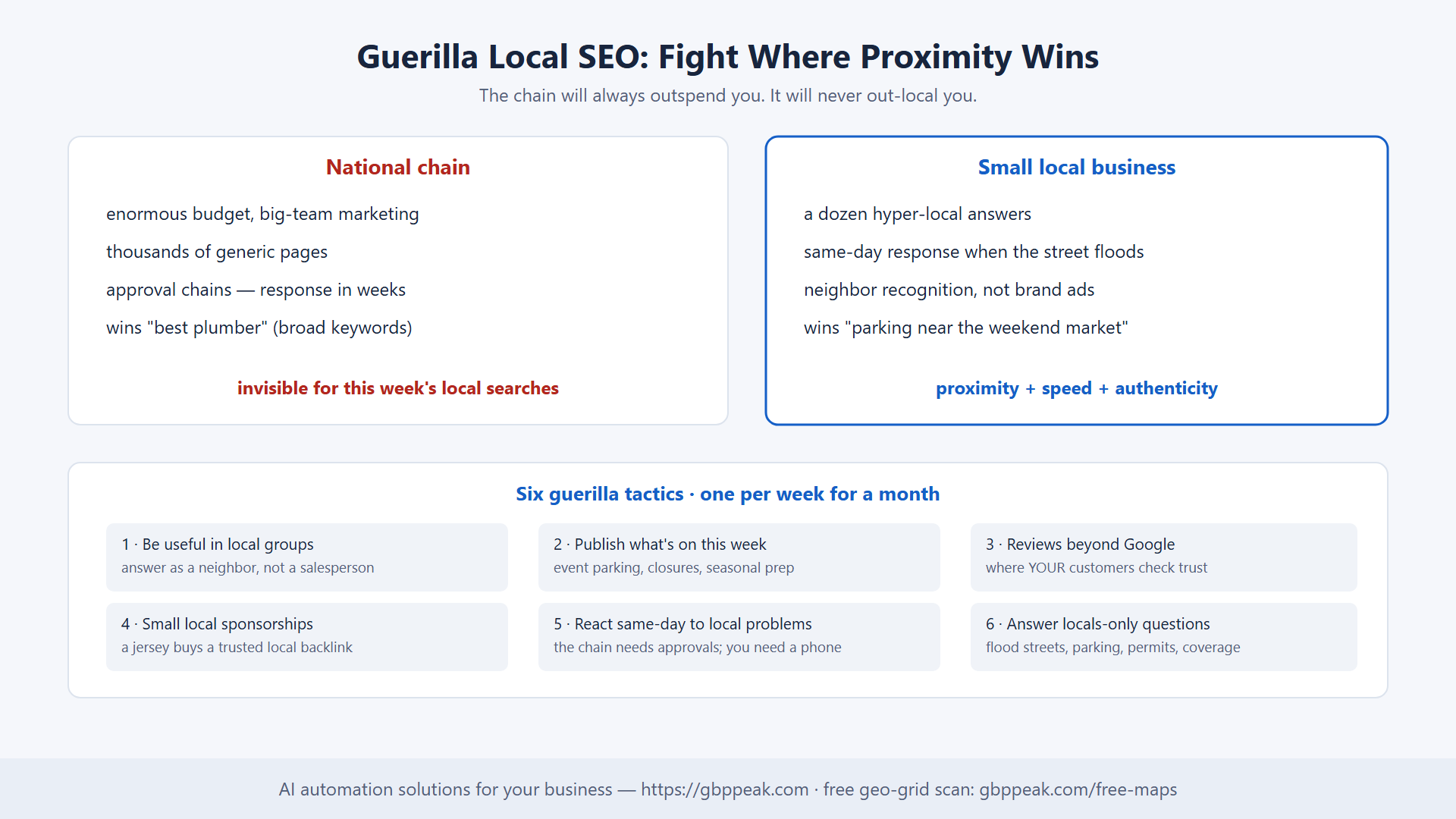
A national plumbing chain can outspend your local shop a hundred to one. It can publish a thousand pages, bid on every keyword, and run ads all year. And yet when the road outside the market floods, the shop that posts "we're doing on-site drain checks around Soi 71 today, message us" gets the calls — because the chain's content calendar was approved in another country six weeks ago.
That is guerilla local SEO: small businesses winning with proximity, speed, and authenticity instead of budget. You cannot beat the giants at their game, so you play the game they structurally cannot play — being genuinely, usefully local.
Guerilla local SEO uses a small business's natural advantages — local knowledge, community ties, and agility — to outmaneuver bigger competitors. Instead of outspending them on broad keywords, you win hyper-local searches: being genuinely helpful in neighborhood groups, publishing content about local events and conditions in real time, collecting reviews on the platforms your customers actually check, making small local sponsorships, and answering questions only a local would know. Speed and authenticity are the weapons; the goal is to become the trusted go-to in your specific area.
Why David Wins Locally
| National chain | Small local business | |
|---|---|---|
| Budget | Enormous | Tiny |
| Content | Thousands of generic pages | A dozen hyper-local answers |
| Response time | Approval chains, weeks | Same day |
| Local knowledge | Market reports | Lives it daily |
| Community trust | Brand advertising | Neighbor recognition |
| Broad keywords | Wins | Skip them |
| "parking near the weekend market" | Invisible | Winnable |
The entire strategy lives in the bottom rows: never fight where the budget matters, always fight where the proximity does. This is the niche-dominance logic from becoming the best in your niche, with the boundary drawn around your own neighborhood.
Tactic 1: Be Useful Where Neighbors Ask
Big brands treat social media as a billboard. Treat it as the village well. Local Facebook groups, neighborhood pages, and community forums are where recommendation requests happen daily: "anyone know a reliable plumber around here?"
The move is to answer as a neighbor, not a salesperson — give real advice, answer the actual question, skip the link (the first post with a link reads as spam; the third helpful answer builds a reputation). A helpful human reply turns into a name search later: a warm lead who already trusts you, arriving without you spending a baht.
Tactic 2: Publish What's Happening This Week
Corporations target "best plumber." You target what your area is searching this weekend: the festival parking guide, the farmers' market checklist, the road-closure notice with your workaround.
local-events content queue:
  this month's events → parking / timing / what-to-bring guides
  seasonal moments ... flood season prep, heatwave pipe care
  transit changes ..... "closed road? here's how deliveries still reach you"
  freshness rule ...... update or replace every seasonal piece —
                        stale event pages cost more than they earn
This captures intent the chains never see, keeps your site visibly fresh (which both search engines and AI tools reward — see sustainable local SEO), and positions you as the community's reference point.
Tactic 3: Reviews Beyond Google
Google reviews are essential — but they are not where every customer checks trust. Facebook, Yelp, industry directories, and community listings all carry weight with different segments.
Pick the one or two platforms your actual customers use most, then make leaving a review effortless: a direct link, sent right after a completed job, from a person they met. A personal ask from the local team beats the chain's automated email every time — and detailed reviews across several platforms teach AI search engines what you're known for, per tracking your AI visibility.
Tactic 4: Small Sponsorships, Real Mentions
You do not need stadium money. Community organizations constantly need modest help — kit for a youth team, printing for a school fundraiser, a small donation. Support three groups that genuinely fit your values, and ask for the simple mention: a "thank you" on their website or page.
That mention is exposure to exactly the right local audience and a backlink from a trusted local site — the hyper-local authority play from offsite SEO, at the price of a jersey.
Tactic 5: Speed When Local Problems Hit
Storms, floods, burst pipes, closures — local conditions change instantly and search follows within the hour. The chain's response needs approvals; yours needs a phone.
rapid-response playbook:
  local event affects customers → post within the day
  content = what happened + what to do + how we can help
  example: "Main St is closed for repairs — our vans are rerouted,
            on-site service unaffected, message us."
  why it wins: you're helping while the chain's page still says nothing
Tactic 6: Answer What Only a Local Knows
"Which roads flood in heavy rain?" "Best parking near the town hall?" "Do you serve [specific neighborhood]?" "What permits does this district require?" These searches have almost no competition and near-perfect intent — and answering them proves local expertise to humans and AI systems alike. List the ten questions you hear every week; each becomes an FAQ entry or a short post.
The 30-Day Plan
week_1_presence:
  - join 3 active local groups (listen first, answer second)
  - audit the Google Business Profile
  - list 10 common local questions
  - choose 1 extra review platform
week_2_content:
  - answer question #1 as a post
  - publish 1 local-event / seasonal update
  - add a local FAQ section to the site
  - ask 2 happy customers for reviews
week_3_community:
  - shortlist 3 local organizations to support
  - make the best-fit offer; agree on the mention
week_4_refine:
  - check calls, inquiries, mentions, and rank movement
  - keep what worked, drop what didn't
  - scoreboard: geo-grid scan district by district (gbppeak.com/free-maps)
Before posting anything, run the five-question gut check: genuinely useful to a neighbor? locally relevant? sounds human? contains local knowledge? helpful rather than selling? Five yeses means it fits the strategy.
FAQs
What is guerilla local SEO?
It is the practice of competing against bigger businesses using speed, local knowledge, and community involvement instead of budget — winning hyper-local searches and neighborhood trust that corporate marketing structurally cannot reach. Helpful group participation, event content, multi-platform reviews, small sponsorships, and rapid response to local conditions are the core tactics.
How can a small business outrank a large competitor locally?
By refusing the broad-keyword fight and dominating the narrow one. Large chains win "plumber" but are invisible for "which streets flood near the market" or this weekend's event parking. Hyper-local content, faster responses, and genuine community presence win those searches — and enough of them compounds into local authority that budget alone cannot dislodge.
Do Facebook groups and forums really help SEO?
Indirectly but powerfully. A helpful answer rarely carries a ranking link, but it creates branded searches ("that plumber from the group"), referrals, and mentions — signals both classic search and AI engines read. Treat community participation as reputation building that search visibility follows, not as link building.
How do small sponsorships help search rankings?
Community organizations you support typically mention you on their sites — trusted, locally relevant pages linking to yours. Those hyper-local backlinks are disproportionately valuable for local rankings, and the sponsorship itself puts your name in front of exactly the audience most likely to need you.
Fight Where Proximity Wins
The giant will always have the bigger budget; it will never have your street. Be useful in the groups, publish what's happening this week, collect reviews where your customers look, sponsor the team, respond the same day, and answer the questions only a local can. One tactic per week for a month, then keep what moved the needle — measured honestly with a free geo-grid scan at gbppeak.com/free-maps.