
Chosen by Default: How to Become the Best in Your Niche
Markets overpay the recognized #1 and ignore the generalist. Narrow to a winnable niche, quit dead ends, survive the Dip, and double down on your natural gift.
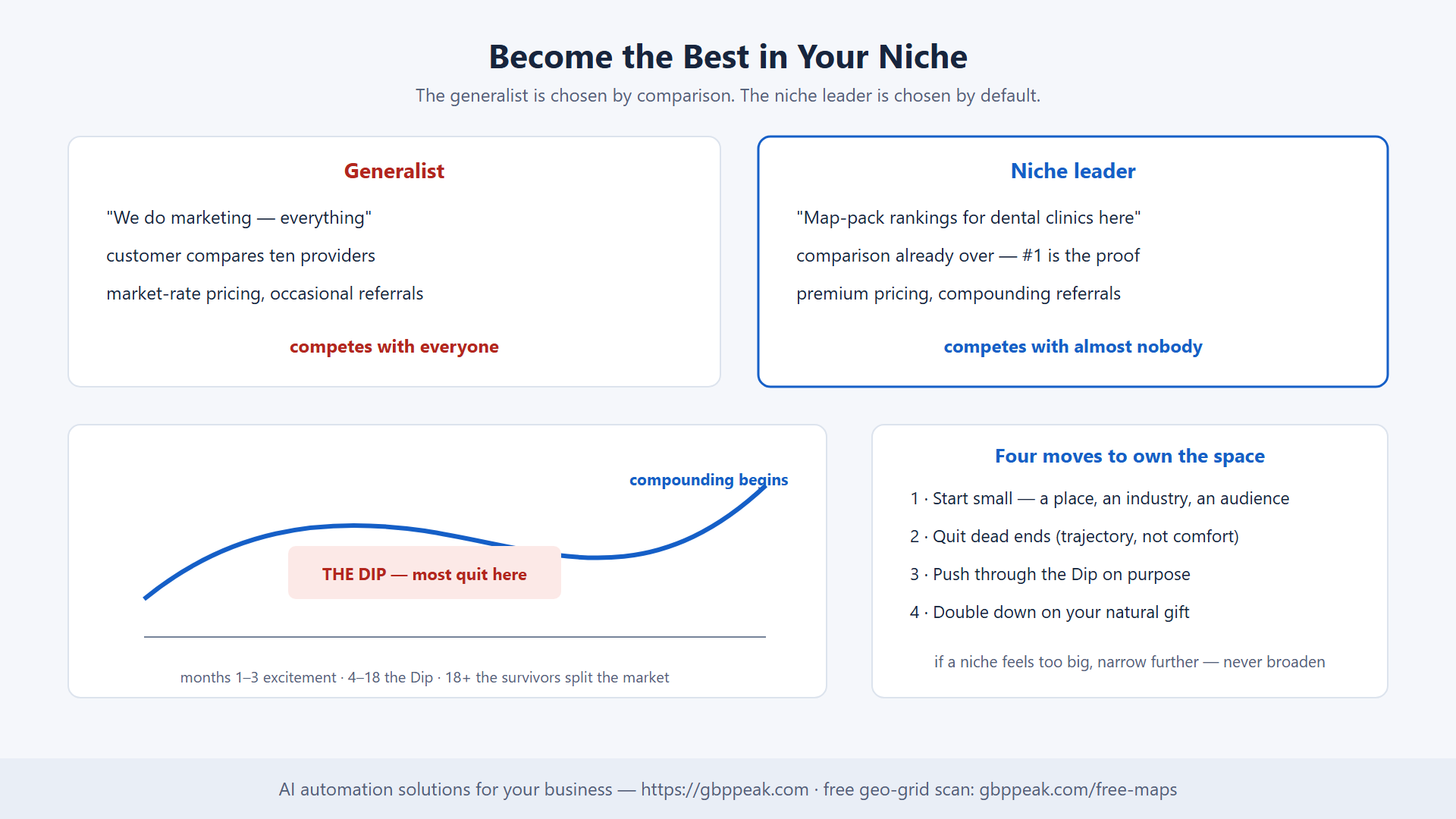
Two agencies pitch the same dental clinic. One says: "we do marketing — websites, social, ads, everything." The other says: "we get dental practices onto page one of the local map pack in this district, and here are three clinics we did it for." The clinic does not comparison-shop the second agency. The choice already feels made.
That is what being the best in a niche does — it removes the comparison. Markets pay a disproportionate premium to the recognized number one in a specific space, and almost nothing to the "pretty good at everything" option. This is how that mechanism works and how to occupy it deliberately.
Becoming the best in a niche works because markets concentrate rewards on the recognized leader: small early advantages compound through word of mouth and visibility, and customers default to the obvious #1 choice to avoid comparison effort. To occupy that position, narrow to a specific market segment (a city, an industry, an audience), quit dead-end projects that have no path to mastery, push through "the Dip" — the frustrating middle phase where most competitors quit — and double down on your natural strengths instead of trying to be well-rounded.
Why Number One Wins Disproportionately
Two forces stack in the leader's favor.
1. Compounding advantages
In most markets, a small early lead snowballs. The specialist gets the first referrals, the referrals produce results, the results produce content and case studies, the content produces more leads. Each turn widens the gap. Competitors arriving later must spend more to achieve less — which is exactly what a moat is, the same defense we described in offsite SEO authority and the agency-directory-media flywheel.
2. The lazy brain
People are wired to conserve mental energy. Comparing ten providers is expensive; picking the recognized leader is cheap. When a customer finds the clear #1 for their specific problem, they stop searching — not because they proved it was best, but because being #1 is the proof they accept. If you are number one in your niche, you don't argue that you're better. Your position argues it.
| Generalist | Niche leader | |
|---|---|---|
| Message | "We do marketing" | "Map-pack rankings for dental clinics in this district" |
| Customer's decision | Compare many providers | Comparison already over |
| Pricing power | Market rate | Premium (the safe choice) |
| Referrals | Occasional | Compounding, specific |
| Content | Generic, ignored | Specific, cited |
| Competition | Everyone | Almost nobody |
The right column is not harder work. It is narrower work.
Pick a Niche You Can Actually Own
"Everyone" is not a market; it is a crowd. A niche is a boundary you can dominate inside:
- A place — local SEO for one district or province. Geography shrinks the competitive set to something you can beat.
- An industry — marketing for boutique fitness studios, booking systems for veterinary clinics.
- An audience — services for English-speaking expat business owners in Bangkok.
niche_test:
  specific_enough: "can you name 20 ideal clients individually?"
  reachable:       "do they gather somewhere (associations, groups, directories)?"
  paying:          "do they already spend money on this problem?"
  winnable:        "is the current #1 beatable on focus, not budget?"
  fallback: "if any answer is no → narrow further, don't broaden"
The profitable intersection is simple: what you're good at × what specific people pay for — the same positioning math from building a sustainable sales engine.
Quit the Dead Ends
Not every project deserves persistence. A "dead end" is work that feels safe and familiar but has no path to mastery or scale — the fifth side project, the client who will never grow, the platform that never compounds. Every month spent there is a month not spent compounding in your niche.
The test is trajectory, not comfort: does this project get easier and more valuable over time, or does it just continue? Quitting dead ends is not failure — it is reallocation. Momentum thinking, not sunk-cost thinking; the same compounding logic we walked through in small wins and momentum.
Push Through the Dip
Every path to "best" passes through the Dip: the stretch after novelty fades and before results arrive, where the work is repetitive and the reward is invisible. It is precisely because the Dip is miserable that it works — most competitors quit inside it. Enduring the boring middle is the competitive advantage, and it can be engineered (small logged wins, visible streaks) rather than endured on willpower alone.
the Dip math:
  months 1-3 .... excitement, fast learning
  months 4-18 ... the Dip: routine, frustration, refinement
                  └─ most competitors quit here
  months 18+ ..... compounding: reputation arrives, inquiries arrive
                  └─ the survivors split the market
Double Down on Your Gift
The "well-rounded" advice is a generalist trap: competence at everything usually means being the best at nothing. Your unfair advantage is the strength that comes naturally:
- Persuader — you sell the vision; partner with a builder.
- Writer/explainer — you turn complexity into clarity; content compounds for you.
- Systems builder — you make the machine run; hire the voice.
Pick the lane where effort feels lighter for you than for others, and pour the hours there — delegating or partnering around the rest. That is not avoiding hard work; it is aiming it, the same "one tool per function" focus that runs the lean operations stack.
FAQs
What is a niche in business?
A niche is a specialized slice of a market — "marketing for independent dental practices" instead of "marketing." It bounds the competition to a set you can beat, lets you speak one audience's language, and makes "best in class" an achievable target rather than a slogan.
How do I find a profitable niche?
Look for the intersection of three things: what you are already good at, what you can tolerate doing for years, and what a specific, reachable group already pays to solve. If you can name twenty ideal clients individually and find where they gather, the niche is specific enough.
What is the Dip and why does it matter?
The Dip is the middle phase of any mastery path — after the excitement fades, before the results arrive. It matters because it filters the field: most competitors quit inside it, so simply continuing with discipline through the boring months leaves you among the few who ever reach compounding.
Should I improve my weaknesses instead of leaning on strengths?
In business, no — that is the well-rounded trap. Hours spent dragging a weakness to average return little; the same hours invested in an existing strength can make you the best in a niche. Cover weaknesses with partners, hires, and systems instead of personal effort.
Be Something Specific
The generalist competes with everyone and is chosen by comparison. The niche leader competes with almost no one and is chosen by default. Pick a boundary, quit the dead ends, survive the Dip on purpose, and aim your natural gift at the narrow space where it can become undisputed. If your niche lives in local search, see the territory before you claim it — a free geo-grid scan at gbppeak.com/free-maps shows exactly where you already rank, district by district.