
Deals Die in Limbo: Building a Sustainable Sales Engine
Authority that attracts, conversations that build trust, a pipeline that never forgets, proposals that give the map away, and one direct ask at the end.
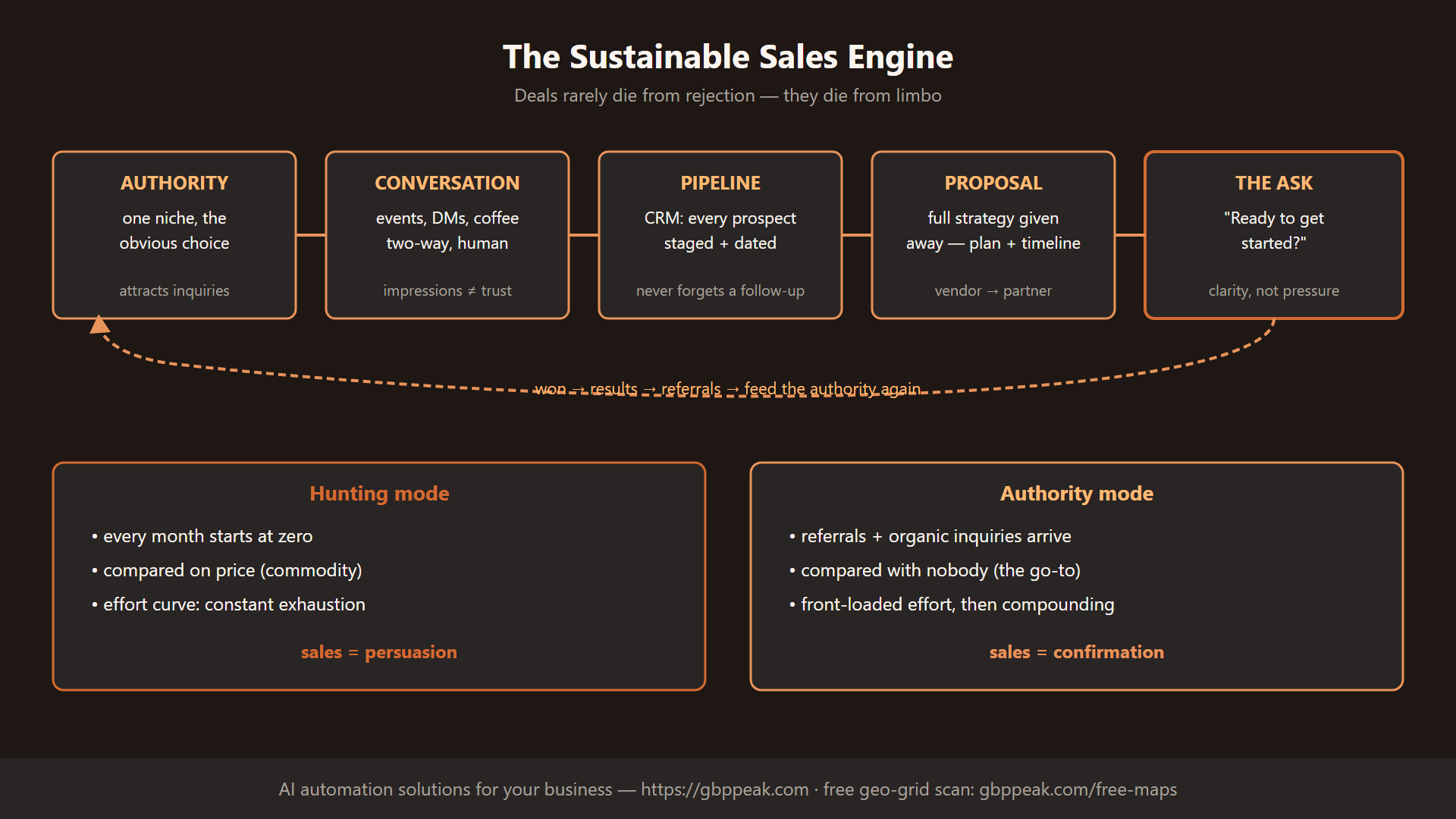
Watch a deal die in slow motion: a promising conversation in March, a proposal sent in April, and then… silence — because nobody asked for the business and nobody tracked the follow-up. The prospect didn't say no. They just drifted, while the seller waited politely for a reply that was never coming.
Deals rarely die from rejection. They die from limbo. A sustainable sales engine is the machine that prevents limbo: authority that attracts, conversations that build trust, a pipeline that never forgets, proposals that sell the roadmap, and a direct ask at the end. No magic script, no born-salesman gene required.
A sustainable sales engine replaces persuasion tricks with a repeatable process: specialize narrowly to become the go-to authority in one niche, prioritize real two-way conversations over one-way impressions, track every prospect in a simple CRM with consistent follow-up over weeks or months, write value-first proposals that give the full strategy away, and close with a direct, unpressured ask — "are you ready to get started?" The engine runs on discipline and organization rather than personality, so deals stop dying in limbo and revenue becomes predictable.
Hunting vs Attracting
The default sales mode is hunting: chase leads, pitch, repeat. It works, but it is exhausting and it never gets easier — every month starts at zero.
The alternative is becoming the authority in one specific space. A generalist is a commodity, easily replaced on price; a specialist is the obvious choice for a specific type of client. Narrow focus is the fastest route there — the same one-page-one-keyword logic from building an inbound lead engine, applied to your entire positioning.
| Hunting mode | Authority mode | |
|---|---|---|
| Leads come from | Your outbound effort | Referrals + organic inquiries |
| Position | Commodity, compared on price | The go-to, compared with nobody |
| Month starts at | Zero | Existing demand |
| Effort curve | Constant | Front-loaded, then compounding |
| Sales conversation | Persuasion | Confirmation |
The transition is gradual: hunt while you build, and let the hunting fund the attracting. Over time the ratio flips — that flip is the sustainable sales engine.
Impressions Are Not Conversations
Beginners mistake marketing for selling. Content, posts, and websites are one-way streets — excellent for visibility, useless for trust on their own. An impression is someone seeing your content; a conversation is a human interaction, and only conversations create the empathy that deals are built on.
Prioritize high-touch contact deliberately:
- Industry events and conferences — rooms where your exact buyer already gathers.
- Direct messages and forum discussions — answering real questions in public.
- Coffee and one-to-one meetings — the oldest conversion technology there is.
People buy from people they know, like, and trust — and the knowing has to happen somewhere. The weekly selling rhythm from agency growth: content to sales operationalizes exactly this: ten warm conversations a week beats a thousand impressions.
The Pipeline That Never Forgets
The quiet deal-killer is the forgotten follow-up. Most prospects need several touchpoints over weeks or months before buying, and the first "no" is usually "not yet." Without a system, "not yet" silently becomes "never."
A CRM is the fix — HubSpot, a lightweight tool, or even a disciplined spreadsheet. The tool matters less than the rule: every prospect exists in a stage, with a next action and a date.
pipeline_stages:
  new_lead:      "entered from referral/event/inquiry"
  conversation:  "first real talk done → note their actual problem"
  proposal_sent: "full strategy delivered → date sent, date to follow up"
  nurturing:     "said not-yet → value touch every 2-3 weeks"
  won:           "asked, closed, onboarded"
rules:
  - "no prospect without a next-action date"
  - "follow up until a clear yes or no — never assume"
  - "nurture touches give value: a relevant article, an intro, a scan of their visibility"
Sales is a numbers game played slowly — the pipeline's job is keeping you in the game long enough for deals to mature.
Proposals That Give Away the Map
The instinct in many industries is to hide the "secret sauce" until after signature. The stronger play is the opposite: give the full strategy in the proposal — the plan, the sequence, the timeline, the expected outcomes.
This feels risky and is not. Modern clients have all the information in the world; they are not paying for the plan. They are paying for:
- Execution — your ability to actually implement it.
- Time — handling the details they have no hours for.
- Peace of mind — a clear roadmap instead of a mystery box.
A proposal that lays out exactly what will happen demonstrates competence on the spot. It converts you from vendor (replaceable) to strategic partner (specific to their problem). The tailoring is the proof of work — it shows you understood their situation, not just your own offer.
The Final Mile: Ask
The most common failure point is the last one: everything went well, the proposal landed, and then… nobody asked. So the deal floats.
The fix is a simple, direct, unpressured question at the right moment:
"Are you ready to get started?"
That sentence does three things: it removes ambiguity, it signals the shift from planning to execution, and it protects your time — a prospect who dodges a direct ask is telling you they are not ready, which is cheaper to learn now than after six weeks of chasing. Directness is not pressure; it is clarity, the same evidence-first, no-fluff posture that runs through offer clarity and lead quality.
The Engine, Assembled
AUTHORITY (niche focus)
   → attracts INQUIRIES
      → real CONVERSATIONS (events, DMs, coffee)
         → PIPELINE (CRM: every prospect staged + dated)
            → VALUE-FIRST PROPOSAL (the full map)
               → THE ASK ("ready to get started?")
                  → WON → results → referrals → back to authority
Each stage feeds the next, and the won deals loop back into authority through results and referrals. That loop — not any single script or tactic — is what makes revenue predictable. It is the same flywheel thinking as the agency-directory-media model, pointed at your sales process.
FAQs
Do I need to be a "natural" salesperson to succeed?
No. Natural charm helps in a single conversation, but sustainable sales come from process: niche authority, tracked follow-ups, value-first proposals, and a direct close. A disciplined introvert with a working pipeline outperforms a charismatic one without one, because the engine — not the personality — carries the deals.
How long does it take to close a deal?
Anywhere from a day to over a year depending on the industry and deal size. That range is exactly why a CRM and a nurture cadence matter: deals mature on the client's timeline, and the seller who stays politely present wins the deals the impatient ones abandon.
Should I really give my full strategy away in the proposal?
Yes. Clients can find information anywhere; they buy execution, saved time, and certainty. Showing the complete plan proves competence and builds trust immediately — and the client who takes your plan and executes it themselves without you was never going to be a client.
How do I follow up without being annoying?
Give value on every touch instead of asking for status: share a relevant article, introduce them to someone useful, send a visibility scan of their business. Value-touches every two or three weeks keep you in the "trusted expert" slot, so when readiness arrives, you are the first call.
Build the Machine
Sales does not need a new personality. It needs a niche worth owning, conversations worth having, a pipeline that never forgets, proposals that give the map away, and the courage of one direct sentence at the end. Put those five in place this quarter and revenue stops being weather and starts being machinery. And if your engine runs on local visibility, measure the fuel: a free geo-grid scan at gbppeak.com/free-maps shows exactly where your market sees you.