
Build the Momentum First: Why Small Wins Compound Into Big Results
The Dip kills most projects before results arrive. Small logged wins, steady effort, and reinvestment build the momentum that compounds into big outcomes.
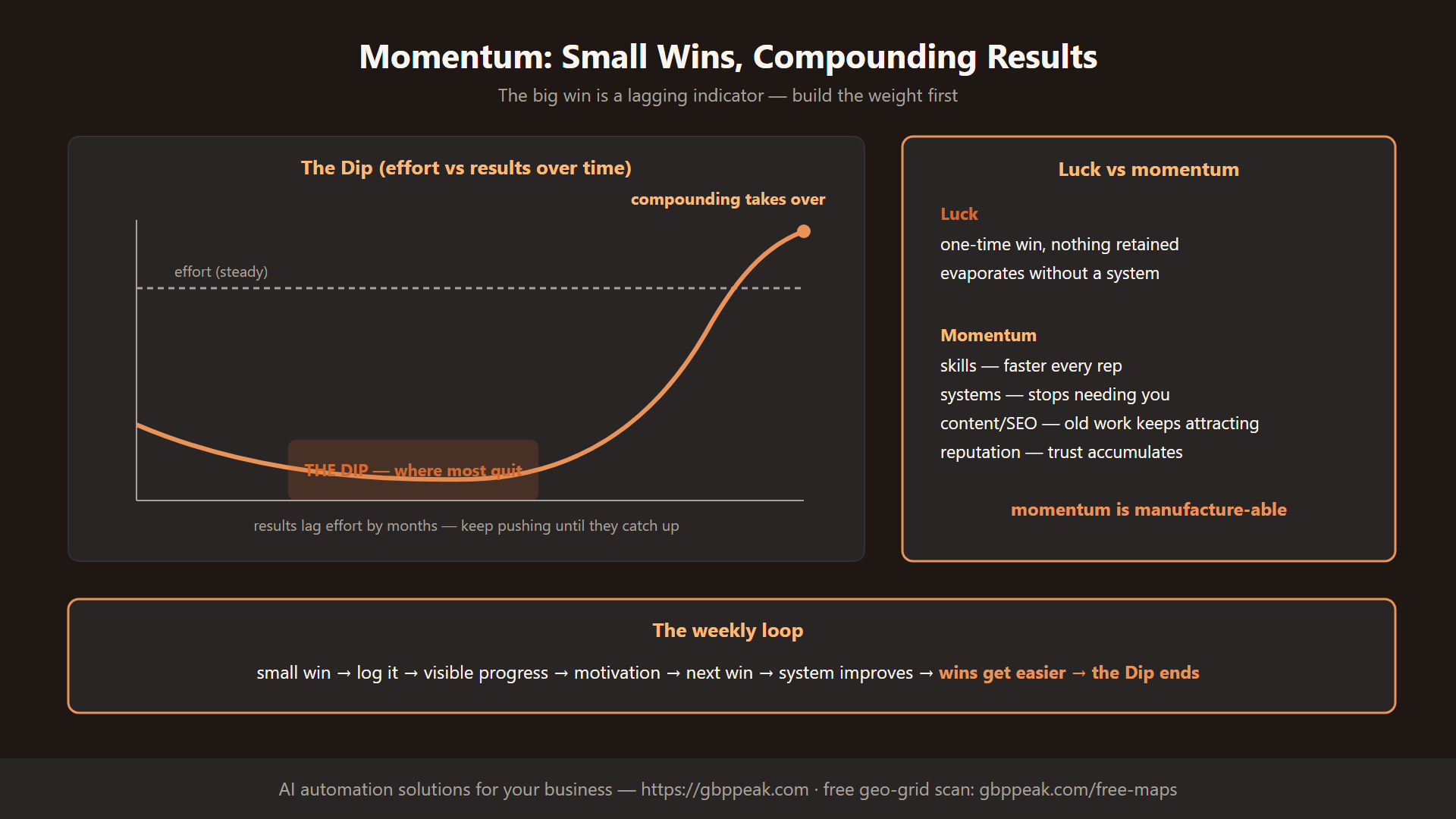
Two businesses launch the same month. One spends its first quarter hunting for the big break — the viral post, the whale client, the overnight pivot. The other publishes one useful answer every week and signs one small client a month. Eighteen months later, the first has a folder of abandoned projects. The second has a body of work that brings inquiries while the owner sleeps, and can name the month each layer started paying for the next.
Nothing dramatic happened in the second business. That is the point. Big outcomes are usually the visible end of an invisible compounding process, and the people who reach them are the ones who survived the boring middle. This is how that works — and how to engineer it deliberately.
Lasting success comes from momentum, not breakthroughs. Momentum is the weight a project gains from consistent daily progress: each small win builds skill, confidence, and assets that make the next win easier. It carries you through "the dip" — the stretch after novelty fades but before results arrive — and it compounds, because past work keeps producing value while new work stacks on top. Focus on process over outcomes, celebrate small wins as emotional fuel, and reinvest each milestone into the next improvement.
The Dip Is Where Projects Die
Starting is easy — excitement does the work for you. The real test arrives months in: the newness has worn off, the results haven't shown up yet, and the work has become repetitive. That valley is the Dip, and it quietly kills more projects than any competitor ever did.
The misleading part is how the Dip feels. It feels like failure, like proof the idea was wrong. In reality it is arithmetic: early effort goes mostly into infrastructure nobody sees — skills, systems, content, relationships — and visible results lag behind effort by months.
| Breakthrough hunting | Momentum building | |
|---|---|---|
| Goal | One big win | Repeatable system |
| The Dip | Proof it's not working | Expected terrain, planned for |
| Effort curve | Spikes and crashes | Steady, sustainable |
| Results | Lumpy, mostly absent | Slow, then compounding |
| Quit cost | Low ("it didn't work") | High (you'd abandon assets) |
| 18 months later | Folder of pivots | Stack that pays while you sleep |
The Dip ends for everyone eventually — but only for those still working when it does.
What Momentum Actually Is
Picture pushing a block of clay. At first every shove is heavy: you are learning, making mistakes, building nothing reusable. Keep pushing and the corners round off. Habits form, systems tighten, and the same effort starts moving more mass. Eventually the block rolls a little on its own — past work producing present results.
Momentum is that weight. And unlike luck, it is manufacture-able:
luck      = one-time win, nothing retained
momentum  = consistent action + retained assets
            ├─ skills (you get faster every rep)
            ├─ systems (the process stops needing you)
            ├─ content/SEO (old work keeps attracting)
            └─ reputation (trust accumulates in the market)
This is the same mechanism that powers the inbound engine we built in building an inbound lead generation engine: each focused service page and each answered question is a small win that keeps working after the day it shipped. Search visibility is perhaps the purest compounding asset a small business can own — invisible for months, then suddenly the phone rings from work you did last quarter.
Why Compounding Feels Unfair (in Your Favor, Eventually)
Without momentum, work adds linearly: 1 + 1 = 2. With momentum, the pieces start multiplying — content feeds search rank, rank feeds inquiries, inquiries fund better systems, better systems free time to make more content. The parts reinforce each other.
Concretely, a compounding business gains three levers:
- Options — spare time, knowledge, and cash to invest in better tools or a second asset (the exact progression in the agency-directory-media flywheel).
- Pricing power — a track record of visible, consistent work lets you charge more for the same effort.
- Reinvestment — each milestone funds the next layer instead of paying for last month's scramble.
The uncomfortable corollary: compounding is nearly invisible at the start. A project earning modest income with clear momentum is worth far more than its current numbers suggest — to an outsider it looks small; to its owner it is a machine with compounding interest.
Small Wins Are Fuel, Not Decorations
The Dip is primarily an emotional problem, so the solution must be emotional too. Waiting eighteen months for the huge payday is how motivation dies; collecting small, visible wins along the way is how it survives.
A small win is anything real and finished:
- A skill step mastered — you ran the geo-grid scan without checking the docs.
- A workflow improved — onboarding that took a week now takes a day, the payoff from scalable systems.
- A single human victory — one client saved an hour, one reader replied, one review mentioned your work.
Track them, because memory is biased toward the Dip:
weekly_log:  # 5 minutes every Friday
  shipped:   "what actually got finished this week"
  improved:  "what got faster/easier/cheaper"
  evidence:  "one number or message proving movement"
  next:      "the single small win to chase next week"
Ten weeks of that log is not just motivation — it is the proof, on paper, that the Dip is being crossed rather than endured. If the process itself cannot generate wins worth logging, that is real information: the project may need a design change, not more effort.
Engineering Momentum on Purpose
Wishing for persistence is not a strategy. Set the conditions so consistency is the path of least resistance:
- Shrink the unit of work. Make the daily commitment so small it survives bad days — one answer written, one call made, one scan reviewed. Momentum dies when the minimum viable day becomes heroic.
- Make progress visible. Streak counters, completed-task lists, the weekly log — momentum you can see is momentum you can sustain.
- Ship at 80%. Perfect work compounds at zero. Published work compounds immediately, then improves in place.
- Reinvest each win. Hit a milestone → immediately point the freed resource at the next constraint. This is the reinvestment loop from business growth concepts applied at weekly scale.
- Protect the streak during the Dip. In the low months, lower the bar rather than stopping. Ten percent effort maintains the compounding engine; zero percent starts it over.
momentum loop (weekly):
  small win → log it → visible progress → motivation
     → next small win → system improves → wins get easier
        → compounding takes over → the Dip ends
FAQs
What is the difference between momentum and luck?
Luck is a one-time event that leaves nothing behind. Momentum is retained capability — skills, systems, content, reputation — built by consistent action, which makes future success structurally more likely. Luck can start momentum; only consistent work sustains it.
Why is the Dip so hard to get through?
Because effort and reward are out of phase: early effort mostly builds invisible infrastructure, while visible results lag by months. The Dip feels like failure but is actually a timing gap — and it ends only for those still working when the lag catches up.
How do I know I am building momentum?
Three signals: the same work takes less time than it did last quarter; people start responding to work you did in the past (search traffic, referrals, replies); and wins begin arriving that you did not directly chase. If all three are absent after sustained effort, revisit the design, not the effort.
Should I chase a big opportunity or keep making small improvements?
Do both — but in the right proportion. Keep the small-win engine running as the baseline, because it is what you control, and treat big opportunities as things momentum makes you ready for rather than things you wait on. A big win without a system behind it evaporates; with one, it compounds.
Build the Weight Before the Win
The big win is a lagging indicator. By the time it arrives, the cause is usually a hundred quiet Wednesdays of small, logged, reinvested progress. Pick the smallest unit of work you can defend on a bad day, start the streak this week, and let the compounding do what compounding does. And if your small wins live in local search — where visibility itself compounds — start by seeing the board: a free geo-grid scan at gbppeak.com/free-maps shows exactly where your consistent work should point.