Local Search’s Three Layers: Map Pack, AI Answers, and the Phone Google Listens To
#2 in the Maps pack, invisible to ChatGPT. The map and the AI answer read different libraries — and Google now gathers data from your phone calls.
A Bangkok dental clinic ranked #2 in the Maps pack for "dentist Sukhumvit" — and didn't appear once when the same question was asked to ChatGPT and Google's AI Overviews. The owner's reaction: "So the map ranking is worthless now?" No — it's worth exactly what it's worth, and nothing more. The map and the AI answer are two different systems reading two different libraries, and optimizing only one leaves you invisible in the other.
Local search is now a three-layer game: the map pack, the AI answer, and the automated systems quietly listening to your phone calls. 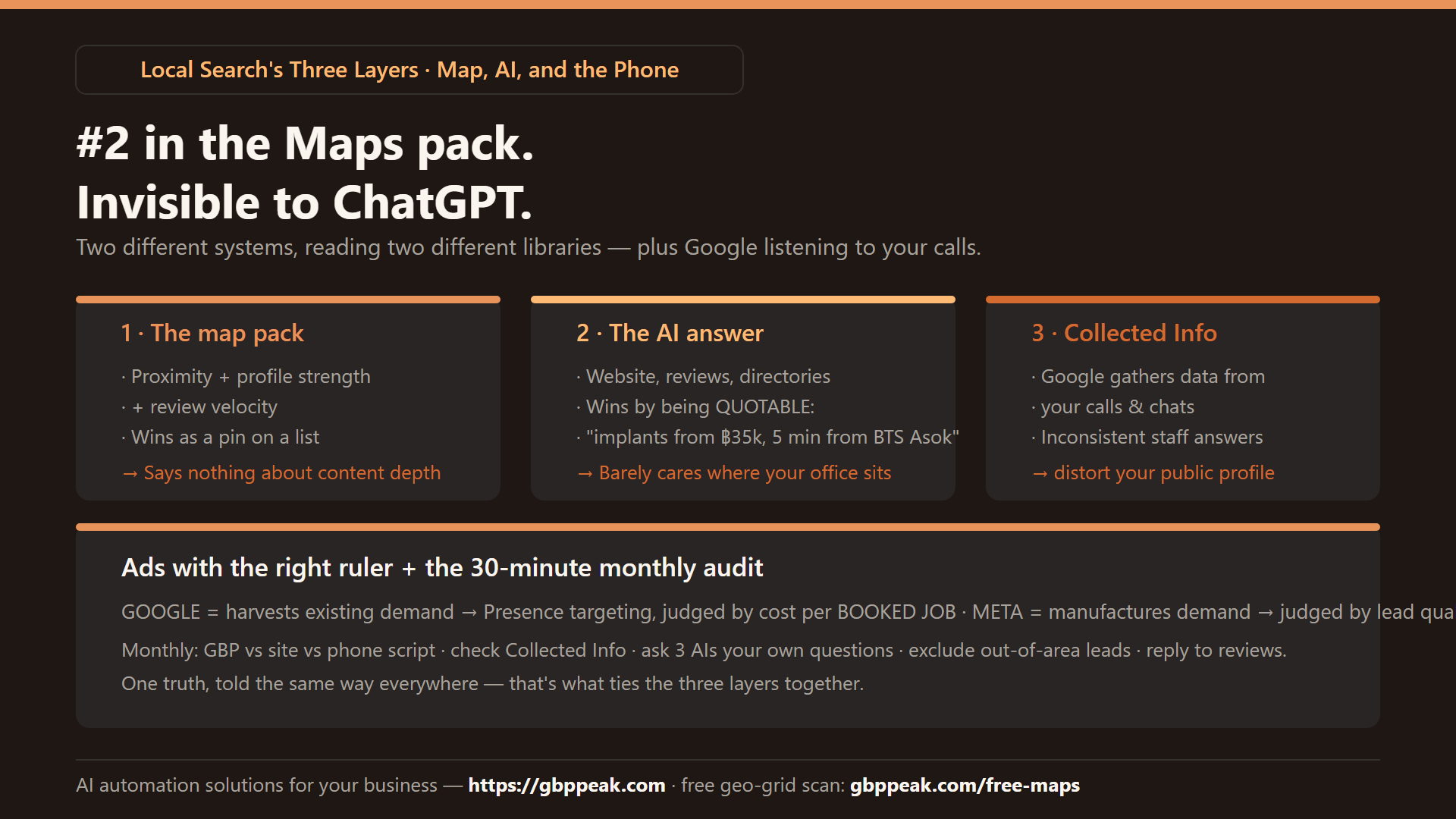
This guide walks through all three, plus the ad-targeting precision most local businesses get wrong.
Local visibility today requires three separate efforts. First, AI visibility: assistants like ChatGPT and Google AI Overviews pull from your website, reviews, and directories — not just the map — so your site must state services, locations, and problems solved clearly enough for a machine to verify you. Second, profile accuracy: Google's "Collected Info" gathers data from your calls and chats, so inconsistent answers from staff can distort your public profile. Third, precise advertising: Google captures existing demand (use Presence targeting for service areas), while Meta builds awareness — judge each by the right metric. One consistent "truth" across phone scripts, website, and profile ties all three together. :::
Layer 1: The map and the AI answer are different systems
Studies comparing Map-pack results with AI-assistant recommendations keep finding the same uncomfortable fact: the overlap is low. A business can dominate the map and never be named by an AI — because the two systems read different sources:
| Google Maps / Map pack | AI assistants (ChatGPT, AI Overviews) | |
|---|---|---|
| Primary inputs | Proximity, GBP data, reviews | Website content, reviews, directories, wider web |
| What wins | Location + profile strength + review velocity | Clarity, specificity, verifiability of claims |
| Format | A pin on a list | A named recommendation in a sentence |
| Blind spot | Says nothing about your content depth | Barely cares where your office sits |
The AI answer needs quotable facts. A pretty landing page with "premium dental experience in the heart of Bangkok" gives a model nothing to verify. A page stating "implants from ฿35,000, English-speaking staff, 400+ whitening cases since 2021, 5 min from BTS Asok" gives it everything. (We covered the content side in depth in the GEO guide — the principle: write to be quoted.)
Layer 2: Google is listening — "Collected Info"
The quieter shift: Google Business Profiles now show Collected Info — data Google's automated systems gathered from your phone calls and chat interactions. If a caller asks "do you open Sundays?" and a tired receptionist says "yes, I think so" while your profile says closed, Google may reconcile that contradiction in ways you don't control.
Your digital presence is no longer just what you type into a form. It's every interaction:
one_truth_policy:
  hours:        "same answer on GBP, website, phone script, LINE auto-reply"
  prices:       "ranges on the site = ranges quoted on the phone"
  services:     "the list staff reads from = the list on the profile"
  review_replies: "same voice, same facts, no promises the site doesn't make"
The practical fix is a one-page phone script kept next to the front-desk phone, reviewed quarterly — boring, and the highest-leverage data-quality tool in local SEO. (Same discipline as the NAP-consistency sweep in our entity-trust guide.)
Layer 3: Ads with the right precision and the right judge
Presence vs. Interest targeting
Google Ads lets you target by Presence (people physically in your service area) or Interest (people searching about the area from anywhere).
- Presence — for plumbers, clinics, salons: the customer must be nearby to buy. This is the safe default.
- Interest — for hotels, relocation services, destination restaurants: people planning a trip to Bangkok from Germany are perfect targets even while in Germany.
And even with correct settings, location targeting is not a perfect fence — check your actual lead locations in reporting monthly, and exclude regions you keep paying for without ever serving.
Don't judge Meta by Google's ruler
The classic mistake: comparing CPC across platforms and concluding "Meta is cheaper" or "Meta is worse." Different machines, different jobs:
GOOGLE  = harvests existing demand  ("plumber near me" — they're ready)
META    = manufactures tomorrow's demand (familiarity before the need exists)

judge GOOGLE by: cost per booked job
judge META by:   lead QUALITY — response rate, booking rate,
                 and how many became repeat customers
A Meta lead that costs more but books at 2× the rate is the cheaper lead. The attribution pipeline for measuring that honestly is the same conversation-mining pattern we covered earlier: ask "how did you first hear about us," log it, count it.
Practical tactics that cut across all layers
A few evidence-based moves that improve both human trust and machine verification:
- Statement headlines beat clever questions — "Emergency dental care, Sukhumvit, open Sundays" outperforms "Tooth pain keeping you up?" for both readers and crawlers
- Believable review mix — a wall of perfect 5-stars reads as filtered; a 4.6 with occasional detailed 3-stars (and thoughtful replies) reads as real — to customers and to models
- Watch the emerging surfaces — Google Search Profiles, Apple Maps updates, and AI shopping answers are opening new discovery paths; check quarterly, don't chase weekly
- Track the hand-off — since some customers now start with an AI assistant, add "How did you first hear about us today?" to your intake and watch for "ChatGPT said..." as a real answer
The monthly consistency audit
Everything above collapses into one recurring 30-minute check:
MONTHLY (30 min):
  1. GBP: hours, services, prices vs website vs phone script
  2. Collected Info: what did Google gather from calls? Correct it
  3. Ask 3 AI assistants your own core questions — named? facts right?
  4. Ads report: any leads from outside the service area?
  5. Review replies: current, consistent, no stale promises
And the geographic half of the audit — where the map actually carries you across the city — is a free geo-grid scan away: https://gbppeak.com/free-maps. It plots your Maps ranking point by point across your service area, so you know exactly where the pin works and where it doesn't.
Frequently Asked Questions
Is ranking in the Map pack enough to get recommended by AI assistants?
No — the two systems read different sources. The map rewards proximity and profile strength; AI assistants pull from your website, reviews, and directories, and reward verifiable specificity. Strong map presence plus a vague website is the most common "invisible to AI" pattern.
How does Google's "Collected Info" affect my profile?
Google gathers data from your calls and chats and may update or flag your profile based on it. If staff give inconsistent answers about hours, prices, or services, those contradictions can surface as public profile data. One phone script, kept current, prevents it.
Should a local business run Meta ads or Google ads?
Usually both, judged differently. Google harvests existing demand — measure cost per booked job. Meta builds awareness before the need exists — measure lead quality and booking rate, not raw CPC. Comparing the two by click price alone misleads both budgets.
How do I know if AI assistants are actually sending customers?
Ask. Add "How did you first hear about us today?" to intake, log every answer, and watch for AI mentions specifically. It's the same honest attribution table from our attribution guide — and "ChatGPT recommended you" is now a real, countable answer.
Final note
Being discovered used to mean being on the map. Now it means being on the map, quotable by machines, and consistent on the phone — one truth, told the same way everywhere. Master the three layers and the gap between being found and being chosen closes on its own.