
Six Ad Sets Bidding Against Themselves: The New Local Marketing Playbook
Six overlapping Meta ad sets, merged to two, cost-per-lead −34% overnight. The three quiet leaks: invisible authority, technical waste, margin-blind growth.
A Bangkok beauty clinic ran six Meta ad sets at once — each "targeting a slightly different audience" per their agency. Costs climbed for three months while results flatlined. The autopsy found the flaw in ten minutes: the audiences overlapped so heavily that Meta's algorithm was bidding against itself in the same auctions — paying more to reach the same people it had already paid to reach. Consolidating six ad sets into two cut cost-per-lead 34% overnight, with no creative change at all.
That's "technical waste": budget burned by structure, not strategy. 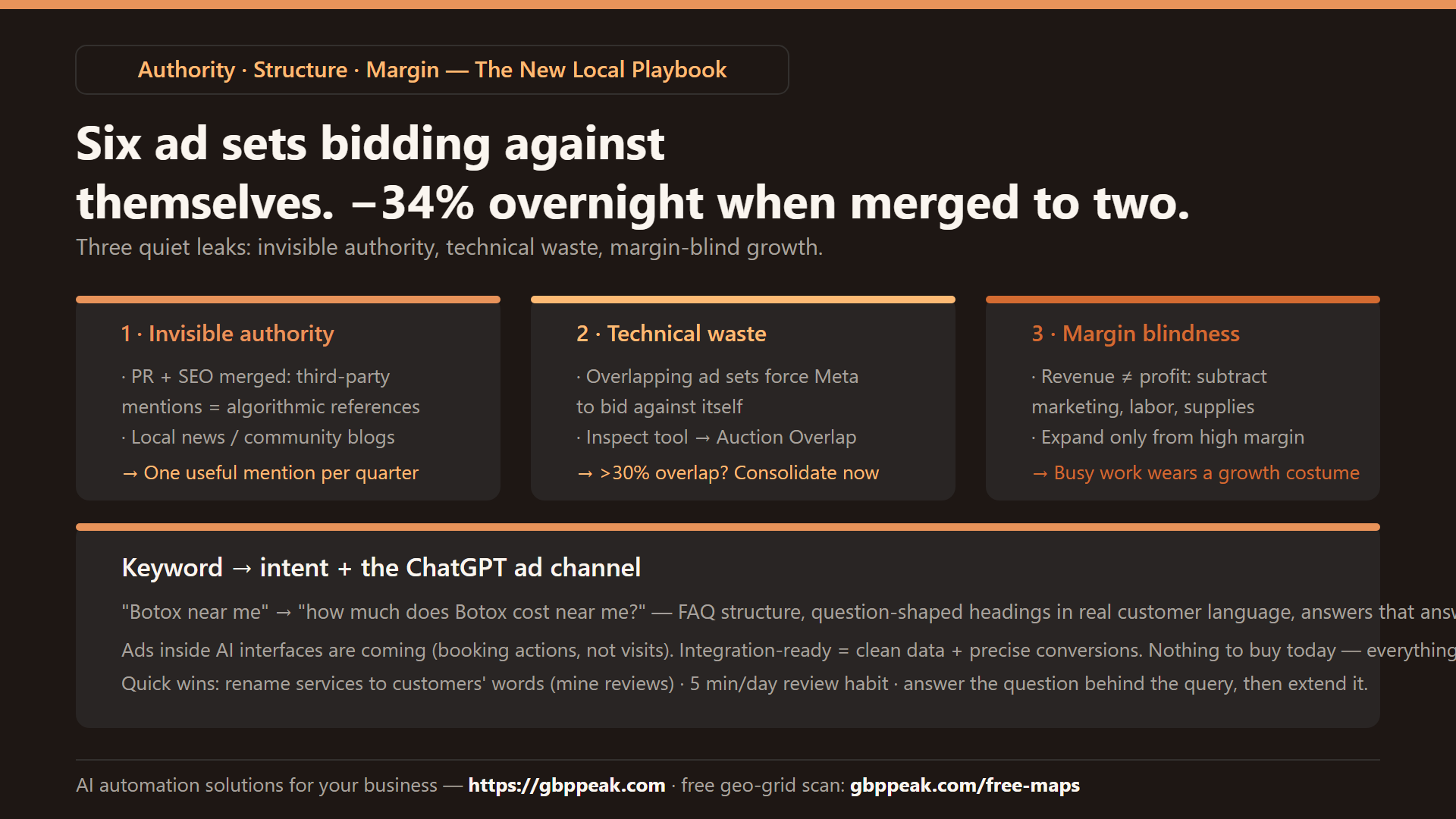
And it's one of three quiet leaks — the others being invisible authority and margin-blind growth — that this guide covers under the new local-marketing reality.
Modern local marketing rests on authority, structure, and margin. Authority: AI engines decide whom to recommend using third-party signals — local news mentions, community blogs — so PR and SEO have merged into one credibility-building effort; pitch useful local content, not ads. Structure: over-segmented Meta ad sets with heavy audience overlap force the algorithm to bid against itself (check "Auction Overlap" in the Inspect tool; above ~30% means consolidate). And intent: optimize content as answers to conversational questions ("How much does Botox cost near me?") in FAQ form. Finally, measure profit per client, not revenue — high-volume low-margin leads are busy work wearing a growth costume. :::
Leak 1: invisible authority (the PR-SEO merger)
PR and SEO used to be different departments. In the AI era they've merged into one job: building the third-party evidence that recommendation engines read.
When a local outlet or community blog features your business, it works three ways at once:
| What the mention does | Who reads it |
|---|---|
| Validates you as a real, trusted entity | The AI model deciding whom to name |
| Earns a high-authority link | The classic ranking algorithm |
| Compounds with your own content | Both — credibility algorithms can't ignore |
The practical play for a local business:
LOCAL AUTHORITY PLAYBOOK:
  1. List the publications your CUSTOMERS actually read
     (neighborhood blogs, local FB groups' associated sites,
      city lifestyle magazines — not national press)
  2. Offer genuinely useful content: seasonal tips, local
     expert commentary, data about your neighborhood
  3. One mention a quarter > a blast of press releases
  4. Track it in the [monthly AI audit](https://gbppeak.com/blog/ai-search-engine-differences):
     is the engine citing you? citing your mentions?
This is the entity evidence layer, built the honest way — one relationship at a time.
Leak 2: technical waste (ads bidding against themselves)
The overlap problem in full:
THE OVERLAP AUTOPSY (Meta Ads Manager → Inspect):
  1. Open each active ad set → "Auction Overlap"
  2. Any pair competing >30% of the time = self-sabotage
  3. Consolidate overlapping sets into one broader set:
     - more data per set → smarter algorithm decisions
     - fewer internal auctions → no artificial inflation
  4. Re-check in 2 weeks; expect cost-per-result to drop
     with zero creative changes
The counterintuitive part: fewer, broader ad sets almost always outperform many narrow ones, because the algorithm gets richer data and stops fighting itself. Complexity in ad structure feels like precision; it usually performs like friction.
The shift underneath: keyword matching → intent matching
The queries themselves have changed shape. Nobody asks an AI "Botox near me" — they ask "how much does Botox cost near me?" or "which clinic is best for skin rejuvenation in my area?" Content designed for the old world misses the new one:
| Keyword-era page | Intent-era answer |
|---|---|
| "Botox Pricing Information" | "How much does Botox cost in Bangkok?" |
| Service list | Problem-solving structure |
| Marketing voice | The phrases people say out loud |
The build rules: FAQ formatting so machines can extract cleanly, question-shaped headings in real customer language, and answers that actually answer. Mine that language from your reviews and calls — the conversation pipeline automates the mining.
The coming channel: ads inside ChatGPT
OpenAI and others are building conversion-focused ad formats for AI interfaces — booking actions and trial starts, not website visits. For local businesses this is an early-mover story:
- Integration-ready wins — clean data, complete profiles, precise conversion definitions are the entry ticket (the signal hygiene work again, now a placement prerequisite)
- Less competition, cheaper auctions — early channels reward the prepared; the unprepared can't even participate
- Action-targeted — these ads will optimize toward bookings and trials, so your tracking must already define those
Nothing to buy today. Everything to prepare, today.
The reality check: revenue vs profit
The growth trap: chasing lead count and revenue totals while margins quietly erode.
profit_per_client:
  formula: "job revenue − (marketing cost + labor + supplies + overhead)"
  decisions_it_drives:
    - "which services deserve ad budget"
    - "which 'busy work' clients to stop pursuing"
    - "whether expanding to a new channel makes sense
       ([expand only from high margins](https://gbppeak.com/blog/lead-quality-audit))"
  trap: "high revenue + low margin = working harder
         to earn less"
A smaller book of high-profit clients beats a crowded calendar of break-even jobs — and only the profit number tells you which is which.
Three quick wins
- Speak the customer's language — read your reviews; if customers say "skin refresh" instead of "facial," rename the service to match. Their words are your highest-converting copy
- The 5-minute daily habit — request or respond to one review every day; consistency beats quarterly overhauls for map rankings
- Intent-based content — answer the question behind the query, then extend it: the better alternative or fuller solution the searcher hadn't thought to ask about
And keep the geographic baseline current: a free geo-grid scan at https://gbppeak.com/free-maps shows where your Google Maps ranking carries all this new authority across your service area.
Frequently Asked Questions
What's the difference between keyword matching and intent matching?
Keyword matching surfaces pages containing the searched words; intent matching tries to understand the goal behind the query and provide a solution. AI-driven search is intent-first, so content structured as answers to real questions outperforms pages built around keyword placement.
How do I know if my Meta ads are bidding against themselves?
Open the Inspect tool in Ads Manager and check Auction Overlap between ad sets. Anything above ~30% overlap means your sets are fighting over the same auctions — consolidate them into fewer, broader sets and costs typically fall immediately.
Why do third-party mentions matter to AI engines?
Models like ChatGPT and AI Overviews gauge credibility from web-wide evidence. A local news or blog mention is algorithmic social proof that you're a real, trusted authority — often weighted more than anything you say about yourself.
Should I add new ad channels if Google and Meta are already running?
Only if current campaigns produce high-profit clients. If margins are thin, optimizing profitability on existing channels first is nearly always cheaper than buying volume on a new one — expand from strength, not from sprawl.
Final note
Traditional marketing isn't dying; it's being graded harder. Authority earns the recommendation, clean structure stops paying the overlap tax, and profit per client — not the lead spreadsheet — decides what deserves to grow. Build the evidence, simplify the machine, count the margin. The visibility follows the credibility.