
140 Blog Posts, Zero Calls: Why Service Pages Win Local Search
140 posts, respectable traffic, zero calls — an 11-page competitor took every emergency search. Intent, the service-page blueprint, and situation content that closes.
A Bangkok plumbing company spent a year publishing three blog posts a week — "How to maintain your water heater," "5 signs you need pipe replacement," the works. 140 posts, respectable traffic, and almost zero calls from any of it. Meanwhile their competitor, with an eleven-page website, captured every "leaking pipe repair Sukhumvit" search in the district — because their page said, in the first screen: pipe repair, Sukhumvit and Rama 9, 24/7, from ฿800, 4.8 stars, call now.
One business wrote for the internet. The other wrote for the customer who was already standing in water.
That's the blog trap: believing content volume is the growth lever, when for local businesses the money is in a handful of service pages engineered for the ready-to-buy moment. 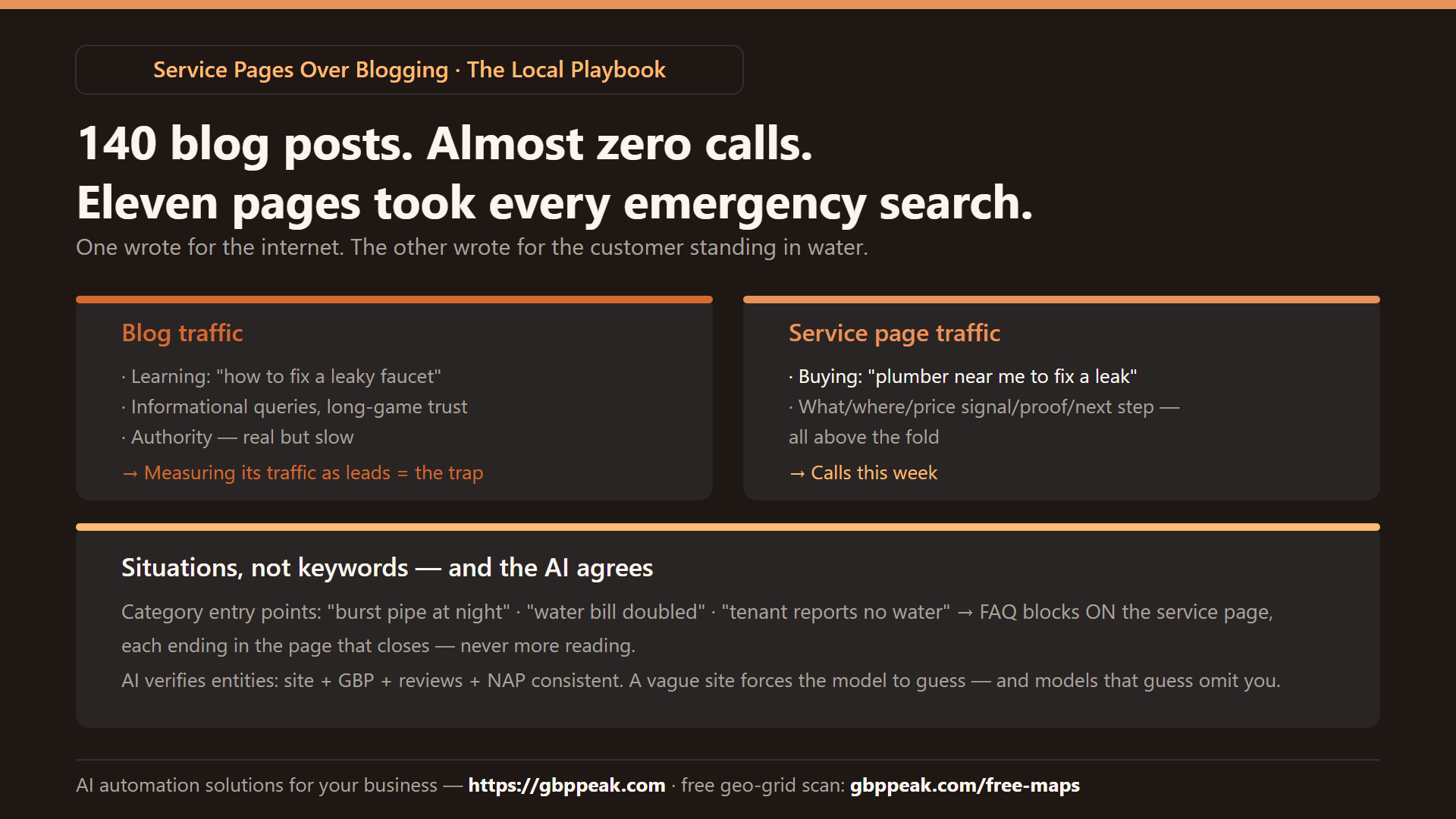
This guide covers the trap, the fix, and how AI search changes both.
For local businesses, high-intent leads come from service pages, not blog volume. A person with a leak searches "pipe repair near me" — they need immediate clarity on what you do, where, at what price, and the next step; an educational article serves a different, earlier-stage reader. Build a small set of dense service pages (service + location + proof + call to action), then support them with content targeting "situations" — the real-world moments customers realize they need you (category entry points). AI search reinforces this: it recommends clear entities with structured, consistent data across site, profile, and reviews — not prolific blogs. :::
The intent split that explains the trap
| Blog traffic | Service page traffic | |
|---|---|---|
| User state | Learning ("how to fix a leaky faucet") | Buying ("plumber near me to fix a leak") |
| Query type | Informational | Transactional / local |
| What they need | Education | Provider + price + next step |
| Value to you | Authority, long-game trust | Calls this week |
| Common mistake | Treating its traffic as lead traffic | Letting blogs absorb the content budget |
Blogs aren't worthless — they build authority and feed AI answers. But when a business measures blog traffic and wonders why phones stay quiet, it's measuring the wrong intent. (Worth noting: this very blog plays the supporting role — for a service business, the money pages are elsewhere.)
The service page that captures intent
The plumbing competitor's page worked because it answered the four questions a ready-to-buy customer has, in order, above the fold:
service_page_blueprint:
  H1: "[Service] in [Location]"        # "Pipe Repair Sukhumvit"
  above_the_fold:
    - what:  "24/7 emergency pipe repair"
    - where: "Sukhumvit, Rama 9, Phrom Phong"
    - price_signal: "from ฿800, free quote by photo"
    - proof: "4.8★ · 312 reviews · 9 years"
    - next_step: "Call now — avg response 40 min"
  below:
    - situations section (see below)
    - FAQs from real calls
    - photos of actual jobs
  ai_layer: "LocalBusiness + Service schema,
             NAP matching the GBP exactly"
Every element answers a buying question. No blog post structure does that — which is the point.
Write for situations, not keywords
Search behavior is shifting from service names to described problems: "water coming through my ceiling what do I do" — the category entry point (CEP), the moment a person realizes they need help. CEP content is the legitimate middle ground between blogs and service pages:
YOUR TOP 5 SITUATIONS (mine them from call logs + LINE):
  1. "burst pipe at night"      → who to call, what to shut off first
  2. "water bill doubled"       → leak investigation, what it costs
  3. "tenant reports no water"  → landlord checklist, response options
  4. "brown tap water"          → causes, when it's urgent
  5. "remodel, moving pipes"    → planning, permits, typical price
each becomes: an FAQ block ON the service page (best)
or a short post linking straight to it (fine)
Notice each situation ends in the service page, not in more reading. CEP content's job is to catch the customer earlier and hand them to the page that closes.
Why AI search rewards the same structure
AI assistants and AI Overviews don't rank keywords — they verify entities: who are you, where, trustworthy, what's the next step. A vague site forces the model to guess, and models that guess tend to omit you. The competitor's eleven pages worked for the AI for the same reason they worked for humans: structured, specific, consistent.
The identity layer the AI cross-checks:
- Website — clear service + location pages, schema in place
- GBP — matching hours, categories, services
- Reviews — specific, recent, answered (they're training data)
- Citations — NAP identical across directories
One more AI-era wrinkle: AI answers are becoming a source of branded demand — a user hears your name from ChatGPT, then Googles you specifically to find the site. A clean identity layer is what makes that second search land on you instead of a directory.
The paid-search echo
The same "capture intent precisely" logic governs ads: small local businesses have limited conversion data, and a noisy signal (button clicks) teaches the automated bidding system the wrong lesson — it chases clickers while the bookings you want stay expensive. Hard conversions only: qualified calls, completed bookings.
The 30-day pivot
For a business stuck in the blog trap:
- Week 1: audit your top 3 service pages against the blueprint; fix the above-the-fold block first
- Week 2: list your top 5 customer situations; write the FAQ blocks onto the service pages
- Week 3: align the identity layer — NAP, categories, service names across site/GBP/directories
- Week 4: repurpose the blog: keep posts that answer situations (link them to service pages), prune or refresh the rest; pause new posting until the foundation converts
And verify the geographic half of the pivot: a free geo-grid scan at https://gbppeak.com/free-maps plots where your Google Maps ranking carries those fresh service pages across your service area.
Frequently Asked Questions
Does blogging help local SEO at all?
Yes — as support. Posts build authority, answer situational questions, and give AI systems more verified material about you. They just don't substitute for service pages that clearly state service, location, price signal, and next step — which is what the ready-to-buy customer needs.
How is AI search different from traditional search for local businesses?
Traditional search matches keywords to pages; AI search verifies entities — validating who you are, where you are, and whether you're trusted across your site, profile, reviews, and citations. Clear structured data beats content volume in both.
What's a "high-intent" lead?
Someone actively solving a problem right now — they want a local provider, a price signal, and a next step, not education. Your service pages exist for them; your blog exists for everyone earlier in the journey.
Should I stop blogging entirely?
Stop aimless blogging. Keep (or start) posts targeting real customer situations — category entry points — each linking to the service page that closes. Prune generic posts that serve neither intent, and let the service-page foundation carry the business.
Final note
More content was never the strategy — more clarity was. Eleven pages that answer exactly what a flooded customer needs will outperform 140 posts written for nobody in particular, every single time, for humans and machines alike. Build the small foundation that closes, support it with situational content, and let the blog be the helper it was always meant to be.