
Building Reliable AI Tools Without Being a Developer: The Spec-Driven Method
"Add a supplier filter" — and the AI broke three working features. From vibe coding to spec-driven development: the blueprint that keeps non-coder tools alive.
A Bangkok operations manager "vibe coded" his way to an inventory dashboard: three evenings of chatting with an AI, watching it build, asking for fixes. By Friday it worked beautifully. Two weeks later he asked for one small change — a filter by supplier — and the AI confidently broke three things that used to work. He couldn't see where. The AI couldn't either. The project died, and with it his enthusiasm for the whole idea.
The autopsy is always the same: there was never a plan the AI could be held to. Just a long conversation with no source of truth. 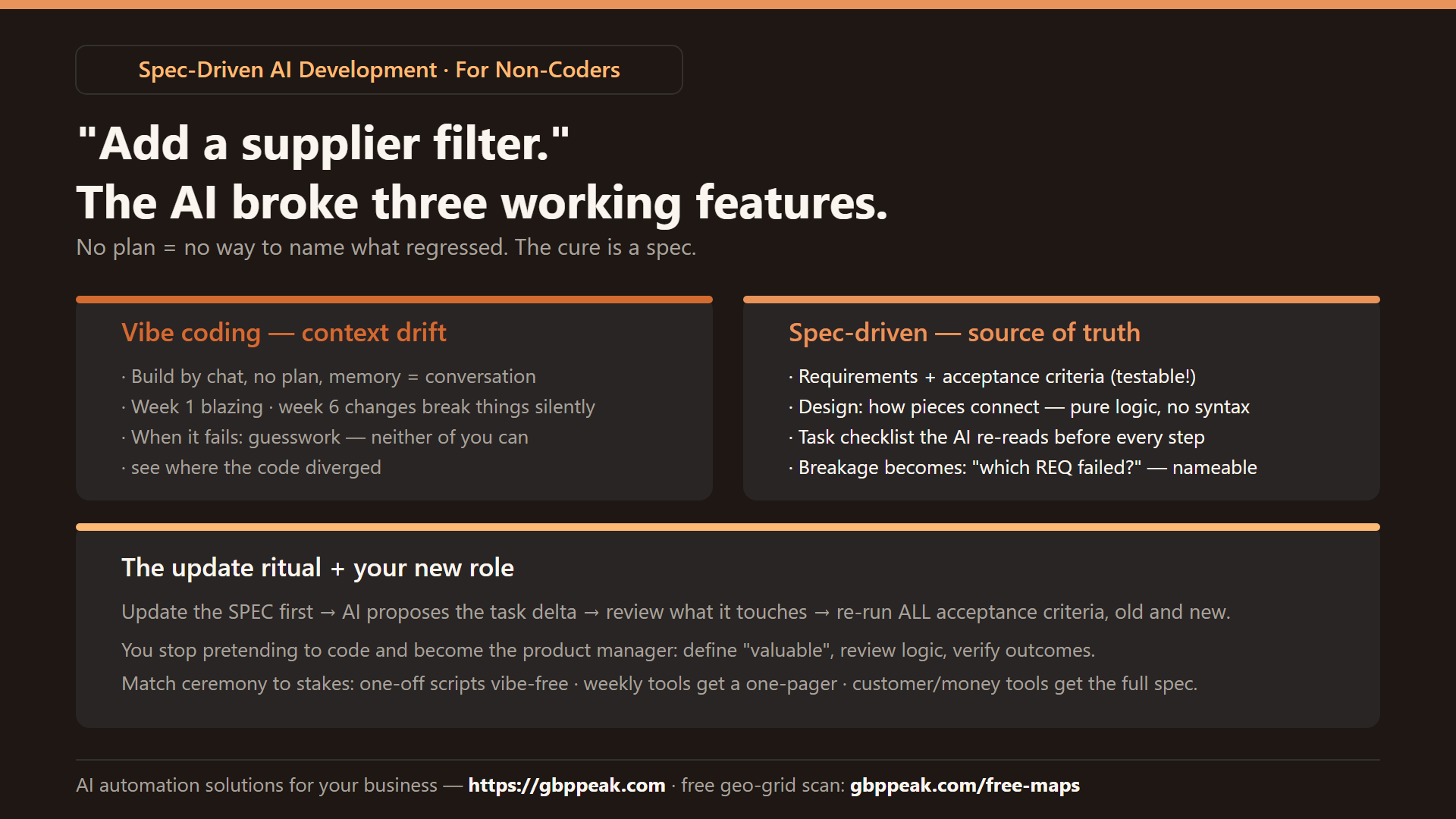
This guide is about the cure — spec-driven development — and why it lets a non-coder build tools that survive their own updates.
Non-developers build reliable AI tools by replacing "vibe coding" (iterating in chat with no plan) with spec-driven development: before any code, you and the AI write a specification — requirements with acceptance criteria, a design describing how components connect, and a task checklist. The spec becomes the source of truth the AI re-reads on every change, eliminating context drift. Your role shifts from frustrated coder to product manager: you define what "done" means, review designs for logic, and verify outcomes. You never need to master syntax — you master the blueprint. :::
Vibe coding and the context-drift tax
Vibe coding — building by conversation, no plan — feels like a superpower for a week. Then the bill arrives:
- Context drift: the AI optimizes this message, losing the plot of the project; features you "agreed" on quietly vanish
- Invisible breakage: a small request breaks three other things, and without a spec you can't name what regressed
- The black-box cliff: the moment something fails, you're stuck — you can't read the code, and the AI can't remember why it wrote it that way
| Vibe coding | Spec-driven | |
|---|---|---|
| Speed, week one | Blazing | Slower (specs first) |
| Small change at week six | Breaks things silently | Checked against the spec |
| Knowing what "done" is | Vibes | Written acceptance criteria |
| When it breaks | Guesswork | Diff against the blueprint |
| Your role | Frustrated coder | Product manager |
| Ceiling | Toy tools | Systems that grow |
No-code platforms dodge the syntax but hit their own wall: when the built-in blocks almost fit, you're stuck in a black box you can't open. Spec-driven AI development sits between the two — full power of code, governed by a document you actually understand.
The spec: three documents before any code
1. Requirements — what "done" means
Not "a dashboard." Testable statements:
REQ-1  The dashboard shall display current stock per SKU.
REQ-2  The user shall filter items by supplier (dropdown, multi-select).
REQ-3  Items below reorder level shall be highlighted in red.
REQ-4  The page shall load fully in under 3 seconds on 4G.
ACCEPT REQ-2: select 2 suppliers → only their items shown, counts update live.
That ACCEPT line is the trick — acceptance criteria written so plainly that you, not the AI, can verify them. If you can't test it, it isn't a requirement yet.
2. Design — how the pieces connect
One page: what the tool reads (which sheet, which columns), what it writes, what it shows, how the parts talk. This is where you catch nonsense before it's code: "wait, the supplier name comes from column F, not B — fix the design first." For a non-developer, this document is the architecture — you own it with pure logic, no syntax required.
3. Tasks — the checklist the AI follows
tasks:
  - T1: read inventory sheet, normalize columns (per DESIGN §2)
  - T2: stock-per-SKU table, sorted by qty asc
  - T3: supplier multi-select filter (REQ-2, ACCEPT defined)
  - T4: reorder-level highlight rule (REQ-3)
  - T5: load-time check on realistic data size (REQ-4)
rules:
  - work one task at a time; re-read the spec before each
  - on completion, list which REQ each task satisfies
  - never modify a completed task without flagging the spec change
This checklist is the antidote to context drift: the AI re-anchors on the document before every step, instead of on the fading memory of your chat.
Your new job: product manager
In this workflow you stop pretending to code and start doing the part only you can do:
- Define valuable — the AI can build anything; it cannot know whether it's worth building
- Review designs for logic — "does this actually match how my stock works?" is a business question
- Verify against acceptance criteria — run REQ-2's test yourself; 30 seconds, no code
- Demand second opinions — paste the design into a second AI model and ask "what breaks this?"; cheap insurance, and it keeps you in requirements-land where you're strong
The safety net effect: when something misbehaves, you don't debug code — you ask "which requirement does this violate?" The spec makes every divergence nameable, and nameable problems are fixable by pointing the AI back at its blueprint.
The update ritual that prevents Friday's disaster
Our operations manager's fatal request — "add a supplier filter" — is safe under the ritual:
1. Update the SPEC first (add REQ-2 + design note), not the chat
2. Ask the AI: "spec changed — propose the task-list delta"
3. Review the delta: does it touch completed tasks? That's a red flag
   to discuss, not a surprise to discover
4. Approve → AI implements the new tasks only
5. Re-run all acceptance criteria, old and new (the AI writes the
   checklist; you click through it)
Step 5 is your regression gate: old requirements stay proven while new ones land. Nothing that used to work breaks silently — because "used to work" is written down.
But do I need this for everything?
No — match the ceremony to the stakes:
- One-off scripts, personal tools → vibe code freely; drift costs nothing
- Tools your team relies on weekly → light spec: requirements + task list, one page
- Anything touching customers, money, or data you can't lose → full spec, acceptance criteria, second opinions
The pattern rhymes with every architecture piece in this series: small steps with checks, tables that remember state. The spec is simply the memory layer for the project itself.
And when the tool you're speccing feeds growth decisions, spec the input too: a free geo-grid scan at https://gbppeak.com/free-maps delivers structured rank data across your service area — clean input for whatever you build next.
Frequently Asked Questions
What is vibe coding and why is it risky for real tools?
Vibe coding means building by chat iteration with no written plan. It's fast for prototypes, but the AI loses the project's big picture over long conversations (context drift), changes break earlier work invisibly, and without a spec you can't name what regressed — so you can't direct the fix.
How does a spec help if I can't read code?
The spec is written in your language — requirements, logic, checklists. You govern the architecture and verify outcomes against acceptance criteria without ever touching syntax. When something breaks, the question is "which requirement failed?", not "which line of code?".
Do I need to learn programming to build custom AI tools?
Not anymore — provided you adopt structure. Spec-driven development substitutes product thinking (what, why, how it connects) for coding skill (how to type it). The AI supplies the syntax; you supply the judgment that says whether the result is correct and valuable.
Is a one-page spec enough, or do I need formal documents?
Match depth to stakes: a one-pager (requirements + task list) covers internal weekly tools; anything customer-facing or money-touching deserves full acceptance criteria and design review. The principle is constant — a written source of truth beats a good memory, yours or the AI's.
Final note
The gap between a great idea and reliable software was never really code — it was always the blueprint. Write the spec, become the product manager, and let the AI do what it's actually good at: following a plan it can finally see.