
Evidence In, Pattern Out: Using AI for Product Research
AI without data is an idea vending machine — dispensing generic planners forever. Feed it 50 real complaints and it finds the gaps. The PROOF method, end to end.
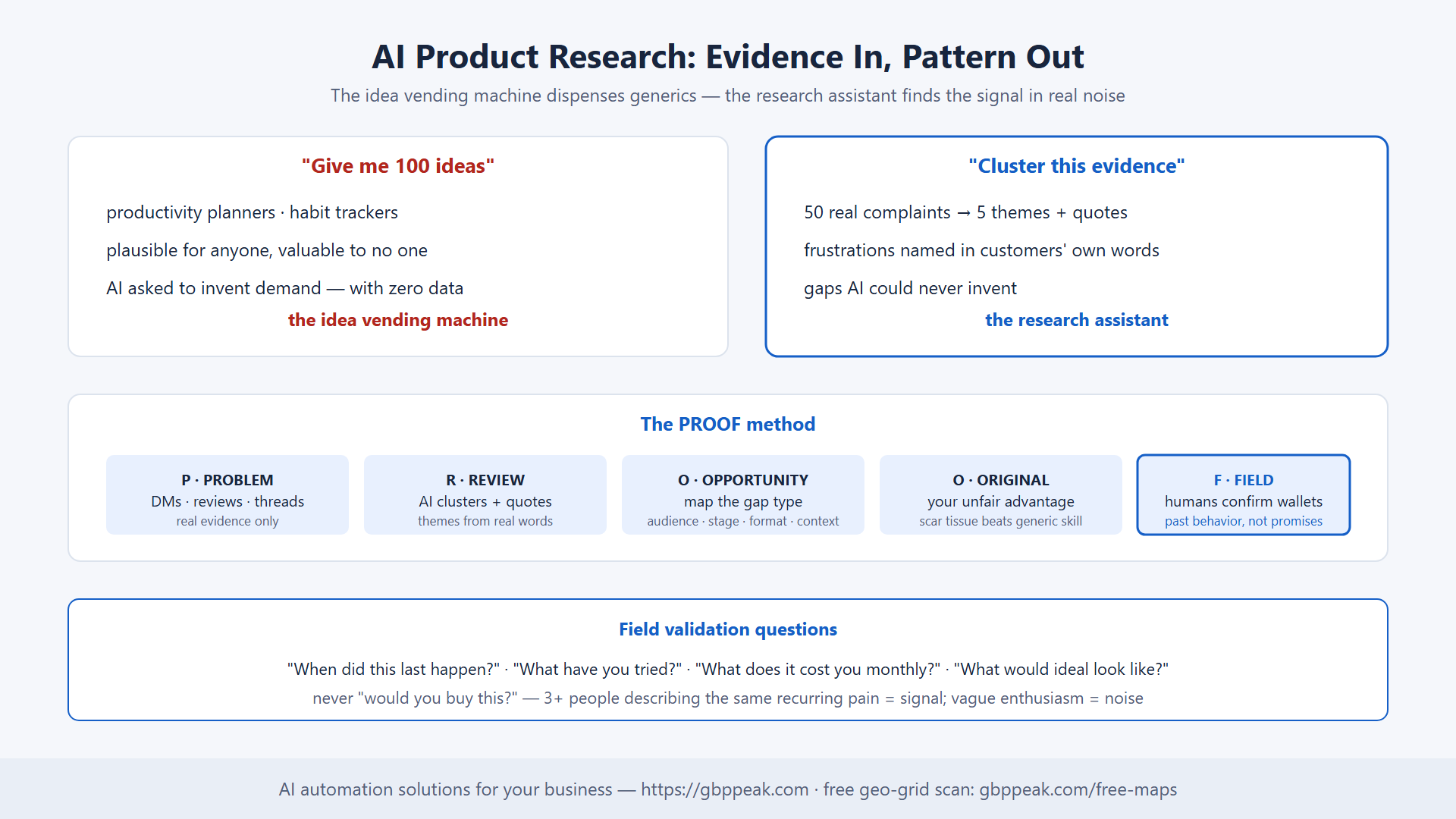
A creator asks ChatGPT for "100 digital product ideas" and receives a list that could belong to anyone — productivity planners, habit trackers, budget templates. Technically plausible, commercially worthless, because the model was asked to invent demand instead of find it. AI without context is an idea vending machine; it dispenses generics because it has no data to work with.
The shift that works: use AI as a research assistant. Feed it real evidence — complaints, reviews, forum threads — and it becomes extraordinary at finding the pattern inside the noise. Here is that workflow, end to end.
Use AI for product research by treating it as a research assistant, not an idea generator. First collect real evidence — customer DMs and emails, 3-star competitor reviews (which name exactly what's missing), Reddit and forum threads, and live search questions. Feed 20–50 pieces to AI and ask it to cluster them into themes, surface the emotional frustration, note what people already tried, and quote the originals. Then find the gap (audience, stage, format, or context), layer your unique experience over it, form a testable hypothesis, and validate with real humans using past-behavior questions — never "would you buy this?"
Format ≠ Product Idea
The most common confusion in product development:
| Format | Product idea | |
|---|---|---|
| What it is | The container | A specific solution, person, problem |
| Example | "An ebook on productivity" | "A 30-day workbook for freelance designers to reclaim billable hours lost to scattered client tasks" |
| Marketing | Hard — sells to nobody in particular | Easy — the audience recognizes itself |
Ebooks, Notion templates, checklists, spreadsheets, workshops — all formats. The idea lives one layer deeper: specific audience + recurring problem + desired outcome. Get that layer right and even the plainest format sells; skip it and no format saves you, per your first product in 7 days.
What AI Is Actually Good At
| AI excels (research assistant) | Human must decide |
|---|---|
| Clustering 100 comments into 5–10 themes | Authority — are you the right person to solve it? |
| Sentiment — which pains are intense vs merely frequent | Viability — urgent enough to open a wallet? |
| Language extraction — the customer's exact words | Accuracy — is this a trend or a one-time outlier? |
| Gap analysis vs competitors | Judgment under uncertainty |
The division of labor is clean: AI compresses noise into patterns; you decide which pattern is a business — the same machine-drafts-human-decides rule as reliable AI in production.
The PROOF Method
Problem collection → Review and analysis → Opportunity mapping → Original angle → Field validation. The workflow below runs it.
Step 1: Collect real evidence (before opening any AI tool)
- Customer feedback — recent DMs, emails, comments from your own audience.
- Review mining — competitors' 3-star reviews: not hate, not praise, but precise statements of what's missing.
- Community threads — Reddit, LinkedIn groups, niche forums where frustrations are described in detail.
- Search behavior — People Also Ask and Autocomplete: what people actively type, per keyword research that attracts customers.
Step 2: Let AI cluster — with the right prompt
Once you hold 20–50 evidence pieces, hand them over as material, not as a prompt for invention:
AI research-analyst prompt (pattern):
  "Here are [N] pieces of real customer feedback. Act as a
   research analyst:
   1. group them into recurring themes
   2. name the emotional frustration under each theme
   3. note what people have already tried that failed
   4. quote the original evidence for every claim
   do NOT invent problems not present in the data."
Step 4 of that prompt — quoting originals — is your hallucination guard: every theme stays traceable to real words a real person wrote.
Step 3: Find the gap
Organized evidence reveals where current offerings fall short, in four recurring types:
gap_types:
  audience: "exists for everyone — speaks to no one
             (generic course → your specific niche)"
  stage:    "helps too early or too late
             (launch course for people with no niche yet)"
  format:   "right info, wrong shape
             (10-hour video vs wanted 1-page checklist)"
  context:  "ignores real constraints
             (full-timer strategy that breaks for part-timers)"
Step 4: Add your unfair advantage
The gap is the opening; your experience is the moat. Ask: what do I know because I've actually done this work? Which mistakes have I personally paid for? How can I make the current messy process simple? AI can match market needs to listed skills, but the real answer usually comes from scar tissue.
Step 5: A testable hypothesis — not a product
Specific audience + recurring problem + desired outcome + your solution + format.
- ❌ "A Notion template."
- ✅ "A project dashboard for interior designers managing multiple renovation timelines simultaneously."
One sentence, one reader, one promise — ready for validation.
Validation: Humans, Past Behavior, No Politeness Traps
AI can rank hypotheses; only humans confirm wallets. Ask about past behavior, not intentions — "would you buy this?" collects politeness, per the same rule that killed "do you like it?" in product feedback:
field questions:
  "When did this problem last happen?"
  "What have you already tried to fix it?"
  "What does it cost you — time or money — every month?"
  "What would your ideal solution look like?"
3+ people describing the same recurring pain = signal
vague enthusiasm = noise
FAQs
Can AI find profitable digital product ideas?
AI finds patterns and sharpens hypotheses; it cannot guarantee profit. Profit comes from solving a real problem for a specific group. Use AI to surface the need from evidence, then apply your own judgment on whether that need is urgent enough to pay for.
Is it okay to research competitor products?
Yes — for gaps, not copies. Study what competitors do well, what their 3-star reviews complain about, and what their FAQs leave unanswered. Those seams are where a more specific, better-fitted product lives.
Does the choice of AI tool matter for this research?
Much less than the data you feed it. ChatGPT, Claude, or any capable model produces output proportional to the evidence provided — no model can conjure market demand that isn't in the input. Spend your effort on evidence collection, not tool selection.
Can I build a product from keyword research alone?
It's risky. Search volume proves people ask a question — not that they want a paid solution, are frustrated enough to buy, or prefer your format. Combine search data with real conversations; keywords open the lead, humans close the evidence.
How original does my idea need to be?
Not 100% unique — just different enough to fit a specific audience better. Differentiate by audience (narrower), stage (right moment), format (right shape), or context (their constraints). Specific beats novel.
Evidence In, Pattern Out, Judgment Decides
AI has collapsed the cost of finding the signal in customer noise — but only when you feed it signal. Collect real evidence, let the machine cluster and quote, find the gap, add your scar tissue, hypothesize in one sentence, and let three real humans confirm the pain. Start tonight: open your last fifty customer messages — that's the raw material your research assistant has been waiting for. And if your product serves a local market, pair the research with a free geo-grid scan at gbppeak.com/free-maps to see where that market already finds you.