
One Person, One Problem, One Week: Your First Digital Product in 7 Days
Scope is the whole game: a checklist or template kit for one exact buyer beats a 12-module course that never ships. Seven days from filter to publish.
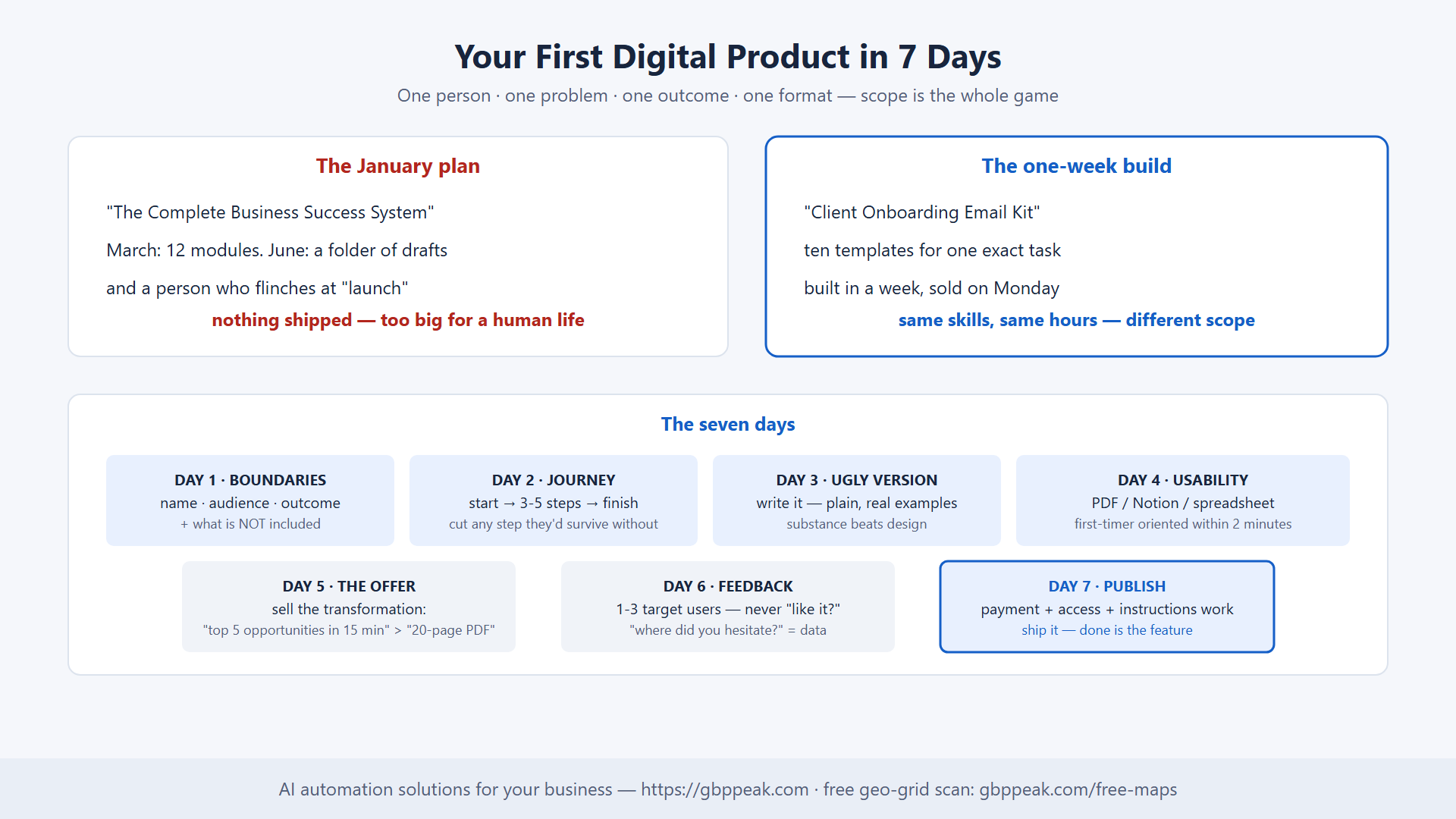
Someone announces a digital product in January: "The Complete Business Success System." By March it has become a 12-module course. By June it is a folder of half-finished documents and a person who now flinches at the word "launch." Nothing shipped — because the idea was too big to fit a human life.
Meanwhile a designer spends one week building a "Client Onboarding Email Kit" — ten templates for one exact task — and sells it the following Monday. Same skills, same hours available. The difference was scope. Here is the seven-day framework for shipping product number one.
Build your first digital product in 7 days by narrowing scope ruthlessly: one person, one problem, one outcome, one format. Pick a small focused tool — a checklist, template kit, workbook, or calculator — not a course or platform. Day 1 set boundaries and exclusions, Day 2 map the 3–5 step journey, Day 3 build the "ugly" working version, Day 4 make it usable, Day 5 sell the transformation not the features, Day 6 get honest feedback from 1–3 target users, Day 7 publish with working payment plumbing. The goal is evidence about what your audience pays for — not perfection.
Small Is Not Lesser — It Is Focused
A small digital product is one a customer opens and uses immediately to get a result. Compare:
| Good first products | Traps for a first build |
|---|---|
| "Local SEO Audit Checklist" | "The Ultimate Success Masterclass" |
| "Client Onboarding Email Kit" | "Complete Business Operating System" |
| "Newsletter Niche Selection Workbook" | 250-item "Resource Bundle" |
| A simple calculator / how-to templates | Complex custom software |
The left column solves a specific hurdle; the right column tries to be everything and never ships — the same complexity trap we covered in the power of simplicity.
Before Day 1: The One Rule Filter
Write this sentence before anything else:
"I am creating a [format] for [specific buyer] who wants to [task / decision / avoid a mistake] without [common frustration]."
- ❌ "I want to make something about social media."
- ✅ "A 10-page guide for small bakery owners who want a month of Instagram posts without spending hours on their phone every week."
One person, one problem, one outcome, one format. If the idea needs multiple audiences, several modules, or weeks of research — it is too big. Cut until it fits.
The Seven Days
day_1_boundaries:
  define: "name · audience · core problem · specific outcome"
  crucial: "write what is NOT included — scope creep dies here"
day_2_journey:
  map: "start (their struggle) → 3-5 core steps → finish line (success)"
  test: "would the buyer fail without this step? no → remove"
day_3_ugly_version:
  "write the content. plain language. real examples.
   a worksheet with instructions + sample beats a feature list"
day_4_usability:
  "simple format (PDF / Notion / spreadsheet). first-time user
   knows what to do within 2 minutes of opening it"
day_5_offer:
  "sell the transformation, not the features:
   'a 20-page PDF' → 'your top 5 marketing opportunities
   identified in 15 minutes'"
day_6_feedback:
  "1-3 target users. never 'do you like it?' —
   ask: what did this help you DO? where did you get stuck?
   what was missing? fix the breaks"
day_7_publish:
  "payment link works · file access works · starting
   instructions clear. share it. done."
Three honest notes from the trenches:
- Day 3 matters more than Day 4. A clear worksheet with zero design outperforms a beautiful thing nobody understands — action over aesthetics, always.
- Day 6's questions are diagnostic. "Do you like it?" collects politeness; "where did you hesitate?" collects data, the feedback discipline from building scalable systems.
- Day 7 ends the project. If the plumbing works, it ships. "One more polish pass" is January's twelve-module ghost whispering.
Pricing the First Product
No correct number exists — price against the value delivered:
- Time saved — turning a 5-hour task into 30 minutes.
- Risk reduced — helping them avoid a costly mistake.
- Clarity provided — making a hard decision manageable.
A 10-page specialist guide that removes real stress is worth more than a 100-page general ebook. Price accordingly.
FAQs
Should I wait until the product is perfect before launching?
No. "Perfect" is a distraction that keeps products in folders. A functional, clearly written product that solves a specific problem beats a masterpiece that never ships — and real users tell you more in a week than another month of self-review.
What if I don't have a big audience to sell to?
That's fine — the first product is a proof of concept. Even a handful of buyers produce evidence: what people pay for, what confuses them, what they ask for next. That evidence, not revenue, is the return that shapes everything you build later, per the agency-first ladder.
How do I know if my product idea is too big?
Apply two tests: does it require multiple different audiences to be useful? Does explaining it need a long presentation rather than one sentence? If either answer is yes, cut scope until one sentence covers it.
What format should my first product be?
Whatever the buyer can use instantly: a PDF checklist, a template kit, a Notion workbook, a spreadsheet calculator. Avoid custom software entirely for product one — the format should carry the value, not fight it.
Ship the Evidence
Your first product is not a business; it is a piece of evidence — about what your audience wants, struggles with, and pays for. One person, one problem, one outcome, one format, seven days, ship on Monday. And if the product serves your local market, let evidence guide marketing too: a free geo-grid scan at gbppeak.com/free-maps shows exactly where your buyers can already find you.