
Service, Systems, Assets: The Three-Step Business Wealth Ladder
Cash-flow service first, systems that run it without you second, income-producing assets third — the sequence that replaces hours-for-dollars with a machine.
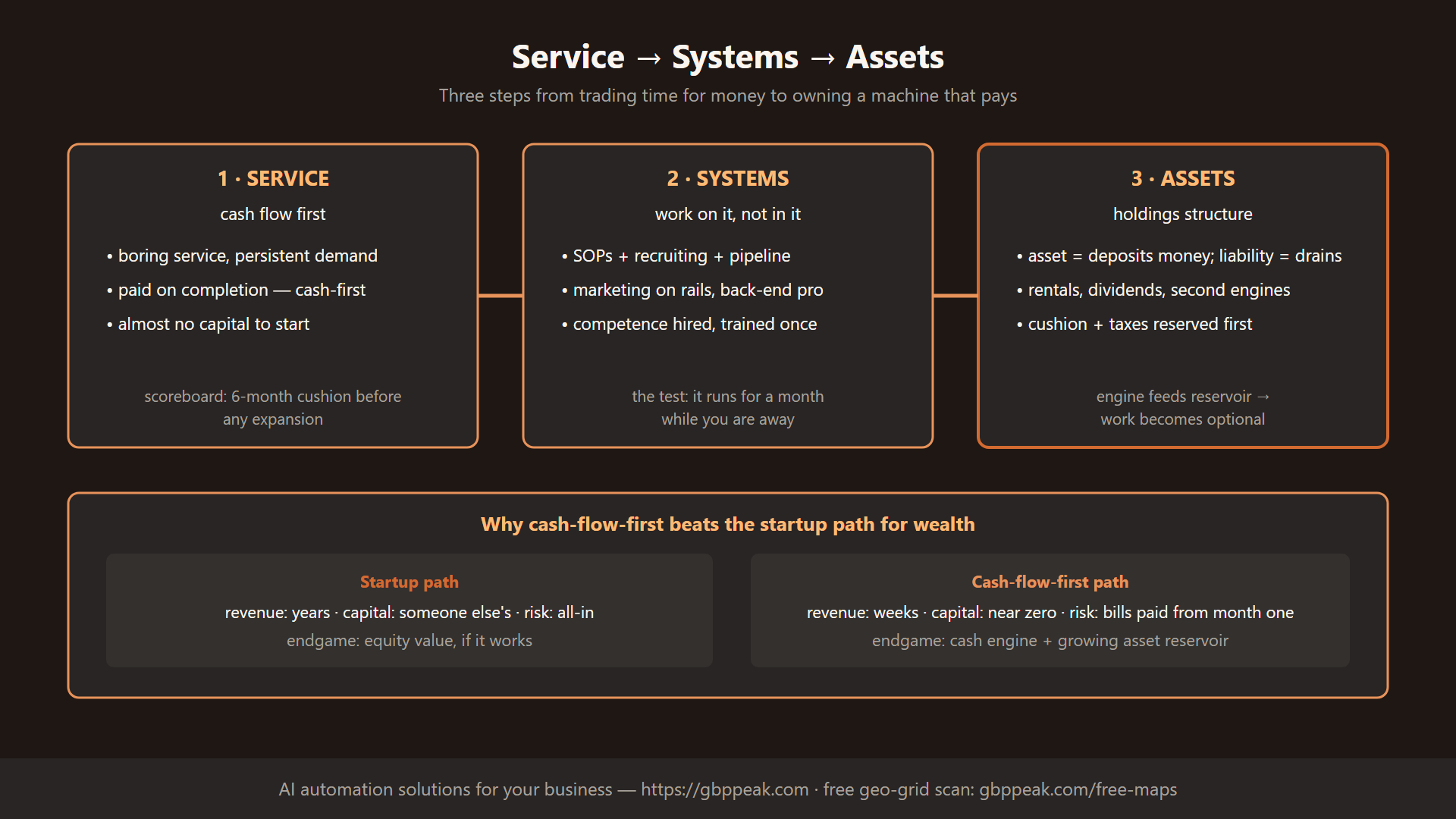
Two consultants earn the same income for ten years. The first spends it — good years fund good months. The second does something quieter: builds a service business, systematizes it until it runs without her, then points the surplus at income-producing assets. A decade later, the first still bills by the hour. The second owns a machine that pays whether she works or not.
The difference was never talent or luck. It was sequencing: cash flow first, systems second, assets third. This is that model, step by step.
Wealth from a business follows a three-step sequence. First, start a cash-flow-positive service business — "boring" services like cleaning, landscaping, or consulting that pay immediately rather than burning capital for years. Second, systematize it with SOPs, hiring, pipelines, and automation so it runs without your daily labor — working on the business, not in it. Third, reinvest the surplus into income-producing assets — rentals, dividend portfolios, other automated businesses — forming a personal holdings structure where the business is the engine and the assets are the reservoir, replacing hours-for-dollars with systems-and-assets income.
Why This Order and Not Another
The tempting path is the exciting one: raise money, build a product, scale fast. Most high-growth ventures burn cash for years before profit — if it ever comes — and along the way the founder's livelihood depends on the next funding round. The quieter path inverts the risk.
| Startup path | Cash-flow-first path | |
|---|---|---|
| Time to first revenue | Years | Weeks |
| Capital needed | Other people's money | Almost none |
| Founder's risk | All-in on one bet | Bills paid from month one |
| Survives a bad year | Only with new funding | Yes — service demand persists |
| Endgame | Equity value (if it works) | Cash engine + growing asset base |
Service businesses are unglamorous on purpose. A landscaping company profits from every lawn it mows; a specialized local-markology or cleaning operation invoices on completion. Nothing revolutionary — just reliable money entering the account every month, which is the oxygen every later stage breathes. We cataloged these durable models in five boring business models.
Step 1: Cash Flow First
Pick a service with three properties:
- Demand that persists — cleaning, repairs, accounting, local marketing. Needs, not trends.
- Payment on completion — cash-first, not chase-invoices-for-90-days.
- Low capital to start — competence and a way to be found, per building an inbound lead engine.
stage 1 scoreboard:
  monthly revenue ≥ costs ......... achieved by month 2-3
  personal draw covered ........... by month 6
  3-6 months operating cushion .... before any expansion
rule: no step 2 until the engine breathes on its own
The cushion matters more than the growth. A business owner with six months of runway makes decisions; a business owner without one makes compromises.
Step 2: Systems, Not Sweat
A service business where you perform every task is a well-paid job with a ceiling. The transition is from operator to architect — working on the business instead of in it. Five systems carry the load:
the_five_systems:
  sops:            "every repeat task documented once, run by anyone"
  recruiting:      "a repeatable hiring process, not panic vacancies"
  sales_pipeline:  "predictable lead flow — profile, pages, reviews, follow-up"
  marketing:       "content + local visibility running on rails"
  back_end:        "payroll, compliance, bookkeeping — monthly, professional"
This is the same machinery we detailed in scalable service systems (your process is the product) and the lean operations stack (four tools, per-client boards, recorded training). The team part came first in building the team that replaces you: hire for competence, train once, coach instead of rescue.
The stage is complete when the business produces its result for a month while you are on holiday. That is not a metaphor — it is the test.
Step 3: The Holdings Structure
Now the surplus does the work. The definition that cuts through confusion: an asset is anything that puts money into your account; a liability is anything that takes money out. By function, not by category.
- The car you drive daily: liability (payments, insurance, fuel out).
- Your primary residence: arguably a liability (carries costs, pays nothing monthly).
- A rental that cash-flows, a dividend portfolio, a second systematized business: assets.
Route the surplus deliberately:
personal holdings company:
  ENGINE  = systematized service business (raw cash, monthly)
  FILTER  = operating cushion + taxes reserved first
  RESERVOIR = income-producing assets
              ├─ rental property (cash-flow positive from day one)
              ├─ dividend/bond portfolio (auto-invest monthly)
              └─ another systematized business (a second engine)
  rule: buy assets that pay you to own them
The structure is the point: the engine feeds the reservoir, the reservoir eventually covers your life, and at that moment selling your labor becomes optional. This is the practitioner → operator → owner progression from the agency-directory-media flywheel, extended one layer further into personal wealth.
The Whole Ladder on One Page
YEAR 1-2   SERVICE      you do the work · cash from month one
             │ document as you go (SOPs from day 1, not year 3)
             ▼
YEAR 2-4   SYSTEMS      team + five systems · the month-away test
             │ surplus starts accumulating
             ▼
YEAR 4+    ASSETS       holdings structure · engine feeds reservoir
             ▼
         OPTIONALITY    reservoir income covers life → work becomes choice
Each stage funds the next, and no stage can be skipped: systems built without cash flow collapse, and assets bought without systems are bought on leverage and hope.
FAQs
What makes a "boring" business better for wealth building than a startup?
Boring service businesses generate cash immediately, need almost no capital, and serve demand that persists through every economic cycle. Startups may offer outsized upside, but most burn cash for years first; the service path keeps your bills paid and compounds quietly while you build the systems and asset base on top.
What is the difference between working in and working on the business?
Working in the business means you are the labor — every call, every delivery, every rescue. Working on it means you are the architect — documenting SOPs, hiring and coaching the team, and refining the pipelines so the business delivers its standard without you. The practical test of the shift: can it run for a month while you are away?
What actually counts as an asset in this model?
Anything that deposits money into your account without requiring your ongoing labor: cash-flowing rentals, dividend portfolios, notes, or a second business that runs on systems. Things that merely cost you money monthly — the daily car, often the primary home — are liabilities in this definition regardless of their paper value.
Should I reinvest profits into growth or into assets?
Both, in order. First buy back your own time — systems and team — because that converts your business from a job into an engine. Once the engine runs without you and the operating cushion is full, direct surplus to income-producing assets rather than forcing growth you no longer need to chase.
Build the Engine, Then the Reservoir
The three steps are unglamorous by design: a service that pays this month, systems that make it run without you, and assets that pay you to own them. Sequence them honestly and the business stops being how you earn a living and becomes how you build wealth. Start at step one — and if your service lives in local search, the engine's fuel gauge is a free geo-grid scan at gbppeak.com/free-maps: see which districts can already find you.