
43 Leads by Monday, 31 Cold by Wednesday: Building Machine-Speed Follow-Up
43 leads by Monday, 31 cold by Wednesday — machine-speed delivery into a human-speed inbox. The sub-5-minute intake, the LSA→PMax transition, and lead-form reality.
A Bangkok aircon service company enabled Google's lead forms on a Friday — by Monday they had 43 leads. By Wednesday, 31 of them had gone cold. Not because the leads were bad: because they landed in an email inbox nobody checked on weekends, and "contacted within 5 days" isn't follow-up — it's an apology. The automation delivered leads at machine speed into a human-speed intake. The mismatch cost them a month of ad budget.
That's the pattern nobody warns about: as Google automates local advertising (LSAs folding into Performance Max) and AI answers handle discovery, every hand-off gets faster — and your follow-up becomes the weakest link. 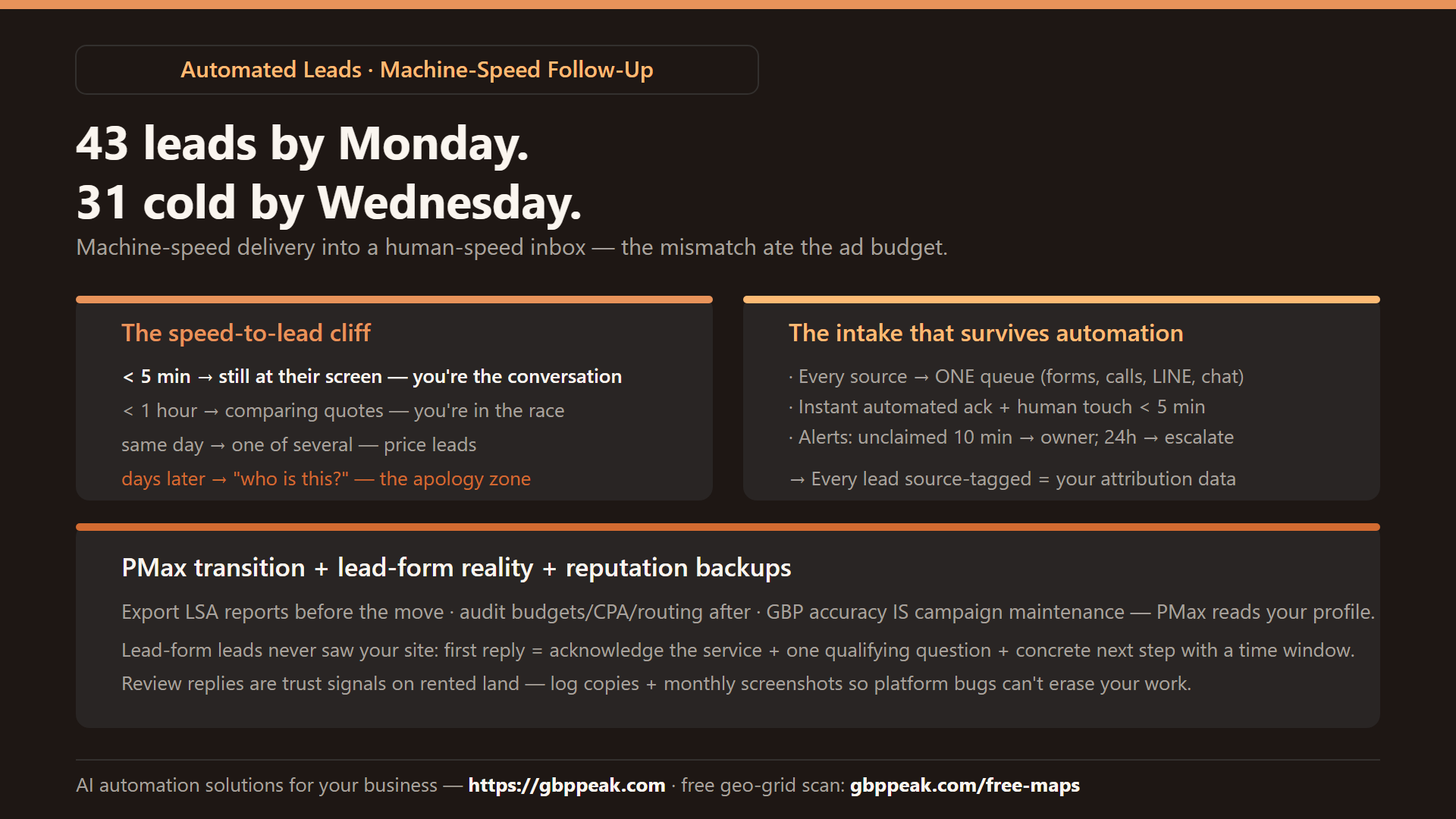
This guide is about building an intake that moves at the speed of the machine sending you customers.
Automated local lead tools (Google Lead Forms, PMax-driven placements) deliver prospects at machine speed, but they only pay off when your follow-up runs at matching speed. Build an intake where every lead — form, call, chat, AI answer — lands in one tracked queue with a sub-5-minute first response during business hours: instant CRM capture, automated acknowledgment, speed-to-lead alerts when a lead sits unclaimed. Vet lead sources by quality (your last 30 leads: how many unreachable, out-of-area, low-intent?), keep your GBP data exact since PMax reads it, and log review replies so platform bugs can't erase your trust work. Fast, tracked, measured — that's automated-lead readiness. :::
Speed-to-lead: the metric that decides everything
Lead quality matters less than lead speed when everyone's quality is similar. Response-time studies keep finding the same cliff: the business that responds in five minutes converts dramatically more than the one responding in an hour — because the customer contacted three businesses and the first real reply wins.
| First response | What the customer is doing |
|---|---|
| Under 5 min | Still looking at their screen — you're the conversation |
| Under 1 hour | Comparing quotes; you're in the race |
| Same day | You're one of several; price leads |
| Days later | "Who is this again?" — the apology zone |
The queue that survives automation:
lead_intake_system:
  capture: "every source → one queue: lead forms, calls, LINE,
            website chat, walk-in calls — no email-inbox graves"
  first_touch:
    automated: "instant acknowledgment with next step + expected time"
    human: "personal contact target: <5 min, business hours"
  alerts:
    - "lead unclaimed 10 min → notify owner"
    - "lead uncontacted 24h → escalate + review why"
  source_tagging: "every lead tagged by origin for the
                   30-lead quality audit"
The source_tagging line is what turns the intake into an attribution system too — you'll know which automated channel actually produces customers, not just contacts.
Surviving the LSA → PMax transition
As Local Services Ads fold into Performance Max, the specialized dashboard gives way to the automated engine. Three mechanical to-dos:
- Export historical reports NOW — transitions have a way of making old reporting awkward to reach; keep your own copies of performance data
- Post-move audit — daily budgets, target CPA, lead routing: automation migrations are exactly when settings drift
- GBP accuracy = ad performance — PMax reads your Business Profile as campaign input; wrong hours or a stale service list degrade the ads directly (the input-audit rule)
And remember what the engine does with leads it generates: it expects you to handle them. Google tracks responsiveness on some placements — a slow business gets shown less.
Lead forms: friction removed — for the customer
Google's lead form assets (now more accessible to smaller advertisers) let a customer submit contact info without ever visiting your site. Great for volume; the catch is structural: the lead never saw your website, so:
- They know only what the ad said — your first reply must establish context, not assume it
- They contacted you and competitors simultaneously — the speed cliff applies doubled
- They may be low-intent ("just curious") — your intake should qualify fast and politely
LEAD FORM FIRST REPLY TEMPLATE (send within 5 minutes):
  1. Acknowledge the specific service they tapped
  2. One qualifying question (area + urgency)
  3. Concrete next step with a time window
  Never: "Thanks, we'll be in touch." (that's the apology zone's front door)
Your reputation is source code (so keep backups)
A recent platform bug made some review replies temporarily invisible to users. Harmless for businesses with no reply strategy; expensive for those whose replies are trust signals — which is what they are now, read by humans and AI alike as evidence of an active, accountable business.
The defense is mundane:
REPUTATION LOG (5 min/week):
  - reply written → paste a copy into a simple log (sheet or doc)
  - screenshot the published reply monthly
  - if a platform bug ever hides your work → you can verify and
    prove what existed, and re-verify when it's fixed
Your replies, your Q&A answers, your profile edits — all of it is content you produced on rented land. Log it.
The four high-impact habits
- Ground-truth audit (monthly) — search your service + area in Gemini, ChatGPT, Perplexity; see what they say and where they got it; fix facts at the cited source
- 30-lead vetting (quarterly) — pull your last 30 leads; count unreachable / out-of-area / low-intent per source; cut or fix the worst source before adding budget
- Content de-templating — replace template language with method details and local specifics (information gain); it's what both humans and AI quote
- Measurement plan first — define success (booked calls, completed jobs, signed contracts) before enabling any new automated tool; the tool optimizes whatever you point it at
And keep the geographic baseline current so lead flow surprises get caught early: a free geo-grid scan at https://gbppeak.com/free-maps plots your Google Maps ranking across your service area — demand-side truth for all the supply-side automation.
Frequently Asked Questions
What happens to my Local Services Ads under Performance Max?
They're absorbed into the automated engine with your profile data as input. Export your historical reports before the transition, then audit budgets, target CPA, and lead routing after — and treat Business Profile accuracy as campaign maintenance, not listing hygiene.
Why do automated lead forms produce worse leads sometimes?
They don't necessarily — but they lower friction so much that low-intent submissions rise alongside good ones, and the leads never saw your website to self-qualify. Fast, qualifying first replies separate the serious from the curious within one exchange.
What's a good first-response time for local leads?
Under five minutes during business hours is the target — that's when the customer is still at their screen comparing options. Every hour of delay moves you from "the conversation" to "one of the quotes," and after a day you're in the apology zone.
Do I really need to log my review replies?
Yes — replies are trust signals built on rented land. Platform bugs can temporarily hide them; a simple log plus monthly screenshots proves your work existed and lets you verify restoration, instead of rewriting history you already paid for.
Final note
Automation keeps accelerating everything upstream of your business — discovery, ads, even the first answer a customer hears. The competitive edge has moved downstream: whoever converts contact into conversation fastest wins the lead that three businesses received simultaneously. Build the fast queue. Tag every source. Log your trust work. Let the machines send you customers — and be ready at machine speed.