Open the Gates: Making Content Discoverable to Search Engines and AI
You cannot rank — or be AI-quoted — unless you are first indexed. Check the gates: indexing, noindex/robots.txt, plain text, schema, mobile stability.
A business publishes a new service page and waits. Nothing happens — not a slow climb, but literal nothing: the page was never indexed, so no search engine ever knew it existed, and no AI tool could ever quote it. All the writing effort landed in a locked room. The invisible failures are always technical: a noindex tag left on, a robots.txt blocking the crawler, critical text locked inside images.
Discovery has gates, and they must be open. This guide is the walkthrough — checking each gate for both classic search engines and the AI tools (ChatGPT, Perplexity, AI Overviews) that increasingly decide who gets recommended.
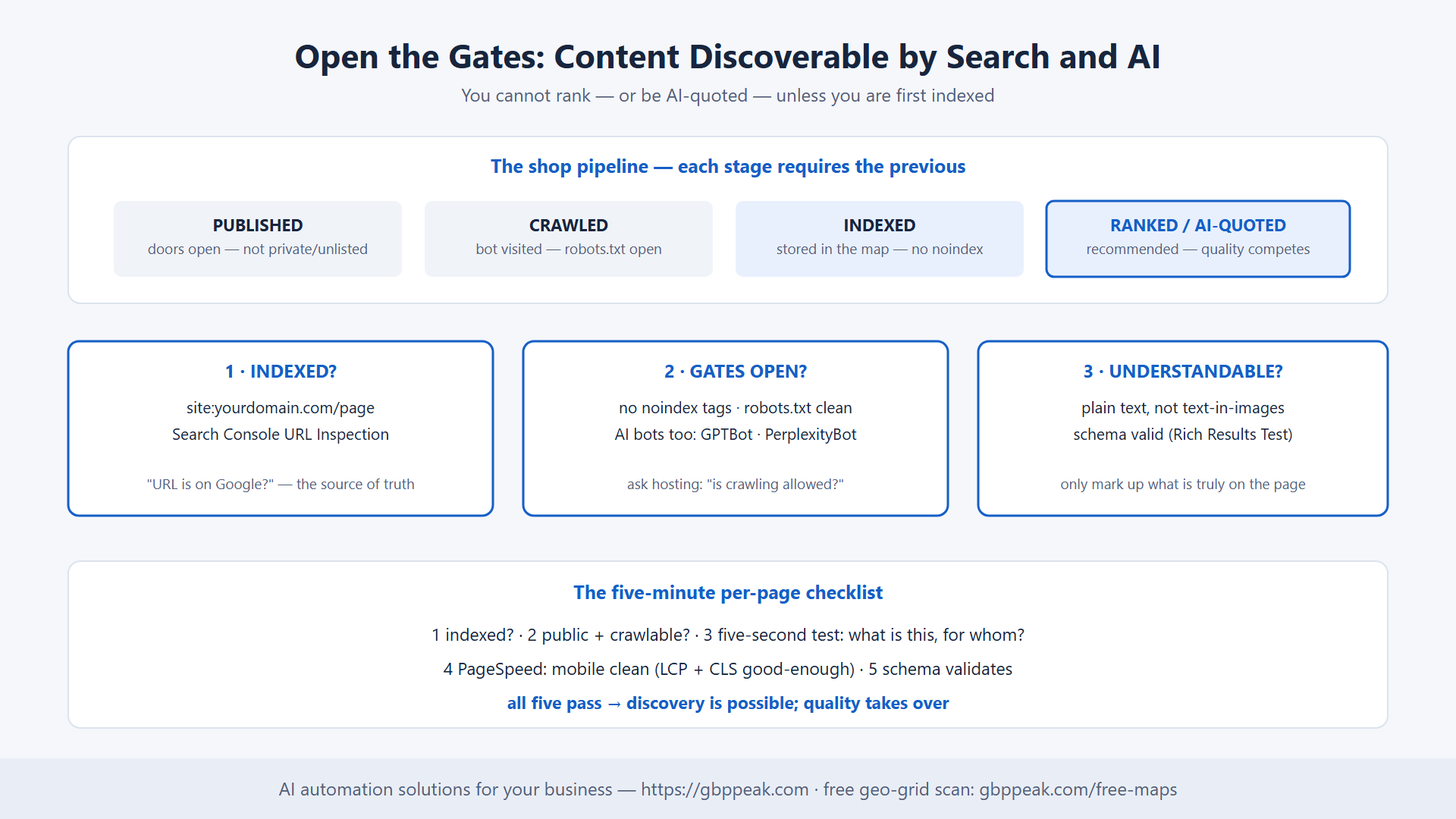
Make content discoverable by verifying three foundations. Indexed: confirm Google has stored the page (Search Console URL Inspection, or site:yourdomain.com/page), because nothing ranks or gets AI-quoted before it's indexed. Accessible: remove noindex tags and robots.txt blocks, including for AI crawlers like GPTBot and PerplexityBot. Understandable: clear titles, plain-text content (not text inside images), schema markup validated with Google's Rich Results Test, a submitted sitemap, stable URLs, and mobile-stable performance. These make discovery possible; quality then earns the recommendation.
The Shop Analogy: Publish ≠ Indexed ≠ Ranked
Think of your site as a shop. Publishing opens the doors. Crawling is someone walking past and looking in. Indexing is them adding your shop to their map. Ranking is them recommending you when asked. Each step requires the previous one — you cannot rank, or be cited by an AI, unless you are first indexed.
| Stage | Meaning | Blocked by |
|---|---|---|
| Published | Doors open | Private/unlisted settings |
| Crawled | Bot visited the page | robots.txt blocks |
| Indexed | Stored in the map | noindex tags, errors |
| Ranked / AI-quoted | Recommended | Weak content, competition |
Check 1: Are You Indexed?
Two reliable checks:
# quick manual check:
site:yourdomain.com/exact-page-url     # in Google
# → appears = indexed · absent = not indexed

# the proper check — Google Search Console:
# URL Inspection → "URL is on Google?"
# not indexed? the tool states why (too new, crawl error, noindex)
Search Console is the source of truth — set it up once and it reports indexing status for every page you care about, forever.
Check 2: Are the Gates Open for Crawlers?
Even public pages can carry hidden "keep out" instructions:
- Noindex tags — "you may see this page, but do not store it." Often left on accidentally by a staging setting, a page-builder toggle, or a "hide from search" checkbox.
- Robots.txt — the crawler's site map of allowed areas; one wrong line can wall off half a site.
The AI layer adds named crawlers: GPTBot (OpenAI), OAI-SearchBot (ChatGPT search), PerplexityBot. If unsure your host allows them, ask support directly: "Can you confirm public pages are crawlable by Google, Bing, and AI bots like GPTBot and PerplexityBot?" — the answer is either a yes or a bug to fix, per tracking your AI visibility.
Check 3: Understandable at a Glance
Once a machine reaches the page, it must parse what the page is within a second:
- Descriptive titles that state exactly what the page is about.
- Early value statement — who it's for and what problem it solves, in the first paragraphs (first-100-words rule).
- Plain text for key facts — critical information must not live only inside images; machines (and screen readers) may never see it.
- Contact clarity — your name and a reachable contact path.
Check 4: Performance, "Good Enough" Edition
Perfection is not required; deprioritizing breakage is. The page should load without significant delay, keep its layout stable (no jump-as-you-read), and work on phones — tappable buttons, readable text. Check with Google PageSpeed Insights: focus on Core Web Vitals, mainly LCP (main content load time) and CLS (layout stability). A 60 with clean mobile function beats a chase for 100 that never ships.
Check 5: Sitemaps and Stable URLs
- Sitemap — the table of contents for crawlers; most platforms generate one automatically. Submit it in Search Console so discovery is systematic, not accidental.
- Stable URLs —
yoursite.com/how-to-guidebeatsyoursite.com/page-id=982; and once a URL is live, don't change it, because each change breaks the accumulated memory of links and citations.
Check 6: Schema — the Machine-Readable Label
Structured data (Schema, in JSON-LD format) tells machines precisely what a page is:
{
  "common_schema_types": {
    "Article":      "title, author, publish date",
    "Person":       "who is behind the content",
    "Organization": "your business entity",
    "Product":      "an item for sale, with price",
    "FAQPage":      "questions and answers, marked up"
  }
}
Two rules. First, only mark up what's truly on the page — fake FAQs for special search results are a shortcut to trouble, not ranking. Second, validate: paste the URL into Google Rich Results Test and confirm the schema parses and matches the visible page — the truth-in-data discipline behind GEO consensus.
The Five-Minute Per-Page Checklist
for any page you need found:
  1 · Search Console → "URL is on Google?"
  2 · no noindex tag / page public?
  3 · 5-second test: what is this, who is it for?
  4 · PageSpeed Insights → no mobile breakage
  5 · Rich Results Test → schema valid
all five pass → discovery is possible; quality takes over
FAQs
Does being indexed mean I'll rank high on Google?
No — indexing only means Google has filed your page in its library. Ranking is the separate contest of being the best answer for a specific query. Indexing makes you eligible; content quality competes.
Does adding Schema improve my ranking?
Not directly. Schema doesn't boost rank — it helps engines and AI systems represent your content accurately, which improves how you appear in results and summaries when you do rank. Mark up truthfully, and treat it as clarity, not a trick.
Do I need a perfect PageSpeed score?
No. Score-chasing past "good" wastes time better spent on content. Ensure the page loads reasonably fast, stays visually stable, and works on mobile — those remove the penalties that actually suppress discovery.
How do I know if my page is "AI-ready"?
If it is public, crawler-accessible (including GPTBot and PerplexityBot), built with plain readable text, answers real questions clearly, and is indexed by regular search engines — it is AI-ready. What helps a human reader almost always positions you correctly for the machines reading the same page.
Open the Gates, Then Earn the Room
Technical accessibility is the entry ticket: indexed, unblocked, structured, stable, labeled truthfully. Run the five-minute checklist on your key pages this week — most sites find at least one gate accidentally closed. Then, with discovery possible, the work returns to content quality. And to see where your visibility actually stands across your market once the gates are open: a free geo-grid scan at gbppeak.com/free-maps.