Borrowed Trust: Digital Landmarks That Make Your Business Findable
No code changes needed — social home bases, a complete GBP, twenty AI-researched directories, competitor backlinks, and community answers build the web that finds you.
A business owner spends a small fortune on a beautiful website and then waits. Months later, almost nobody has seen it — not because the site is bad, but because the web has no reason to show it. The site is an island: no profiles pointing to it, no listings verifying it, no conversations mentioning it. Search engines — and now AI tools — cannot recommend what they cannot connect.
Here is the encouraging part: most findability improvements require zero changes to your website's code. They happen out there — on platforms that already have the trust, where your listings and mentions build the web of connections that pulls customers (and algorithms) toward you.
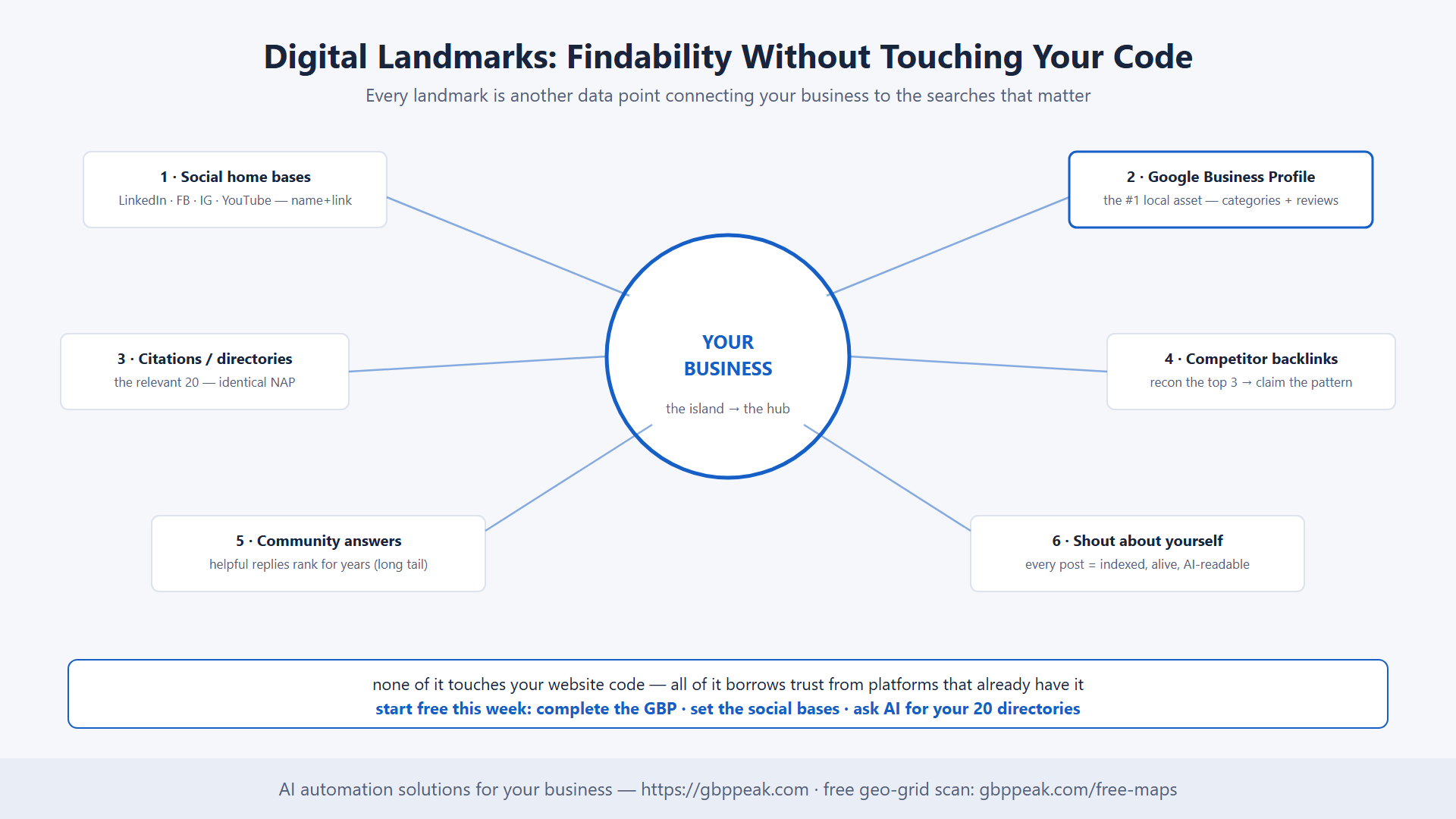
Improve online findability by building digital landmarks on platforms search engines already trust: complete branded profiles on LinkedIn, Facebook, Instagram, and YouTube with your correct name, logo, and website link; a fully maintained Google Business Profile with accurate categories and recent reviews; citations in the 20 most relevant directories for your niche and city; competitor-informed backlink targets; and genuine helpful answers in forums and groups where customers already ask. Each landmark is another data point connecting your business to the searches that matter — no website code changes required.
Borrowed Trust: Why Off-Site Wins First
"High-authority" platforms are sites search engines already trust deeply. A profile there borrows a slice of that trust — and creates a landmark the algorithms can connect to your business.
| Landmark | What it proves | Effort |
|---|---|---|
| LinkedIn / Facebook / Instagram profiles | The brand is real, active, linkable | One setup afternoon |
| Google Business Profile | Real, local, serving now | Setup + weekly touch |
| Niche directories & citations | Verified name/address/phone | Research + submissions |
| Forum & group answers | Real expertise, real helpfulness | Ongoing, small |
| Competitor-matched backlinks | Authority the market already respects | Monthly outreach |
Notice the pattern: none of these touch your website's code — they are all out there, where the trust already lives.
Landmark 1: Social Profiles as Home Bases
Search engines index LinkedIn, Facebook, Instagram, and YouTube constantly. Set up branded profiles with your exact business name, logo, description, and website link — even if you post rarely at first. Each profile is a home base for the brand across the internet, and every click from profile to site reinforces the connection between your name and your expertise. Consistency is the requirement: same name, same details, everywhere, per the five visibility pillars.
Landmark 2: The Google Business Profile
For a local business, the GBP is the single most important visibility asset — it decides your appearance in Maps and "near me" results, the highest-intent searches there are. Get the basics ruthlessly right:
gbp_fundamentals:
  categories: 'accurate and specific — "Plumber", not
               "Construction Company"'
  contact:   "NAP identical to every other platform"
  reviews:   "steady collection + reply to every one"
  freshness: "posts + photos on a weekly rhythm"
A complete profile with recent reviews routinely outperforms a better website with a neglected one — the map decides who gets called first.
Landmark 3: Citations, Researched by AI
A citation — your name, address, phone listed on another site — is how search engines verify you are a real entity in a real place. Finding the right directories used to be guesswork; now it is one prompt:
Ask an AI research assistant:
  "What are the 20 most important directories for a
   [type of business] located in [city]?"
→ verify each suggestion actually exists and fits
→ submit identical NAP everywhere, paste, never retype
→ track in a sheet; audit quarterly for ghosts
Twenty relevant, consistent listings beat a hundred generic ones — the verification logic from citations and NAP consistency.
Landmark 4: Backlinks via Competitor Recon
A backlink is another site linking to yours — a vote of confidence that raises authority. The fastest roadmap to the right links is your competitors': plug the top three into any backlink checker and see which directories, associations, and partner sites link to them. You do not need to copy every link — you need the pattern of which sources matter in your industry, then claim your spot on those, per backlink types that build authority.
Landmark 5: Community Answers and the Long Tail
People ask for recommendations in forums, subreddits, and niche boards every day. Answer genuinely — advice first, business name mentioned naturally, not just a link drop. Two things happen: the person you helped remembers you, and the thread itself ranks. Six months later, someone types that same specific question into Google, and your helpful comment is a top result. That is the long tail working for you while you sleep — the prospecting habit from twenty minutes a day.
The Awkward One That Works: Shout About Yourself
It feels strange, but posting your own work, wins, and updates on your channels is one of the most effective visibility habits. Every post is more content for search engines to index, proof for followers that the business is alive, and material for AI tools learning what you do. A static page that never changes signals stagnation; an active presence signals life, per the sustainable local SEO cycle.
FAQs
Do I have to change my website to improve my SEO?
No. Many of the most effective findability tactics — social profiles, directory citations, forum participation, community mentions — happen entirely on third-party sites. They build the authority and verification that pull your existing site up, without touching its code.
How long until I see results?
Weeks to months, not days. Search engines need time to crawl and index each new landmark, and trust accumulates gradually. The consolation: every listing and answer you place keeps working — findability built this way compounds instead of evaporating like ad spend.
What is the single most important step for a local business?
Completing and maintaining the Google Business Profile. It directly controls your appearance in Maps and "near me" searches — customers with intent, ready to buy — and it is free. Accurate categories, consistent contact details, and a steady stream of recent reviews will outperform almost any other visibility investment.
How do I know which directories matter for my business?
Use an AI assistant to shortlist the most important directories for your business type and city, verify each suggestion, then check which directories link to your top competitors. The overlap — relevant, competitor-validated listings — is your submission list.
Build the Landmarks
Findability is a web of connections, and every landmark — profile, listing, citation, answer, post — is one more thread pulling customers and algorithms toward you. None of it requires code; all of it requires consistency. Start with the free, highest-leverage ones this week: complete the GBP, set up the social home bases, ask AI for your twenty directories. And measure the map-side progress honestly with a free geo-grid scan at gbppeak.com/free-maps — district by district, before and after.