Five Pillars of Local Visibility: Reviews, Profiles, Citations, Answers, Proof
Steady reviews beat big totals; complete all three maps; ten identical citations; answer real questions publicly — and let a monthly geo-grid prove what moved.
A plumber in your district gets a call from a customer who found him on a map. His competitor — better trained, better equipped — sits four streets away and gets nothing, because the map does not show him. Not because of price, not because of quality: because his visibility work was never done.
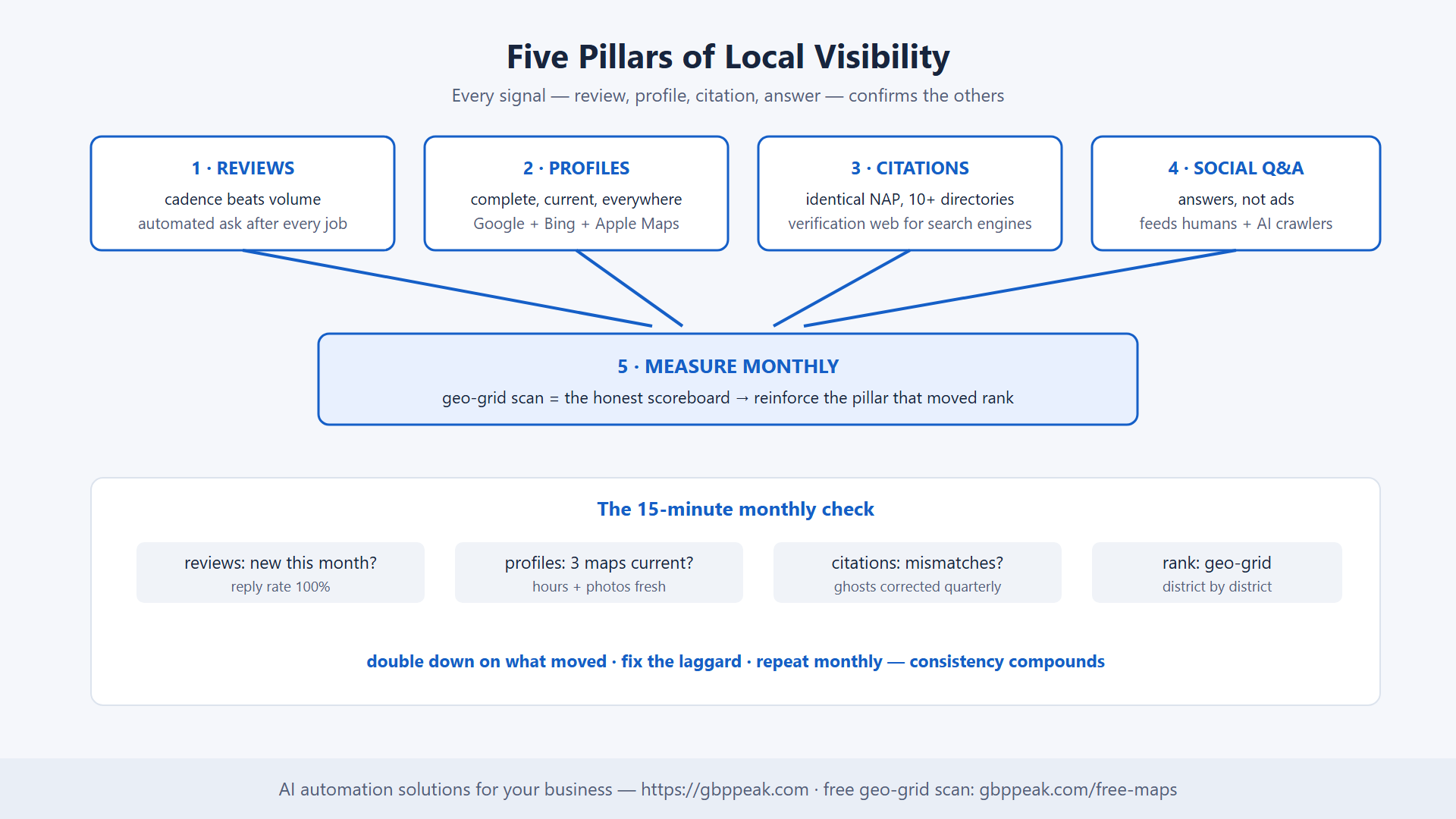
Local visibility is not one lever; it is a stack of five pillars that all confirm the same thing — you exist, you are where you say you are, and people vouch for you. Here they are, in the order that pays fastest.
Improve local visibility with five pillars: collect reviews consistently (a steady stream of fresh Google reviews beats a big pile of old ones — automate the ask after every job); complete your business profiles on Google, Bing, and Apple Maps; build citations (consistent name-address-phone listings across directories) so search engines can verify your location; and answer real customer questions publicly on social media, which feeds both human trust and AI-driven search tools. Consistency across all five is what moves you up the map.
The Five Pillars at a Glance
| Pillar | Confirms | Fastest first move |
|---|---|---|
| Reviews | People vouch for you | Automated review ask after each job |
| Profiles | You are findable + accurate | Complete every GBP field |
| Multi-map presence | You exist everywhere maps look | Claim Bing + Apple Maps listings |
| Citations | Your location is verifiable | List on 10 top directories, identical NAP |
| Social Q&A | You know your craft | Answer the top 10 customer questions publicly |
Pillar 1: Reviews — Cadence Beats Volume
Reviews are the strongest trust signal customers read and a significant ranking input. The counterintuitive part: search algorithms reward recency and cadence more than raw totals. Three hundred reviews that stopped a year ago read as a business that may have slowed down; a steady weekly drip reads as a business that is alive and serving.
The system is mechanical, not motivational:
review cadence loop:
  job completed → automated thank-you message (same day)
    → direct link to the Google review page, nothing in between
    → optional gentle reminder after 3 days
  volume target: 2-4/week sustained beats 50 in one campaign month
Google first — it is where "near me" decisions happen — but Facebook reviews add community context, and industry platforms (the directories your niche actually checks) add specialist proof. Multi-platform reviews also widen the footprint AI search tools read when deciding who to recommend, per tracking your AI visibility.
Pillar 2: Complete Profiles, Everywhere Maps Look
Your business profile is a digital storefront; an incomplete one is a shuttered one. On the Google Business Profile, complete means:
- Accurate hours (including holiday exceptions — stale hours generate "closed" experiences).
- A services/description section written in the words customers search.
- Real photos of the location and finished work, refreshed monthly — the posting rhythm from GBP content types.
And the part everyone forgets: Bing Maps and Apple Maps. iPhone users ask Siri, which asks Apple Maps; a meaningful slice of your market lives outside Google. Claim those listings, match the data exactly, and the cross-platform consistency itself becomes a legitimacy signal.
Pillar 3: Citations — The Verification Web
A citation is your name, address, and phone (NAP) listed on a third-party site. Each accurate listing is one more independent witness to your existence and location, and search engines rank businesses they can verify with confidence.
The rules that make citations work:
citation_foundation:
  start: "top 10 directories in your country + your niche"
  format: "one canonical NAP string — paste, never retype"
  check: "search old phone numbers/addresses to find ghosts"
  maintenance: "quarterly mismatch audit"
  rule: "one contradiction costs more than ten confirmations earn"
Ten high-quality, identical listings are the foundation — more on the consistency mechanics in citations and NAP.
Pillar 4: Social Media as an Answer Engine
Social platforms are not just feeds — modern search and AI systems crawl them to answer questions. That changes what posting is for: instead of ads nobody asked for, publish the answers people actually search for.
- Customers ask about pricing? Post the "how it works and what it costs" guide.
- Ask about your technique or materials? Post the FAQ breakdown.
- Ask how long a job takes? Post the timeline walkthrough.
Each public answer does double duty: humans find it and trust you before contact, and AI tools harvest it as evidence of your expertise — the consensus effect from SEO to GEO. Ten honest answers outperform a hundred promotional posts.
Pillar 5: Measure, Then Reinforce
Visibility work without measurement is guesswork. Close the loop monthly:
monthly visibility check (15 minutes):
  reviews ....... new this month? reply rate 100%?
  profiles ...... hours/photos current on all three maps?
  citations ..... new mismatches appeared?
  rank .......... geo-grid scan — the honest scoreboard
  double down ... on whichever pillar moved rank; fix the laggard
Rank is district-shaped, not a single number — a free geo-grid scan at gbppeak.com/free-maps shows exactly which neighborhoods see you and which see only competitors, turning "improve visibility" into "fix these four grid points."
FAQs
What is the difference between a review and a citation?
A review is a customer's opinion and rating — it builds trust and signals an active, satisfying business. A citation is a listing of your name, address, and phone on a third-party site — it verifies your existence and location to search engines. You need both: reviews persuade, citations confirm.
Do I need a large number of reviews to rank?
Less than you need consistency. A steady stream of recent reviews tells search engines the business is active and currently performing, which algorithms weight heavily. A large total that stopped growing reads as stagnation — build the automated ask and let cadence accumulate the volume.
How many citations do I need?
Start with ten high-quality, fully consistent listings — the top national directories plus the key ones for your niche and city. Accuracy and identical formatting matter far more than quantity; expand only after the foundation is contradiction-free.
Is social media really important for search rankings?
Increasingly yes — not for the posts themselves, but because search engines and AI tools crawl social content as evidence. Publicly answering real customer questions on your pages gives those systems quotable proof of your expertise, and gives future customers answers they can find before they ever contact you.
Consistency Compounds
None of these five pillars is difficult; the compounding comes from running all of them, every month, so that every signal — review, profile, citation, answer, rank point — confirms the others. Start this week: turn on the review ask, complete the three maps, list the ten directories, answer one question publicly, and scan the grid. Your free baseline: gbppeak.com/free-maps.