
Package What You Already Do: Identifying and Creating Your First Digital Product
Your first product is your recurring work with the friction removed — five filters, 25 concrete ideas by profession, formats ranked by effort, and a 7-day MVP build.
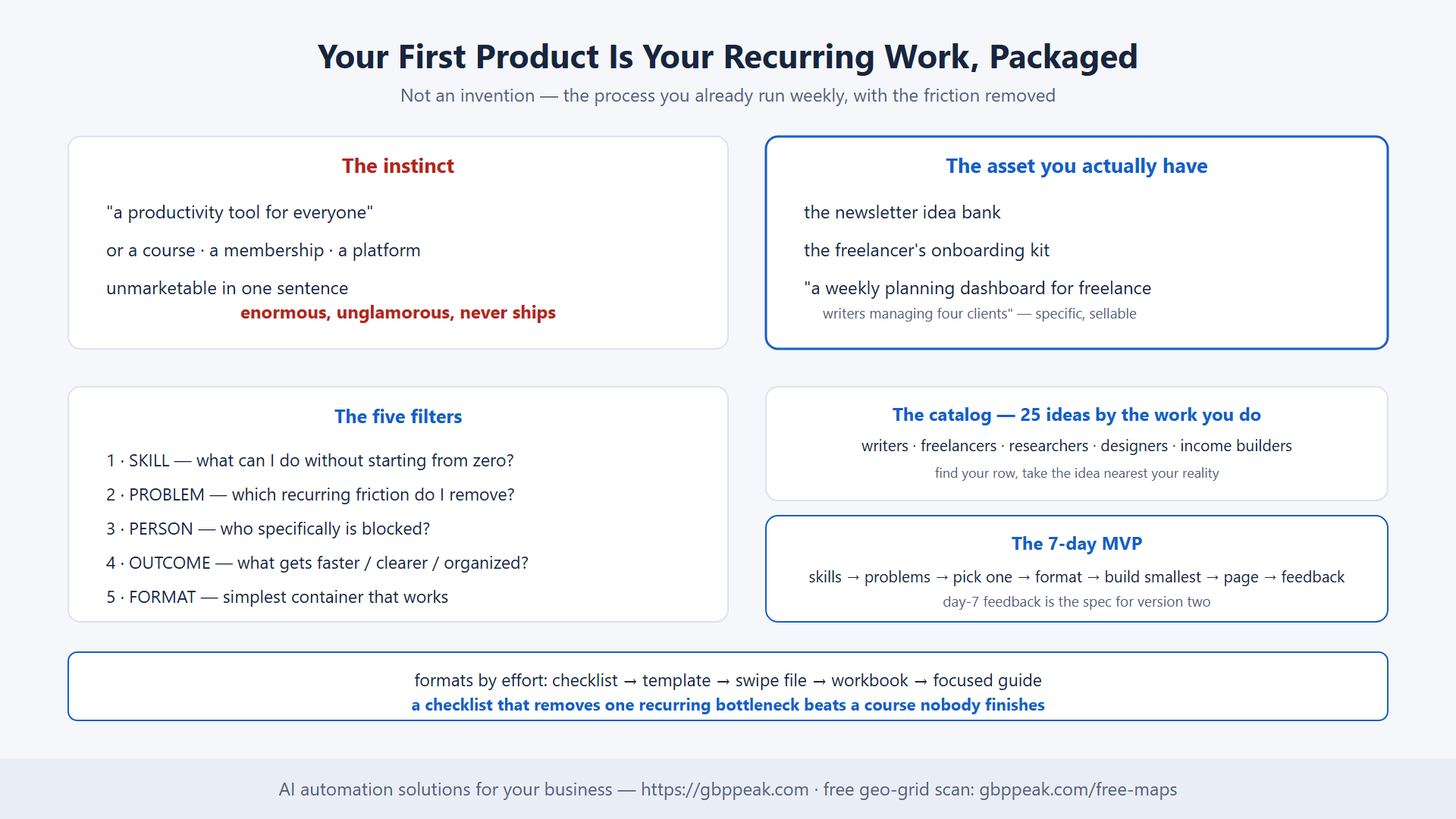
Ask a creator what their first digital product should be and you usually hear a pause, then something enormous: a course, a membership, a platform. What they actually have — the asset that sells — is the process they already run weekly, packaged so someone else can copy it. The newsletter writer's idea bank. The freelancer's onboarding kit. The consultant's discovery-call question bank. Small, unglamorous, immediately useful.
The best first products are not inventions; they are your recurring work with the friction removed. Here is the filter that finds them, the formats that suit them, a catalog of 25 concrete ideas, and the 7-day build.
Identify your first digital product by filtering skills you already have: pick a task you perform regularly, find the small frustrating problem inside it, name the specific person it blocks, define the measurable outcome, and choose the simplest delivery format — template, checklist, workbook, or swipe file. A five-page tool that reliably removes one bottleneck for one audience beats a massive course that covers everything. Build the minimum viable version in seven days, share it with a small group, and iterate on real feedback rather than perfecting in private.
The Five Filters
Run every candidate idea through all five, in order:
| Filter | Question | Fails when |
|---|---|---|
| 1 · Skill | What can I do without starting from zero? | The idea needs new expertise |
| 2 · Problem | What small, recurring friction can I remove? | "Nice to know," not annoying |
| 3 · Person | Who specifically is blocked by it? | The answer is "everyone" |
| 4 · Outcome | What becomes faster, clearer, organized? | No visible before→after |
| 5 · Format | Simplest possible container? | It "requires an app" |
The specificity jump is where most ideas die and the good ones live:
- ❌ "A productivity tool for everyone."
- ✅ "A weekly planning dashboard for freelance writers managing four clients."
Same shelf, different product — only the second can be marketed in one sentence, the test from your first product in 7 days.
Formats: Small Is the Point
The first-product formats, in ascending effort: checklist (prevent mistakes in a process) → template (skip hours of setup) → swipe file (proven examples to adapt) → workbook (guided exercises to a result) → focused guide (deep dive into one narrow situation). A well-designed checklist that saves a busy person a recurring headache routinely outperforms a 10-hour course they'll never finish.
The Idea Catalog: 25 Concrete Examples
Organized by the work you already do — find your row, take the idea nearest your reality:
If you write or run a newsletter
- Newsletter Idea Bank — 100 categorized prompts against blank-page syndrome.
- Subject Line Swipe File — high-performing open-rate lines.
- Repurposing Kit — one article → posts, emails, clips (the multiplication habit).
- Welcome Sequence Template — the pre-written new-subscriber emails.
- Weekly Publishing System — checklist + calendar for consistent output.
If you freelance or provide services
- Client Onboarding Kit — welcome emails, intake forms, scope summaries.
- Discovery Call Question Bank — qualify leads with the right questions.
- Simple Proposal Template — clear quotes in twenty minutes.
- Testimonial Request Pack — scripts that gather real social proof.
- Productized Service Workbook — custom service → fixed-price package.
If you organize information for a living
- Personal Research System — bookmarks, notes, sources, tamed.
- Content Brief Template — writer and client aligned before work starts.
- Decision Dashboard — impact/effort matrix for prioritizing.
- Competitor Research Workbook — a repeatable analysis framework (recon method).
- Content Audit Toolkit — update, delete, or repurpose, decided fast.
If your work is visual or brand-focused
- Mini Brand Strategy Kit — voice + audience definition worksheets.
- Social Content Starter Pack — reusable post layouts.
- Portfolio Refresh Checklist — attract better work step by step.
- Creator Media Kit — the sponsor-pitch one-pager.
- Creative Project Planner — idea → launch without the chaos.
If you're building independent income
- First Product Launch Checklist — the logistics, in order.
- The $25 Idea Generator — brainstorm the low-risk first offer.
- One-Page Sales Page Template — sell without building a website.
- Audience-to-Offer Workbook — customer questions → paid product (the PROOF method).
- Creator Revenue Tracker — sales, costs, growth in one sheet.
The 7-Day MVP Build
day_1: "list 5 skills/processes you perform frequently"
day_2: "extract 10 small problems they solve for others"
day_3: "pick ONE; write the one-sentence result it delivers"
day_4: "choose the format: guide / checklist / template"
day_5: "build the smallest genuinely useful version"
day_6: "one-page product description + announcement post"
day_7: "share with a small group; collect honest feedback"
Day 7's feedback feeds version two — evidence over perfection, the same loop as feedback-driven product validation.
The Pitfall Table
| Common mistake | Better approach |
|---|---|
| Massive all-in-one course | One focused toolkit or guide |
| Solving everything for everyone | One problem for one person |
| Every feature you can think of | One outcome, delivered reliably |
| Waiting for a huge audience | Test with the audience you have |
| Designing for weeks in private | Share early, adjust from feedback |
| Perfection in version one | Useful now, improved next version |
FAQs
Do I need a large following to sell a digital product?
No. You need reach into the specific group with the specific problem — which can be a 200-person niche community that trusts you. Small, targeted audiences convert better than large indifferent ones, and your first product is a learning instrument anyway.
Is a good product always a long course?
Rarely. "Good" for a busy buyer usually means "saves me time now." A single well-designed checklist that prevents a recurring mistake often delivers more felt value than a 10-hour course the buyer will never finish.
How do I know if my idea is genuinely valuable?
Check for a measurable outcome: a task becomes faster, a process clearer, a result more attainable. If users move from confused to clear — and can say so — you have value. If you can't name the before-and-after, refine the idea.
What is the best format for a first product?
Whichever is easiest for you to create and for the user to consume — usually a template, checklist, or short guide. The format is packaging; the specific problem solved is the product.
Package What You Already Do
You do not need to be an expert at everything — helpful in one specific area is the whole requirement. Filter your skills to one friction point, borrow the nearest idea from the catalog above, build the smallest useful version this week, and let a small group of real users tell you what version two becomes. And if your product serves a local market, check demand where it lives: a free geo-grid scan at gbppeak.com/free-maps shows exactly where your buyers can find you today.