One Phrase, Ten Steps: How to Own Your Market in Search Results
Pick the BullsEye Phrase — service + location — and put 80% of your effort into it. Ten steps across Google, Maps, social, and AI search to become the obvious answer.
"Search" no longer means Google. A customer's journey to find you might run through Google Maps, a Facebook group, an Instagram search, or a question typed into ChatGPT. Each of those is a search engine with its own way of deciding who gets recommended — and a business that is only visible in one of them is invisible in the others.
Owning your market means being the obvious answer everywhere your customers look. That sounds enormous, but it compresses into a ten-step framework built around one decision: picking the single phrase that matters most, then making the whole internet agree you are the answer to it.
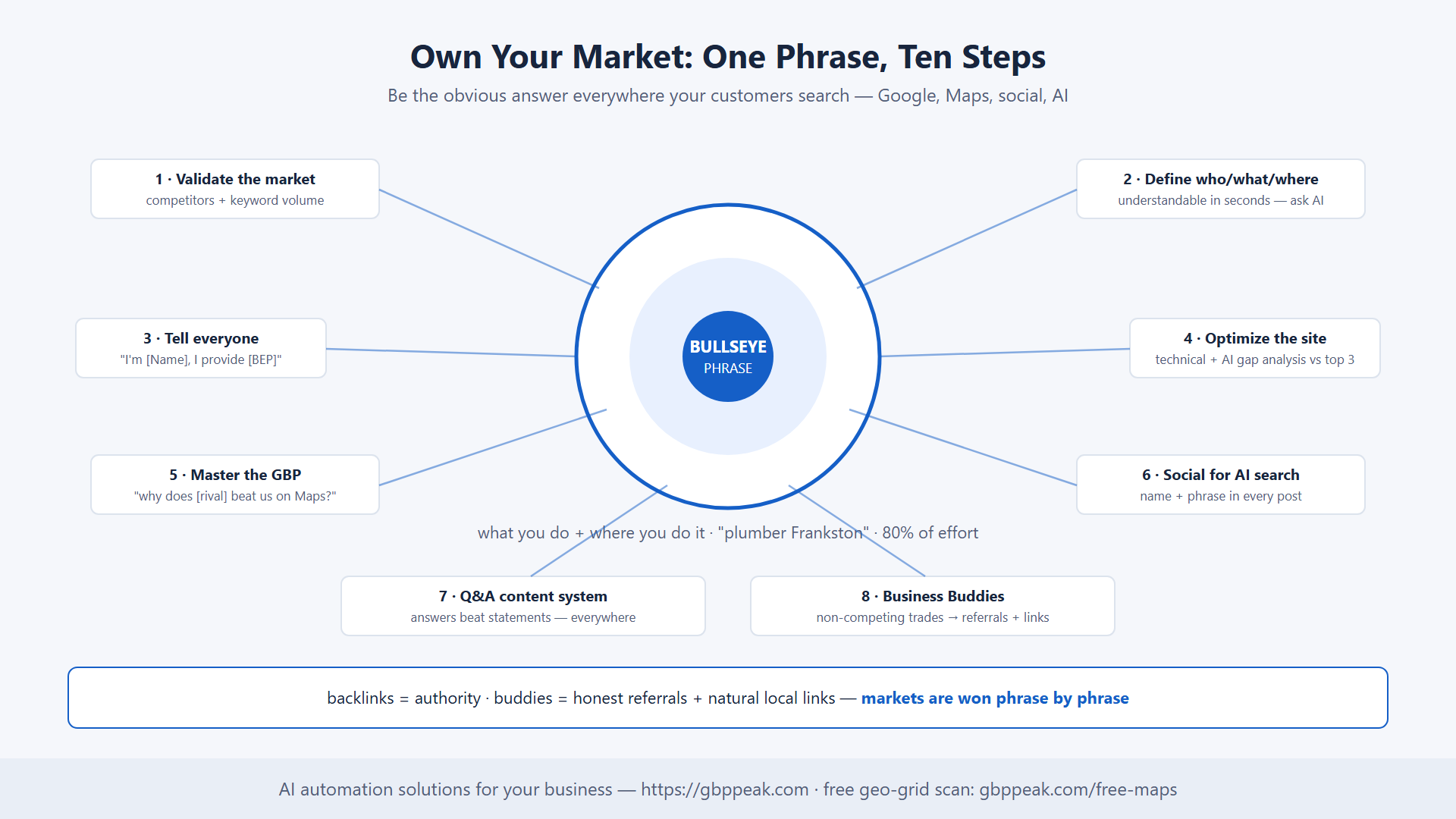
To own your market in search results, first validate demand exists, then pick a "BullsEye Phrase" — your service plus your location (e.g., "plumber Frankston") — and put 80% of your effort into dominating it. Make who/what/where obvious on every touchpoint, optimize your website and Google Business Profile against the top competitor, post social content containing your name and phrase (AI search reads it), answer real customer questions everywhere, and build "Business Buddy" partnerships with non-competing trades serving the same customers — generating referrals and the local backlinks that seal authority.
The Ten Steps at a Glance
| # | Step | Job it does |
|---|---|---|
| 1 | Validate the market | Confirm demand before spending |
| 2 | Pick the BullsEye Phrase | One phrase to rule the strategy |
| 3 | Define who/what/where | Be understandable in seconds |
| 4 | Tell everyone | Broadcast the Who+BEP statement |
| 5 | Optimize the website | Home base ranked for the phrase |
| 6 | Master the GBP | Own the map-pack real estate |
| 7 | Social for AI search | Feed the answer engines |
| 8 | Q&A content system | Answer what customers ask |
| 9 | Build backlinks | Earn authority |
| 10 | Business Buddies | Referrals + natural links |
Steps 1–2: Validate, Then Choose the Bullseye
Before effort, a sanity check: are people actually searching for this? Competitors in your niche are one signal — nobody sustains a business serving nobody. Free keyword tools are the other: real search volume for your service terms means a presence is worth building.
Then, the pivotal decision — the BullsEye Phrase (BEP): the one search term most likely to bring your best customers. Almost always it is what you do + where you do it: "arborist Tauranga," "car rental Bangkok," "gift baskets NZ." Put roughly 80% of your optimization effort there. Ranking #1 for one phrase that converts beats page-two existence for fifty that don't — the same focus logic as hybrid SEO and niche dominance.
Steps 3–4: Be Obvious, Then Say It Everywhere
A stranger — or an AI — should understand your business within seconds of finding any of your profiles. Test it literally: ask ChatGPT "Our business is [Name], we operate in [Area]. Is it clear from our online presence what we do?" and audit what comes back.
Then broadcast the Who + BEP statement everywhere your network can hear it:
"I'm [Name], and I provide [Service] in [Location]
 to help [Audience] achieve [Result]."
Social bios, email signatures, group introductions, conversations. Most of your personal network genuinely does not know your exact niche — this sentence fixes that, and every repetition teaches the algorithms to associate your name with the phrase.
Steps 5–6: Website and Profile, Audited Against the Leader
Two assets carry the ranking: the website (home base) and the Google Business Profile (the most valuable local real estate on the map).
website_checks:
  technical: "free SEO audit tool → fix crawl/blocker issues first"
  competitive: "ask AI to compare your site vs the top 3 competitors
                for the BEP → do the listed gaps"
gbp_checks:
  - "profile audit tool → categories, completeness, accuracy"
  - "local rank check → where you actually appear by district"
  - "ask AI: 'Why does [Competitor] beat [Us] on Maps for [BEP]?'"
    → the answer is your to-do list
That last prompt is the highest-leverage question in local search: the competitor's advantage is usually visible — more reviews, more Q&A, more local links — and therefore copyable, per the five visibility pillars.
Steps 7–8: Feed the Answer Engines with Q&A
Social content is no longer just for humans — ChatGPT, Perplexity, and AI Overviews read it to decide who to recommend. So include your name and BullsEye Phrase in posts naturally, and let AI suggest content angles targeted at your phrase.
Then go deeper: become a Q&A content marketer. List the real questions customers ask, answer them clearly on your website and social, and share those answers anywhere the question appears. Statements claim; answers prove — and they are exactly what answer engines extract, per answer engine optimization.
Steps 9–10: Authority Through Relationships
Backlinks — other reputable sites linking to yours — remain the authority layer that separates the map-pack leader from the rest, per backlink types. But cold link-building is slow. The shortcut is step 10.
Business Buddies: non-competing businesses serving your same customer. The plumber and the electrician. The gym and the physio. The structures:
business buddy system:
  refer .... customers to each other (warm, trusted leads)
  mention .. each other on social (reach + association)
  guest .... write a useful post for each other's site (backlink)
  bundle ... joint offers ("book both, save X")
result: honest referrals + natural, high-quality local links
        that no cold outreach could earn
Four or five solid buddies produce a referral flow and an authority footprint that compounds quietly for years — community as an SEO tactic, the same engine as guerilla local SEO.
FAQs
What is a BullsEye Phrase?
The single highest-value search term for your business — usually your service plus your location, like "plumber Frankston." It focuses 80% of your effort on the small set of searches that produce most of your customers, instead of spreading thin across dozens of generic terms where ranking is slow and intent is vague.
Why does social media affect search engines?
Because AI search engines crawl social platforms for current, real-world context about businesses. Consistent posts that include your name, service, and area teach those systems who you are — so when a user asks for a recommendation, your business is the one the AI can confidently name.
What is a backlink and why does it matter?
A backlink is another website linking to yours — a vote of confidence that search engines count toward authority and rank. Links from reputable, locally relevant sites carry the most weight, which is why partnerships that produce natural mentions outperform bulk directory spam.
How many BullsEye Phrases should I target?
One at a time. Dominate the first phrase — website, profile, social, links all aligned to it — before adding a second. Markets are won phrase by phrase, and a business that owns three specific terms beats one that half-competes for thirty.
Own It Phrase by Phrase
Owning your market is not a mystery; it is a sequence: validate the demand, pick the bullseye, be obvious, tell everyone, out-optimize the leader on site and profile, feed the answer engines, answer the questions, and let business buddies build your authority. Run the ten steps for one phrase, then repeat for the next — and see the ground you're gaining with a free geo-grid scan at gbppeak.com/free-maps, district by district.