
Read the Answer Key: Hybrid SEO for Local Search
Don't optimize everything — reverse-engineer the one business beating you: their Q&A, their links, their profile. AI scales the content; the geo-grid proves the win.
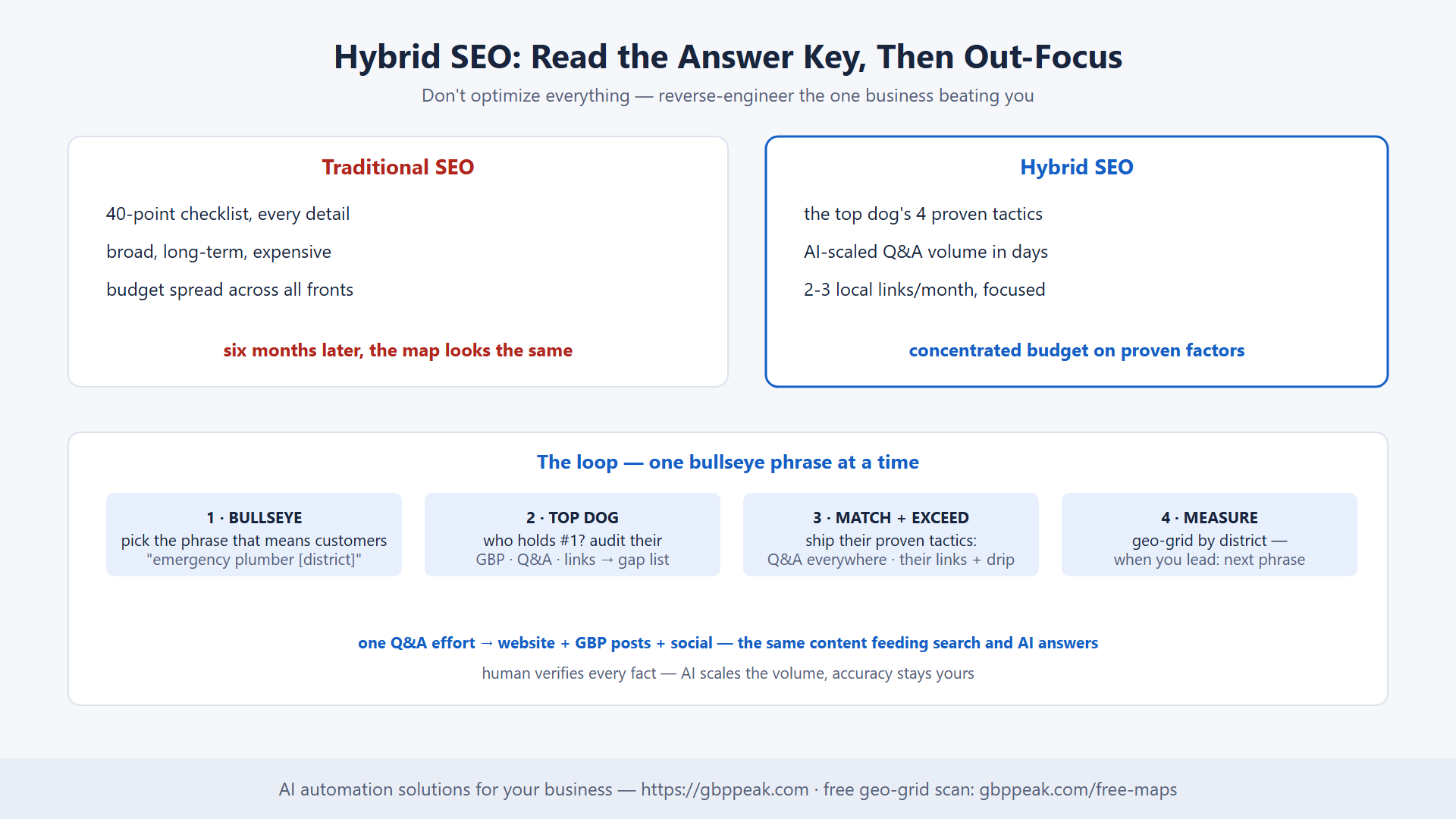
A local business owner budgets for "SEO" and receives a 40-point checklist: site speed, schema, internal links, blog cadence, social signals, meta descriptions… Six months and a lot of money later, the map pack looks the same. Meanwhile the competitor who took the top spot did maybe four things — and did them well.
That gap is the insight behind Hybrid SEO: stop optimizing everything, and instead reverse-engineer exactly what the business currently beating you is doing to win, then do only those things. It is competitive intelligence applied to search — the shortest path from where you are to where the top dog sits.
Hybrid SEO is a targeted strategy: identify the "top dog" currently ranking #1 for your key local search term, reverse-engineer the specific tactics behind their win — their Q&A content, local links, directories, profile setup — and replicate only those, using AI to produce the high-volume Q&A content fast. Instead of broadly optimizing every technical detail, you match and exceed the proven factors for your exact keyword, so a small business can outrank local rivals faster and at a fraction of the cost of traditional all-fronts SEO.
Traditional vs Hybrid: Scope Is the Difference
| Traditional SEO | Hybrid SEO | |
|---|---|---|
| Goal | Perfect presence everywhere | Win against the specific local leader |
| Strategy | Broad, long-term optimization | Reverse-engineer the competitor's win |
| Content | Custom long-form articles | High-frequency Q&A, localized |
| Link building | Any good links | The local links the leader has |
| Speed | Slow — everything compounds | Faster — key factors only |
| Budget | Large, diffuse | Small, concentrated |
Traditional SEO is not wrong; it is just built for a world of unlimited resources. Hybrid SEO assumes the opposite: every hour and baht must attack a proven ranking factor for one bullseye phrase.
Step 1: Pick the Bullseye and Find the Top Dog
Everything starts narrow. Choose the bullseye phrase — the one search term that means customers: "emergency plumber in [district]", "invisalign clinic [neighborhood]". Then find who holds the top of the map pack for it. That business is your blueprint, because the ranking system has already told you its approach works for exactly this term.
# competitive recon (2 hours, once per phrase):
1. search the bullseye phrase from your service area
2. note the #1 map-pack business — the "top dog"
3. their GBP: categories, services, review pattern, post cadence
4. their site: which pages rank, what questions they answer
5. their links: which local sites point at them
6. output: a gap list — what they have that you lack
The logic is simple and ruthless: if they are winning with answered questions and directory listings, you add those questions and join those directories. You are not guessing what works; you are reading the answer key.
Step 2: The Q&A Method, Scaled by AI
Modern search — including AI engines — rewards conversational, useful answers. The top dog's site probably answers dozens of customer questions; that is often the moat. AI lets you close that gap in days instead of months.
Feed the model your business description plus the competitor intel, and ask for a comprehensive Q&A set covering real customer concerns:
Q&A generation prompt (pattern):
  "You are [business]. Competitor analysis shows top-ranking sites
   answer questions like [list]. Generate 30 questions our real
   customers ask, each with a 2-4 sentence accurate answer in
   plain language. Flag any answer you are unsure about."
then — the human pass:
  verify every fact, add local specifics, kill anything generic
Then distribute the same useful answers in three places: your website (FAQ pages and service pages — feeding "People Also Ask" boxes, per answer engine optimization), your Google Business Profile (posts, per GBP content types), and your social pages. One effort, three surfaces — that is the hybrid in Hybrid SEO: the same content working across traditional search and AI answers at once.
Step 3: A Few Local Links a Month
Outranking a local leader usually requires one more layer: the local links that signal geographic authority — the neighborhood blog, the local news mention, the association directory. The hybrid approach takes the same "only what's proven" stance: get the links they have, plus a steady drip.
local_link_routine:
  monthly_target: "2-3 quality local links"
  sources: "their referring domains first, then one new target"
  tactics: "directories they're in · community sponsorship ·
            resource-page pitches"
  rule: "local relevance beats raw authority — the district blog
        outperforms the global directory"
The mechanics of which links matter are covered in backlink types that build authority; the hybrid discipline is the monthly routine, not the heroic campaign.
The Rhythm
Hybrid SEO is a loop, not a project:
quarterly loop:
  scan the bullseye phrase → who leads now?
    → re-run the gap list vs the leader
      → ship the missing Q&A + links
        → measure: geo-grid by district
          → when you lead: pick the next bullseye phrase
The measurement step keeps it honest: a free geo-grid scan at gbppeak.com/free-maps shows whether the gap is closing, district by district — the same evidence-first habit as guerilla local SEO.
FAQs
What makes Hybrid SEO different from standard SEO?
Scope. Standard SEO optimizes every aspect of a site broadly and long-term. Hybrid SEO reverse-engineers the specific tactics of the top-ranking local competitor for your key term and replicates only those — concentrating limited budget on proven ranking factors instead of spreading it across a full checklist.
Does Hybrid SEO require a lot of content?
It requires useful content, not massive original articles. The core format is Q&A: a large set of real customer questions with short accurate answers, generated with AI assistance and verified by a human. That volume covers many searches quickly and feeds both traditional results and AI answer engines.
How does AI fit into the strategy?
AI does the heavy repetition: analyzing competitor content patterns and drafting comprehensive Q&A sets in hours instead of weeks. The human role is judgment — verifying facts, adding local specifics, and deciding what ships. AI scales the work; accuracy stays yours, per reliable AI practices.
Do I need SEO expertise to use this method?
No — the method is deliberately procedural: identify the bullseye phrase, copy the leader's proven tactics, publish verified Q&A, build a few local links monthly, and measure with a geo-grid. The competitor's success tells you what to do; the routine keeps you doing it.
Read the Answer Key
You do not beat the market leader by outworking them everywhere — you beat them by out-focusing them on the one phrase that matters. Find the top dog, take only their proven tactics, let AI carry the Q&A volume, keep the local link drip going, and measure quarterly. Start by seeing the battlefield: a free geo-grid scan at gbppeak.com/free-maps shows exactly where you and the leader stand, district by district.