
Direction, Peers, Speed: The Small Business Growth Resource Kit
A structured plan for direction, a community for fast learning, AI drafting plus curated backlink lists for speed — matched to whichever bottleneck you actually have.
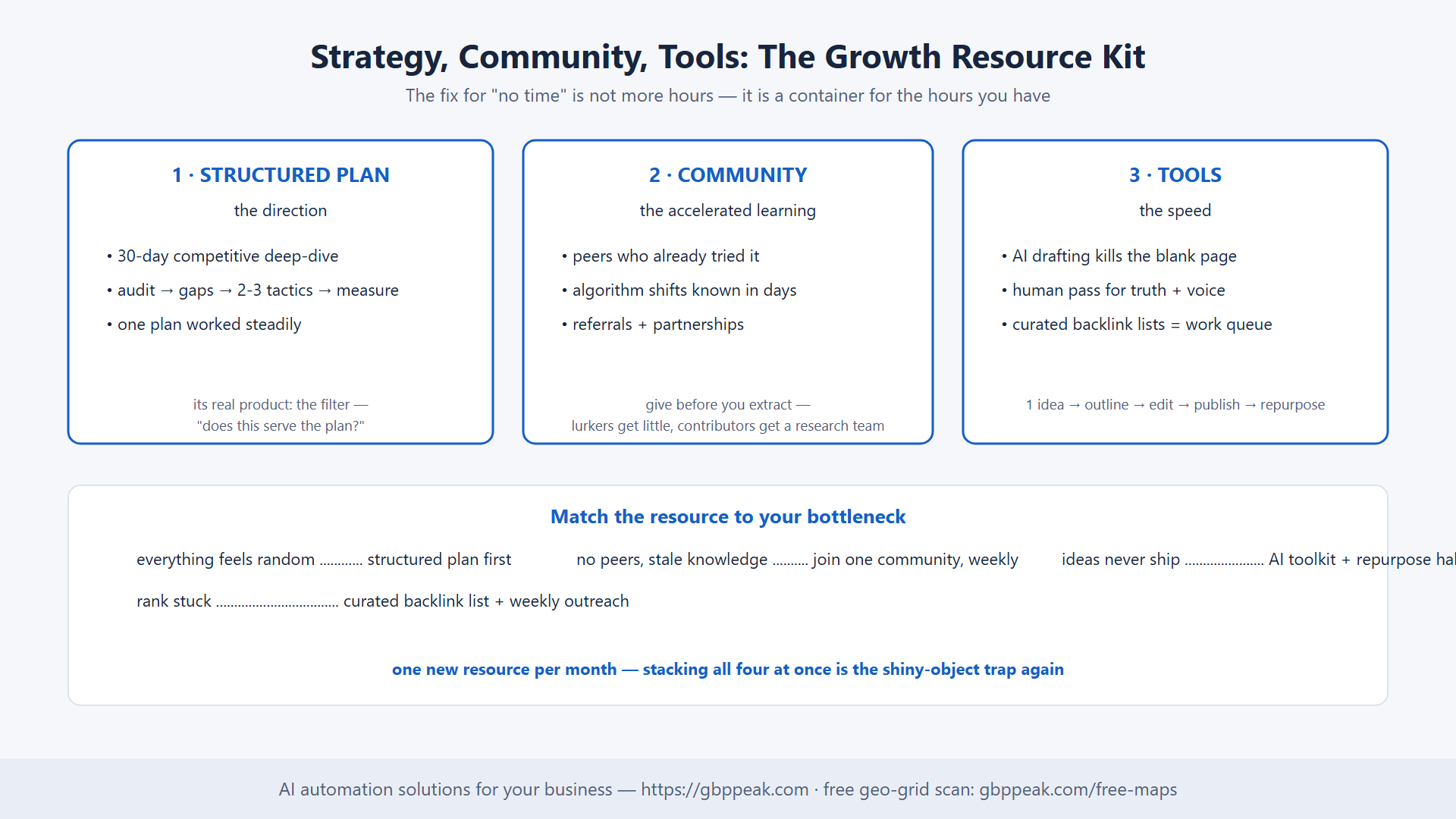
Ask a business owner what stops their online growth and you usually hear "no time." Look at their week and the truth is different: unstructured time. Hours scattered across random tutorials, half-tested tools, and forum rabbit holes — effort without a container. The fix is not more hours; it is the right mix of three resources: a structured plan, a community, and a small set of tools that erase the repetitive work.
This is that toolkit, organized by what each resource actually does for you.
Grow a business online with three complementary resources. Strategy: a structured program (like a 30-day competitive deep-dive) that replaces random tactics with a roadmap. Community: marketing groups where peers share what is working as algorithms shift, so you learn from others' mistakes instead of your own. Tools: AI-assisted drafting to kill the blank page and speed content production, plus curated backlink resource lists to streamline authority building. Choose by current bottleneck — unfocused effort, isolation, or slow content — and apply consistently.
Three Resources, Three Jobs
| Resource | Job it does | Replaces | Failure without it |
|---|---|---|---|
| Structured program | Direction | Random tactics | Shiny-object drift |
| Community | Accelerated learning | Learning solo | Repeating others' mistakes |
| AI + curated tools | Speed | Manual repetition | Content never ships |
The order matters less than the coverage: a plan with no tools dies of friction; tools with no plan produce volume without direction; going it alone makes both slower.
Resource 1: A Structured Plan (Direction)
Standing out against established competitors feels impossible until it is decomposed. A structured program — a 30-day deep dive is a common format — works because it forces sequence over impulse:
30_day_competitive_dive:
  week_1: "audit where you stand vs top 3 competitors"
  week_2: "identify your strengths + the gaps they leave open"
  week_3: "pick 2-3 tactics that exploit those gaps"
  week_4: "execute, measure, keep or kill"
  rule: "one plan, worked steadily — beats ten sampled"
The plan's real product is not the tactics; it is the filter. With a roadmap, every new tool or trend gets one question: "does this serve the plan?" Without one, everything looks like an opportunity, and shiny objects consume the calendar — the focus discipline from becoming the best in your niche.
For local businesses, week 1 has an obvious first move: see the actual battlefield with a geo-grid scan (free at gbppeak.com/free-maps) — where you rank, district by district, next to the competitors you intend to beat.
Resource 2: Community (Accelerated Learning)
Growth does not need to happen alone, and shouldn't. Marketing communities — forums, group chats, membership groups — deliver three things no course can:
- Peer support — people facing the same hurdles, who have already tried what you are about to try.
- Shared intelligence — when an algorithm shifts, a community knows in days; a solo operator finds out in months, from their own traffic graph.
- Networking — partnerships, referrals, and collaborations that grow out of visibility inside the group, the same community-first logic as guerilla local SEO.
The rule for community value: give before you extract. Answer others' questions with real detail, share what worked and what failed, and the group becomes a research department you didn't have to hire.
Resource 3: Tools (Speed)
Two categories of tool erase the most repetitive work.
AI-assisted content
The blank page is where content plans go to die. Modern AI drafting tools fix the start: generate topic ideas, outline the article, produce three platform-specific variations of one message. The discipline stays human — you edit for accuracy and voice, then publish — but the hours per piece drop dramatically, per the weekly AI rhythm.
AI content flow (per piece):
  idea → AI outline → human edit for truth + voice
       → publish → repurpose: 1 post → graphic → email section
  never skip the human pass — accuracy is your brand
Curated backlink resources
Backlinks — other sites linking to yours — remain a core authority signal, but prospecting them by hand is slow. Curated lists (directories, resource pages, niche sites worth pitching) turn hours of searching into a work queue, per the ten backlink types. The craft is in the pitch, not the finding; let the list do the finding.
Matching Resources to Your Stage
{
  "if_your_bottleneck_is": {
    "direction: everything feels random": "structured 30-day program first",
    "isolation: no peers, stale knowledge": "join one active community, weekly",
    "slow_content: ideas never ship": "AI drafting toolkit + repurpose habit",
    "weak_authority: rank stuck": "curated backlink list + weekly outreach"
  },
  "rule": "one new resource per month — stacking all four at once is the shiny-object trap again"
}
FAQs
What is a backlink?
A backlink is a link from one website to yours — a vote of confidence that search engines count when deciding authority and rank. Locally relevant links (community sites, local news, niche directories) carry the most weight for "near me" searches, which is why curated lists of local targets save real prospecting time.
How can AI actually help with content marketing?
By removing the blank page. AI tools generate topic ideas, structure outlines, and draft platform-specific variations of one message in minutes. What they don't replace is judgment — a human edits for accuracy and voice before publishing. The realistic gain: content hours cut roughly in half, with consistency preserved.
Why do I need a roadmap to compete?
Because without one, every new tool and trend looks like a must-try, and effort scatters. A structured plan gives each week a specific job — audit, gap analysis, execution, measurement — so activity compounds instead of restarting. The roadmap's main product is the ability to say no.
Are paid communities worth it?
Often, if you use them actively. The value is not the content library — it is the live intelligence: peers flagging algorithm changes, answering your specific questions, and becoming referral partners. Lurkers get little; contributors get a research team. Judge any group by whether its members are one step ahead of you.
Strategy, Community, Tools — In That Dose
Online growth is not scarce in resources; it is scarce in application. Pick the structured plan for direction, one community for speed of learning, and a small toolset for output — then work them for ninety days before adding anything. Start this week with the free part: run a geo-grid scan at gbppeak.com/free-maps and let the map decide week one of your plan.