Findable, Reachable, Trusted: A Digital Marketing Toolkit for Local Growth
Visibility, conversion, reviews, and AI leverage — four layers that make a local business easy to find and easy to choose, sequenced into a quarterly plan.
A customer finds your website, likes what they see, and wants to call — but the phone number is buried in the footer, the contact form asks seven questions, and the booking page reloads on mobile. They were yours to lose, and you lost them in forty seconds. Meanwhile a competitor with a worse service and a clearer page took the call.
Digital growth is not one big strategy; it is a short list of fundamentals done consistently: be findable, be reachable, be trusted, and use tools (increasingly AI) so the work doesn't eat your week. Here is the toolkit, layer by layer.
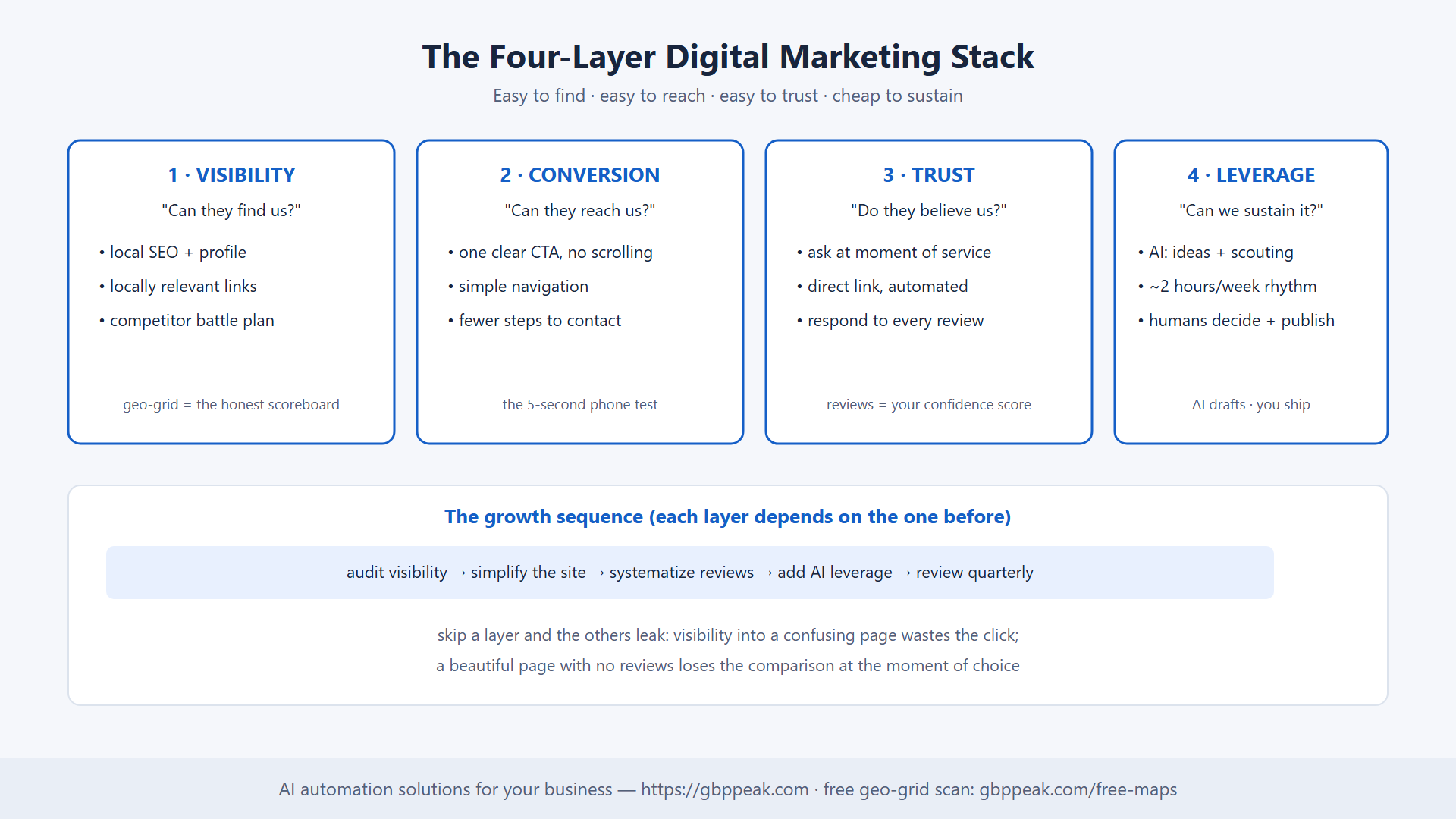
Effective digital marketing for a local business comes down to four layers. Visibility: local SEO plus locally relevant backlinks so customers find you in search and maps. Conversion: a simple site with clear calls to action and minimal steps between landing and contacting. Trust: systematic review collection that builds your online "confidence score." Leverage: AI tools for competitor scouting, content ideas, and backlink targets that used to take hours. Together they make a business easy to find and easy to choose.
The Four-Layer Stack
| Layer | Question it answers | Core tools/practices | Failures it prevents |
|---|---|---|---|
| Visibility | "Can they find us?" | Local SEO, profile, local links | Invisible to searchers |
| Conversion | "Can they reach us?" | Simple site, clear CTA, few steps | Visitors who leave without acting |
| Trust | "Do they believe us?" | Reviews, testimonials, responses | Hesitation at the moment of choice |
| Leverage | "Can we sustain it?" | AI for scouting, ideas, tracking | Burnout, stale content |
Skip a layer and the others leak: perfect visibility into a confusing page wastes the click; a beautiful page with no reviews loses the comparison.
Layer 1: Visibility
Two practices carry most of the weight.
Local link building. Links from other sites remain a major ranking factor, and for local businesses the valuable ones are local: community sites, neighborhood news, relevant directories — the hyper-local authority layer detailed in backlinks that build authority. One district-blog mention outweighs fifty generic directory links.
Competitor analysis. Your competitors' rankings, links, and ads are public. Pull the top three for your core keyword, note what they rank with and where their links come from, and you have a battle plan proven by the market — the audit-first approach from building an inbound lead engine.
# visibility audit (an afternoon, quarterly):
1. search your core keyword + district → who owns the map pack?
2. pull each top-3 competitor's links → tag local vs generic
3. scan your own rank across the service area (geo-grid)
4. gaps = your next quarter's visibility worklist
The geo-grid in step 3 matters: rank is neighborhood-shaped, not a single number. Run one free at gbppeak.com/free-maps.
Layer 2: Conversion
A conversion is a visitor doing the thing you want — calling, booking, filling the form. Conversion work is mostly subtraction:
- Simplify navigation — a stranger should reach any service page in one click.
- One clear call to action — the phone number or "book now" visible without scrolling, on every page.
- Prove credibility on the page — testimonials and review scores near the CTA, not on a separate tab.
- Remove steps — every extra form field and page between intent and contact leaks customers.
the 5-second test (run it on your phone):
  open your site as a first-time visitor
  can you find how to contact → in 5 seconds?
  can you tell what you do + where → in 5 seconds?
  any "no" = the highest-ROI fix on your list
The same clarity logic applies to your offer itself — see offer clarity and lead quality.
Layer 3: Trust (Reviews as Infrastructure)
Prospective customers rarely read only your website — they read your reputation. Reviews are social proof, and collectively they form your "confidence score": how safe a choice you appear compared to competitors. Fewer or older reviews read as risk.
The fix is a system, not hope: ask at the moment of service (when satisfaction peaks), send a direct link, and respond to every review — the review engine from the sustainable local SEO cycle. Automation helps: triggered requests after each completed job turn review collection from a chore into a background process.
Layer 4: Leverage — AI Where It Actually Pays
AI's practical value for a local business is hours saved on recurring work:
- Content ideas — a month of social post angles generated from your services and season, so the calendar never goes dark (publishing rhythm per Google Business Profile content types).
- Competitor scouting — summarizing what competitors rank with, where they're listed, and which of those listings you should claim.
- Backlink prospecting — sorting lists of local sites into "worth pitching / skip" before you spend outreach time.
- Ad audits — spotting wasted budget in campaigns before the next billing cycle.
weekly_ai_rhythm:   # ~2 hours total
  monday:   "generate + queue the week's social posts (human-reviewed)"
  wednesday: "one scouting task: listings, links, or competitor summary"
  friday:   "check rank + review numbers → adjust next week"
The rule: AI drafts and scouts; a human decides and publishes. Nothing customer-facing ships unreviewed — the same guardrails as reliable AI agents in production.
The Growth Sequence
Put the layers in order, because each depends on the one before:
audit visibility ......... where do you actually rank? (geo-grid)
simplify the site ........ 5-second test, one CTA, fewer steps
systematize reviews ...... ask at moment of service, respond weekly
add AI leverage .......... content rhythm + scouting, 2h/week
review quarterly ......... keep what moved numbers, cut what didn't
FAQs
What is the difference between SEO and standard marketing?
Marketing is the whole discipline of reaching customers — ads, social, print, events. SEO is the specific practice of appearing in search results when someone types a relevant query. For local businesses it is the highest-intent channel: the searcher is already looking for what you sell, right now, nearby.
How do online reviews actually impact my business?
Reviews are social proof at the decision moment. Most customers check them before first contact, and the pattern — volume, recency, detail, your responses — forms a confidence score that decides whether they choose you or the competitor with fresher proof. Systematic collection beats organic drift every time.
What are backlinks and why do they matter?
A backlink is another website linking to yours — a vote of confidence that search engines count when ranking. Locally relevant links (community sites, local news, niche directories) carry outsized weight because they signal both trust and geography, which is exactly what "near me" rankings reward.
How much should a small business spend on marketing tools?
Far less than on doing the fundamentals. A rank tracker, a review tool, and a scheduler cover most needs at tens of dollars a month; the free layers — an optimized profile, a simplified site, a review-asking habit — usually move numbers more than any paid tool. Add tools only when a manual process is genuinely the bottleneck.
Findable, Reachable, Trusted
Digital growth is two pillars — easy to find, easy to work with — held up by consistent execution and cheap leverage. Audit your visibility this week, run the 5-second test, build the review habit, then let AI carry the recurring workload. Start where everything starts: see your actual visibility with a free geo-grid scan at gbppeak.com/free-maps.