
Build Before the Wave: Four Disciplines for a Stronger Online Presence
Reviews on autopilot, a website that captures leads, repurposed multi-channel content, and quarterly audits — four disciplines that make you the trusted choice when demand returns.
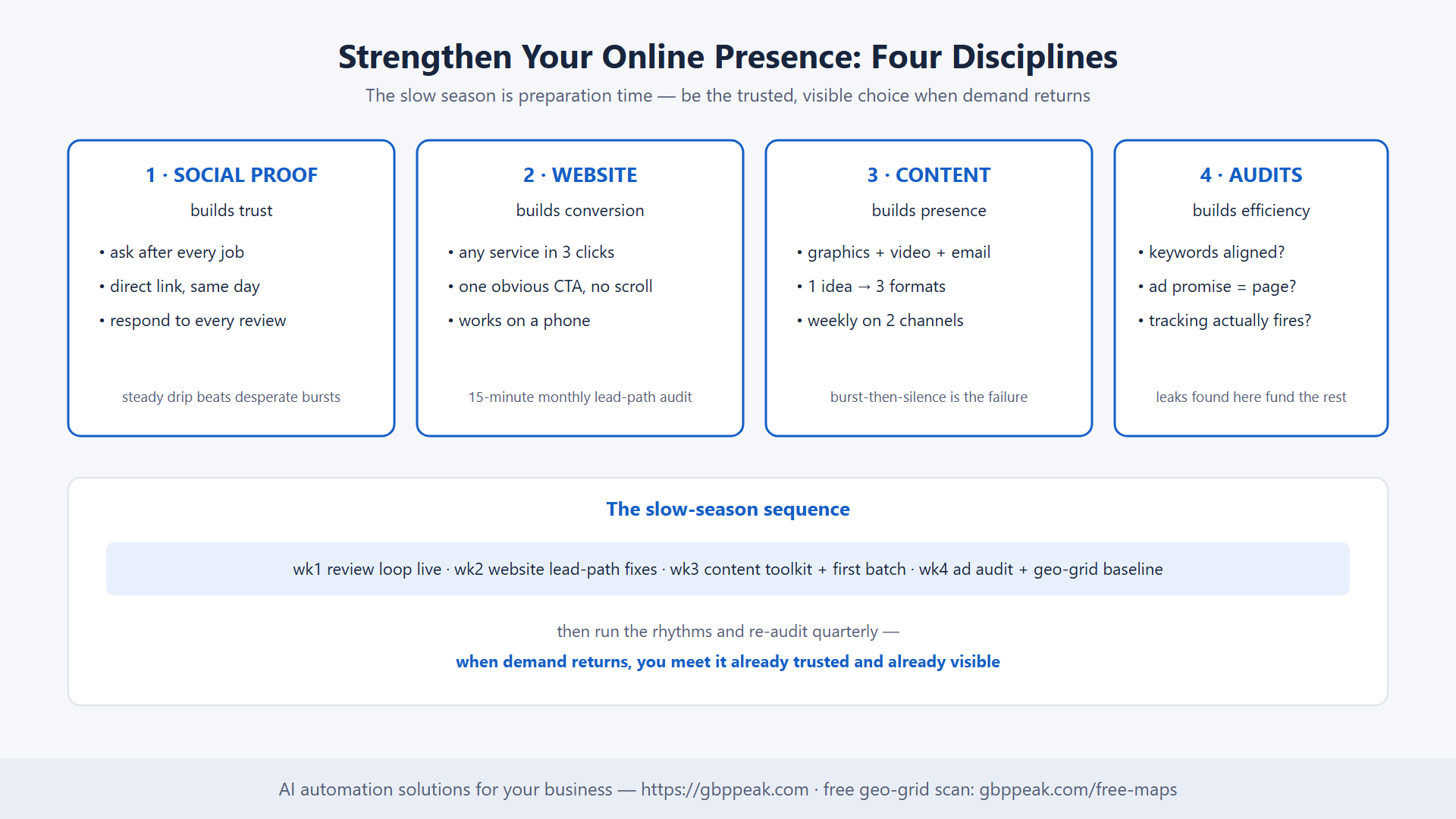
Every business has a slow season. Most owners treat it as dead time and wait. The smart ones use it as preparation time: fixing the website, stacking the reviews, and sharpening the content machine — so that when demand returns, they are the first business customers find, already trusted, while competitors scramble.
Strengthening your online presence is not a single project; it is four ongoing disciplines — social proof, a website that captures leads, consistent multi-channel content, and regular audits of what you already pay for. None requires a big budget. All require consistency.
Strengthen your online presence with four pillars. Social proof: systematically collect reviews after every transaction so your "confidence score" grows automatically. Website: treat it as a lead-generation machine — fast, mobile-working, with a clear call to action reachable in under three clicks. Content: use integrated tools for graphics, video, and email to stay present on multiple channels without burning out. Audits: regularly review paid campaigns for keyword alignment, ad copy, and conversion tracking to stop budget leaks. Done consistently, these pillars make you the trusted, visible choice when demand peaks.
The Four Disciplines
| Discipline | Builds | Core habit | Typical failure |
|---|---|---|---|
| Social proof | Trust | Ask after every job | Hoping reviews happen |
| Website | Conversion | Clear CTA, few clicks | Digital brochure nobody can act on |
| Content | Presence | Weekly rhythm on 2-3 channels | Burst then silence |
| Audits | Efficiency | Quarterly spend review | Paying for ads that stopped working |
Skip trust and the click hesitates. Skip conversion and the click leaks. Skip content and you fade between purchases. Skip audits and you pay for the privilege of all three problems.
Discipline 1: Social Proof on Autopilot
Reviews are your digital word-of-mouth, and volume plus quality forms the confidence score both customers and search engines read. A business with hundreds of specific, recent reviews gets chosen — and ranked — over the competitor with a handful from two years ago.
The habit that gets you there is mechanical:
review loop (runs after every job):
  service completed → same-day automated message
    → one line of thanks + direct review link (no forms in between)
    → review arrives → respond within the week
volume target: steady drip, not bursts — 3/week for a year beats
              60 in one desperate month
Specific reviews do double duty: they persuade readers, and the service words inside them teach search — and AI answer engines — what you are known for, per the sustainable local SEO cycle.
Discipline 2: The Website as Lead Machine
A website is not a brochure; it is your storefront with one job: turn a visitor into a contact. Three checks decide whether it does:
- Under three clicks — can a stranger reach any service and the contact path quickly?
- One obvious CTA — call, book, or quote visible without scrolling, on every page.
- Mobile first — most local visitors arrive on a phone; test on yours, not on a laptop.
lead-path audit (15 minutes, monthly):
  open the site on your phone as a first-timer
  → service clear in 5 seconds? CTA visible? form ≤ 4 fields?
  → tap the CTA: does it actually work?
  any "no" or "huh" = this month's fix, in priority order
Clarity beats beauty here — the same lesson as offer clarity and lead quality: the page that explains exactly what you do, for whom, and how to start outconverts the prettier vague one.
Discipline 3: Multi-Channel Content Without Burnout
Different customers live on different channels — search, social video, email. Presence on two or three of them multiplies the chances of being found. The burnout risk is real, and the answer is a toolkit plus repurposing:
content_toolkit:
  graphics: "one design tool, brand templates locked"
  video: "phone footage of real work — behind the scenes converts"
  email: "one helpful newsletter/month (a repurposed post is fine)"
  repurpose_rule: "1 idea → 1 post → 1 graphic → 1 email section"
  cadence: "weekly on 2 channels beats daily on 5 for two weeks"
One idea, three formats. The multiplier habit from the agency-directory-media model works at any scale: create once, distribute everywhere, and the brand message stays consistent because it comes from one source.
Discipline 4: Audit What You Already Pay For
If ads are running, an audit is usually the highest-ROI hour available. A marketing audit reviews three things:
- Keyword alignment — are you appearing for the terms customers actually type, or adjacent terms that never convert?
- Ad copy — does the message match what the landing page delivers? Mismatched promises quietly destroy conversion.
- Conversion tracking — can you see which ad produced which inquiry? Without it, every budget decision is a guess.
# quarterly ad audit (1 hour):
1. export last 90 days by keyword/ad
2. kill anything with spend and zero tracked conversions
3. compare ad promise vs landing page — fix mismatches
4. verify tracking fires (test lead end-to-end)
5. reallocate the saved budget to the top 2 performers
Leaks found here fund everything else in this playbook.
The Slow-Season Sequence
Put the disciplines in order during the quiet window:
week 1: review loop live + respond to every existing review
week 2: website lead-path audit → fix the top 3 frictions
week 3: content toolkit set up + first repurposed batch queued
week 4: ad audit + baseline visibility check
then:    run the rhythms; re-audit quarterly
And baseline visibility means the map, not vibes — a free geo-grid scan at gbppeak.com/free-maps shows where you rank district by district, so when the season turns, you can prove the groundwork moved the needle.
FAQs
What is the best way to get more online reviews?
Automate the ask. Send a short thank-you with a direct review link the same day a job completes — by the channel the customer already uses. Removing friction (no forms, no searching) is what turns "happy customers" into published reviews; adding a gentle reminder after three days recovers most of the rest.
How can I improve my website's conversion rate?
Focus on clarity and simplicity: the main offer front and center, real photos, one obvious contact action visible without scrolling, and a form with the fewest possible fields. Then test on a phone as if you were a first-time visitor — every hesitation you feel is a customer leaving.
Why use multiple marketing channels if one is working?
Because your customers don't all live on one channel — some find you in search, others through a video, others via email. Multiple channels multiply discovery opportunities, and repurposing makes the extra channels nearly free: one idea becomes a post, a graphic, and a newsletter section.
How often should I audit my marketing?
Review paid campaigns quarterly at minimum — keyword performance, ad-to-page match, and tracking health. Websites deserve a monthly 15-minute lead-path check, and visibility a quarterly geo-grid scan. Small, regular audits catch leaks while they are drips instead of floods.
Build Before the Wave
The slow season is a gift of preparation time. Stack the reviews, fix the lead path, set the content rhythms, stop the ad leaks — and when demand returns, you meet it already trusted and already visible, while everyone else is starting cold. Begin with the baseline: a free geo-grid scan at gbppeak.com/free-maps.