"Website Traffic Is Dying." The Shop Had Never Been Busier.
Website visits sliding, shop never busier — calls from Maps tripled. Zero-click search relocated the decision. Win the impression: profile, evidence, clean signals.
A Bangkok auto repair shop owner complained that his "website traffic was dying" — Analytics showed visits sliding for a year. But the shop had never been busier. The mystery resolved in his Google Business Profile insights: calls from Maps had tripled. Customers were finding his hours, his reviews, his photos — and calling straight from the search page. The website hadn't died; the journey had just stopped needing it.
That's zero-click search, and for local businesses it's not a threat — it's a relocation of the decision. The customer still decides; they just decide on the results page, in the map card, in the AI summary, before any click happens. 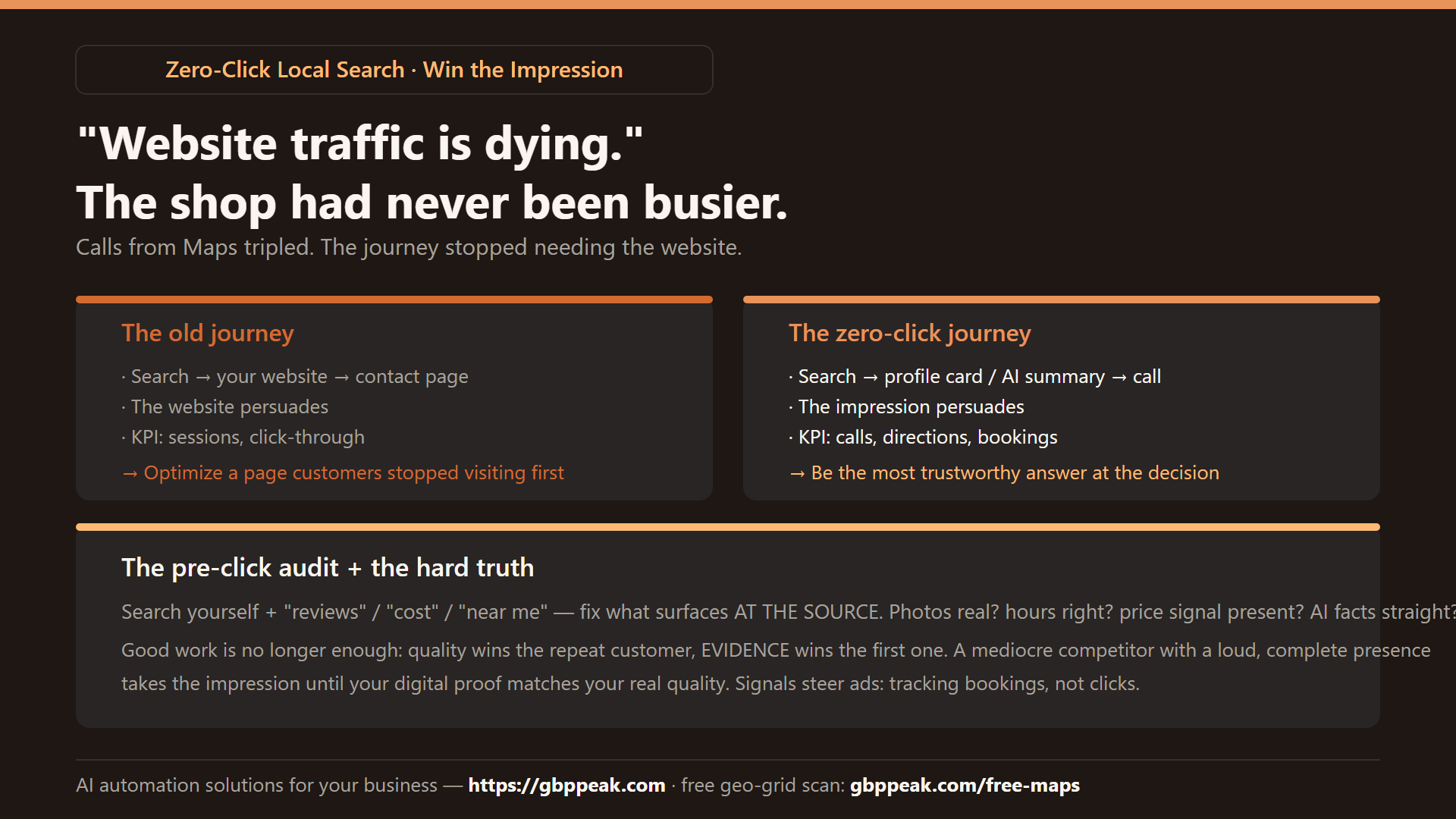
Your job changed: stop trying to win the click, start winning the impression.
Zero-click search means users get their answer — phone number, hours, reviews, directions — directly on the results page without visiting any website. For local businesses this is opportunity, not loss: the high-intent customer still acts, but decides from your profile card or an AI summary. So optimize the impression: complete, accurate, photo-rich Google Business Profile; consistent data everywhere machines read; conversational content answering real customer questions (not bare keywords); and precise ad conversion signals so automation finds booked appointments rather than clicks. Be the most trustworthy answer in the moment of decision — click or no click. :::
Where the decision actually happens now
| Old journey | Zero-click journey |
|---|---|
| Search → your website → contact page | Search → profile card / AI summary |
| Website persuades | Impression persuades |
| KPI: sessions, click-through | KPI: calls, direction requests, bookings |
| Assets: website | Assets: GBP, reviews, photos, structured data |
The customer asking "emergency plumber near me" is in high-intent mode — ready to act, looking for the fastest trustworthy path. If your map card answers hours, price signal, rating, and a call button, they never need your website. That's not lost traffic; that's a converted customer with a shorter path.
Win the impression: the decision card audit
Since the search page is now your sales page, audit what a customer sees there — before your website ever loads:
THE PRE-CLICK AUDIT (search your own business, 15 min):
  1. Search "[your business] reviews" — what rating and
     review snippets surface? recent? answered?
  2. Search "[your service] cost [your area]" — does a
     price signal appear? accurate?
  3. Search "[your service] near me" (from your area) —
     map card: photos real or stock? hours correct?
     call/book buttons working?
  4. Ask an AI assistant the same — facts straight?
  fix whatever's wrong AT THE SOURCE (profile, listings),
  because the snippet only mirrors its sources
This is also the honest test of the hard truth for service businesses: good work is no longer enough. An excellent plumber with three photos and inconsistent hours loses the impression to a mediocre one with a loud, complete, current presence. Quality still decides the repeat customer; the evidence decides the first one.
AI search isn't a separate world
The instinct to treat "AI search" as a new channel with a new strategy is mostly wrong. AI is being folded into the systems you already use — ad automation expands across AI surfaces (AI Max and friends), AI Overviews sit above the results you already compete in. The same fundamentals power both:
- Data quality is the fuel — reviews, citations, accurate photos, consistent NAP: the raw material every AI recommendation is built from
- Signals steer the automation — messy tracking that can't tell a "get a quote" click from a "just browsing" click teaches the machine to find browsers. Clean signals (booked appointments) teach it to find customers
signal_hygiene:
  events:
    quote_click:  "count, never optimize"
    browse_click: "ignore entirely"
    call_60s:     "qualified floor"
    booking:      "optimization target"
  rule: "more automation = more signal-dependent;
         feed it truth or it amplifies noise"
Write for the conversation, not the keyword
Search language has shifted. "Dentist Bangkok" is becoming "which dentist near Ari treats cracked molals and takes appointments after 5 PM?" — conversational, situational, specific. Your content should meet it:
- Pain points as headings — "cracked molar same-day repair," not "dental services"
- Real locations — neighborhoods, landmarks, transit stops; the specifics both neighbors and models use to place you (situation content)
- Proof everywhere — real photos of real jobs, current reviews, answered questions; evidence is what the summary quotes
The test for every page: does it answer a question a real customer would actually say out loud? If not, it's decoration.
The practical sprint
- Day 1: run the pre-click audit; fix the worst surface finding
- Day 2: replace generic stock photos with 10 real ones — your team, your work, your shop front
- Day 3: upgrade conversion tracking to the qualified signals above
- Day 4–5: write the top 5 real-customer FAQs onto your profile and service page, with specifics (pricing, timing, areas)
- Day 6: consistency pass — NAP and hours identical across site, GBP, directories
- Day 7: baseline the map: a free geo-grid scan at https://gbppeak.com/free-maps plots where your Google Maps ranking carries your impression across your service area
Frequently Asked Questions
Does zero-click search make my website useless?
No — it changes the path, not the need. Many customers still research on your site before big purchases; it also remains the structured source of truth that profiles and AI systems cite. But the first decision now happens on the results page, so your profile and listings deserve equal (often more) attention than the site.
How do I make my business more AI-friendly?
Give the models clean, detailed, consistent material: current reviews with answers, real photos, specific service descriptions, and identical data across every platform. AI recommends the businesses it can verify — completeness is the strategy.
Will AI search replace traditional ads?
AI is being folded into existing ad systems rather than replacing them. What matters more than the surface is your signal quality: automation, AI-driven or not, places you in front of whoever your conversion tracking says you want. Define the qualified lead; the machine finds it.
I do great work — why am I invisible online?
Because visibility runs on evidence, not excellence. Customers can't see your workmanship through a sparse profile; they see photos, reviews, completeness, consistency. The loud-but-mediocre competitor wins the impression — and the first customer — until your digital evidence matches your real quality.
Final note
The click was never the prize — the customer was. Zero-click search just made that literal: the decision now happens where you don't control the design, powered entirely by the evidence you've published. Complete the profile. Answer the real questions. Feed the machines truth. The customer who never clicks your link still becomes the customer who calls your number.