Decisions, Not Dashboards: Building Your AI SEO Tool Stack
No magic all-in-one tool: Search Console for truth, Screaming Frog for audits, one research platform, ChatGPT as the analysis layer — plus the five-question filter before buying.
A business owner subscribes to four SEO tools in one month — a keyword platform, two content optimizers, an "AI visibility tracker" — and six months later still cannot answer the basic question: which page should I fix first? The tools had features; the strategy never existed. The "best" AI SEO tool is never the one with the longest feature list — it is the one that helps you make a better decision faster, on data you can verify.
Here is the practical stack: which tool does which job, how to evaluate anything new, and the mistakes that quietly waste budgets.
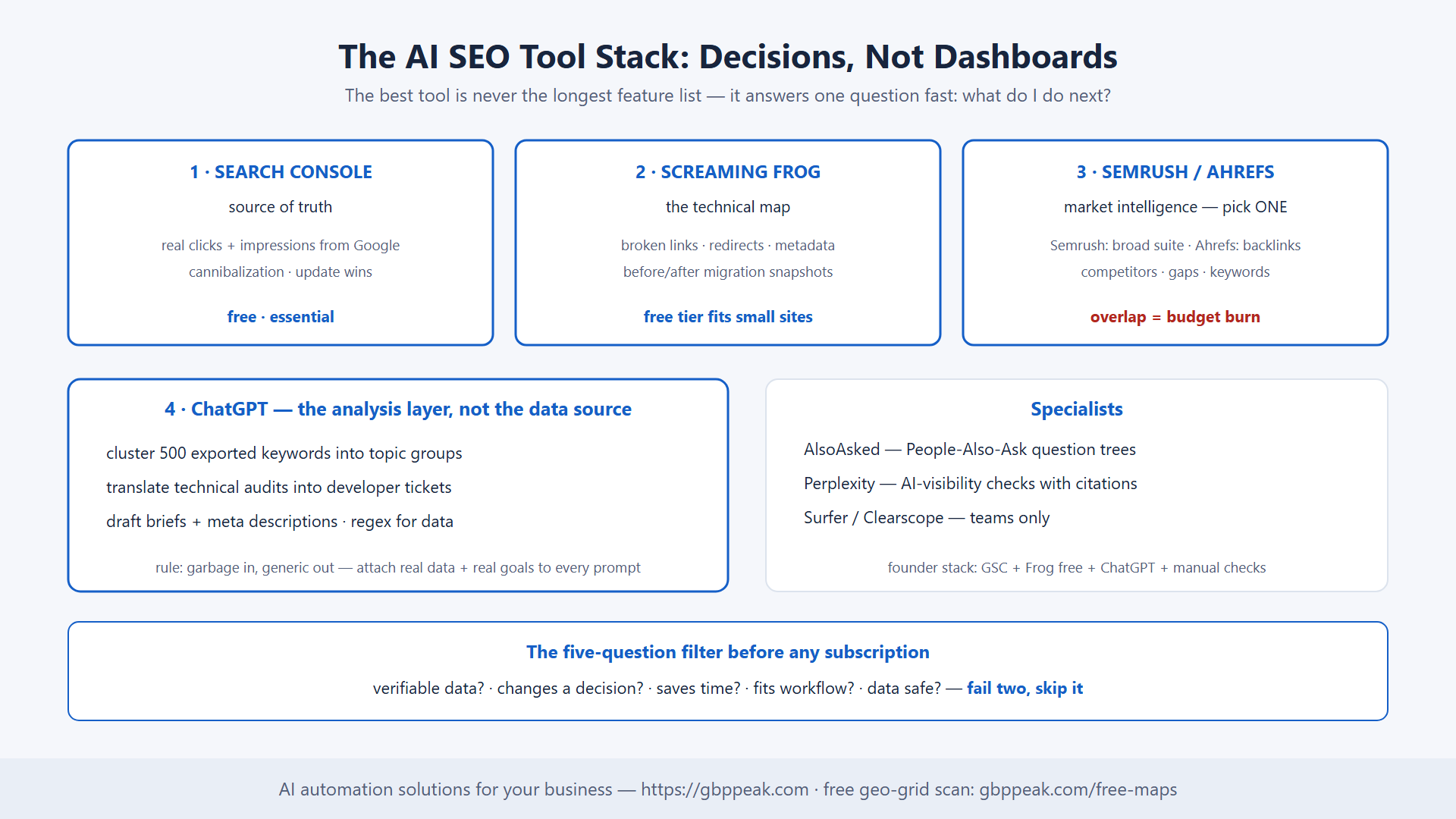
There is no single all-in-one AI SEO tool. Build a specialized stack: Google Search Console for first-party truth on queries and clicks, Screaming Frog for technical crawls, one research platform (Semrush or Ahrefs — rarely both) for competitor and keyword intelligence, and ChatGPT as the analysis layer that clusters keywords, translates audit findings into tasks, and drafts content. Add AlsoAsked for question intent, Perplexity for manual AI-visibility checks, and Surfer/Clearscope only for high-volume content teams. Evaluate every tool on five criteria: verifiable data, decision changed, time saved, workflow fit, and data safety.
Two Games, One Foundation
- SEO — rankings, clicks, visibility in classic results.
- GEO (Generative Engine Optimization) — how accurately AI answers represent your brand, per SEO to GEO.
Different tactics, identical foundation: a technically sound, authoritative site. Which is why the core stack below serves both games at once.
The Core Stack
| Tool | Job | Tier |
|---|---|---|
| Google Search Console | Source of truth — real clicks/impressions from Google | Free, essential |
| Screaming Frog | Technical map — crawl, broken links, redirects, metadata | Free tier suffices for small sites |
| Semrush or Ahrefs | Market intelligence — competitors, gaps, keywords | Paid, pick one |
| ChatGPT (or Claude) | Analysis engine — processes data from the others | Low cost |
| AlsoAsked | Question intent from People-Also-Ask trees | Cheap, optional |
| Perplexity | Manual AI-visibility checks with citations | Free tier works |
| Surfer / Clearscope | Content coverage vs ranking competitors | Teams only |
1. Search Console: where guessing stops
Third-party tools estimate; Search Console reports. It answers the questions that drive action: which queries drive growth? Which pages lose clicks while holding rank? Are two pages cannibalizing one keyword (the cannibalization check)? Did that update actually help?
2. Screaming Frog: the technical map
It crawls your site like a search engine spider, surfacing broken links, redirect chains, and missing metadata — the invisible barriers from discoverability gates. During migrations, before/after crawl snapshots prove nothing was lost.
3. Semrush or Ahrefs: pick one
Semrush leans broader (all-in-one suite, brand tracking); Ahrefs leans deeper (backlink analysis, competitor content). Most businesses need neither both nor a second keyword tool once they have one — overlap is budget burn.
4. ChatGPT: the analysis layer, not the data source
AI processes; it does not provide original data. Its best work happens fed with exports from the tools above:
high-leverage AI SEO tasks:
  cluster 500 exported keywords into topic groups
  translate a technical audit into developer tickets
  draft content briefs + meta descriptions
  write regex to slice messy spreadsheet data
rule: garbage in, generic out — always attach real data
      and real business context to the prompt
5–7. The specialists
AlsoAsked maps how one search expands into a question tree — the raw material of comprehensive content, per intent-based content. Perplexity shows, with citations, which sources influence AI answers in your niche — the manual layer of AI visibility tracking. Surfer/Clearscope keep multiple writers hitting coverage points; solo operators can skip them.
The Five-Question Tool Filter
Before any new subscription:
tool_evaluation:
  1_verifiable: "claims checkable against our analytics?"
  2_decision: "does the report tell us WHAT to do next?"
  3_time: "saves more time than it takes to manage?"
  4_workflow: "fits our CMS / spreadsheets / habits?"
  5_safe: "no sensitive data (clients, PII, secrets)
           without a security review?"
fail_two: "skip it — a report is not a strategy"
The Four Budget-Burners
- Feature overload — buying overlapping tools; one keyword platform is enough.
- Blind AI trust — hallucinated "facts" shipped unverified; every number gets cross-checked (the AI verification rule).
- Unguarded AI posting — raw AI content with no experience or expertise layered in loses visibility over time.
- Context-free prompts — asking AI for SEO help without attaching your data and goals produces generic junk.
Stacks by Size
founder / small business:
  Search Console (free) · Screaming Frog (free tier)
  · ChatGPT · manual Google + Perplexity checks
agency / in-house team:
  + Semrush or Ahrefs · AlsoAsked · Surfer/Clearscope
when to add an AI-visibility platform:
  only after a defined AI-answer strategy exists —
  tracking without acting is dashboard decoration
FAQs
What are the best AI SEO tools?
There is no single best — there is a best stack: Search Console for real performance data, Screaming Frog for technical audits, Semrush or Ahrefs for competitor intelligence, and ChatGPT to analyze and act on all of it. The right question is which tool solves your current bottleneck.
Can ChatGPT replace Semrush or Ahrefs?
No. ChatGPT has no live database of keywords, backlinks, or search trends. It is the analysis layer that makes sense of the data those platforms export — powerful exactly because the platforms feed it, worthless as a replacement for them.
What is the difference between SEO and GEO tooling?
SEO tools measure rankings and clicks in classic results; GEO tooling measures how AI models describe and cite your brand in generated answers. Both rest on the same site-quality foundation, so core stack first, AI-visibility layer second.
What is the best free AI SEO toolset?
Google Search Console plus Screaming Frog's free tier plus ChatGPT covers audits, real performance data, and analysis at near-zero cost — sufficient for most small businesses before any paid platform.
How do I track visibility in AI search engines?
Start manually: run a fixed set of persona-based prompts monthly, record whether you appear, how you're described, and which sources the AI cites (Perplexity shows citations). Move to a dedicated AI visibility platform only when the manual check becomes unmanageable.
Decisions, Not Dashboards
The winning stack answers one question fast: what do I do next? Search Console tells you what's real, Screaming Frog what's broken, one research platform what the market does, and AI turns it all into prioritized action. Start where your process actually slows down, buy only that tool, and verify everything. For the local side of the picture, the free first step is a geo-grid scan at gbppeak.com/free-maps.