
This Is Who I Am: Founder Identity and Brand Alignment
Profitable but hollow is the cost of a borrowed brand identity. Experiment away, notice what gives energy, consolidate, and return to a core you believe in.
A founder steps away from the company that carries his name. The business keeps running — invoices go out, clients stay, revenue holds. But he feels a quiet loss he cannot file under any spreadsheet column. A year later, after experiments that taught him more than any course could, he comes back and rebuilds the same brand — this time with a sentence he can say without flinching: "This is who I am."
That arc — leave, experiment, return — is one of the most common and least discussed journeys in business. Its lesson is not about logos or strategy. It is about identity: a business aligned with its founder runs on conviction; one that is not runs on willpower, and willpower runs out.
A business is strongest when its brand identity aligns with the founder's core mission. When the founder loses touch with the personal "why," the company can be profitable yet feel hollow, and decisions drift. Recovering alignment usually involves experimenting with other models (memberships, products, partnerships) to learn what you actually want, then returning to a focused core — typically an agency-style service business — and consolidating scattered projects under one brand so overhead drops, marketing focuses, and the founder leads from identity instead of obligation.
Identity: The Invisible Operating System
"Identity" in business is the set of values and personality a company projects. When those are borrowed — from a market trend, a partner's vision, a playbook that worked for someone else — the business can succeed on paper while the founder feels directionless. The mismatch is expensive in ways that never show on a P&L:
- Decision fatigue — every choice gets re-argued internally because there is no compass.
- Hollow marketing — customers can feel the difference between a message believed and a message deployed.
- Burnout with revenue — the strangest kind of tired: profitable and unmotivated at once.
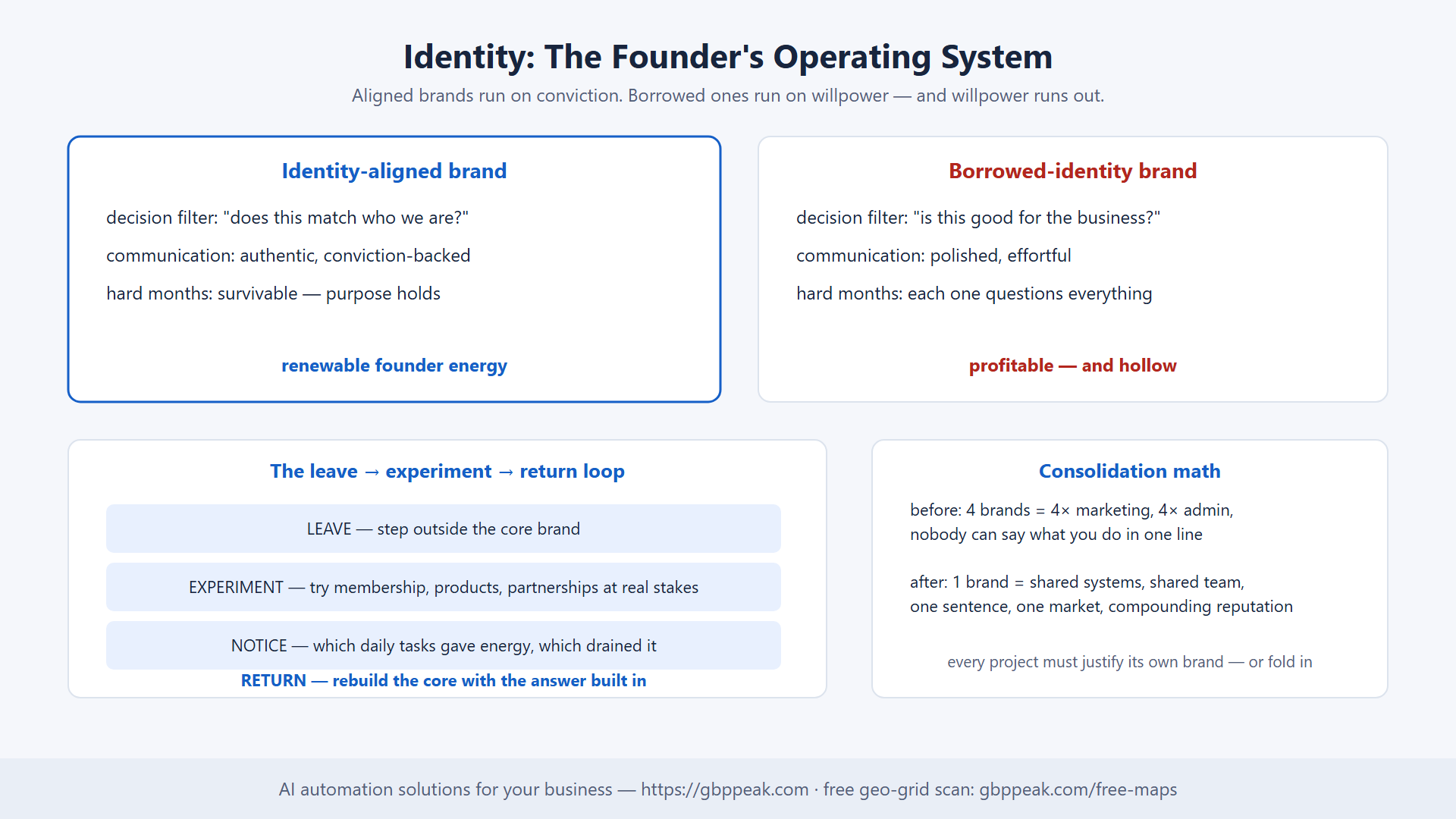
| Identity-aligned brand | Borrowed-identity brand | |
|---|---|---|
| Decision filter | "Does this match who we are?" | "Is this good for the business?" |
| Communication | Authentic, conviction-backed | Polished, effortful |
| Hard months | Survivable — purpose holds | Each one questions the whole project |
| Founder energy | Renewable | Depleting |
| Longevity | A legacy | An exit, or a slow fade |
The founder is the face whether or not they accept the role. Accepting it deliberately is what turns the business from a transaction into a calling.
Learn by Leaving: What Experiments Teach
The counterintuitive truth about clarity: you often find your core by stepping away from it. Two experiments in particular teach founders what they actually want.
The membership experiment
Building a community or membership platform sounds like the natural evolution of expertise. Many founders discover instead that B2C memberships demand a completely different operational mindset — high volume, constant content, community management as a daily practice — and that they miss the depth of solving a specific client's problem well. (We covered the community-vs-content trade in business growth concepts.)
The agency experiment
The agency-style model — a specific service for a specific audience — appeals to founders who value:
- Direct results — a concrete problem solved, visibly.
- Fast profitability — services invoice from month one, no product build phase, per the agency-first ladder.
- Scalable systems — SOPs and processes that let the team deliver without the founder on every call, the machinery from scalable service systems.
The point is not that one model is correct. It is that you cannot know which one fits until you have felt both. Experimentation is not a detour from identity — it is how identity gets tested into certainty.
the leave-experiment-return loop:
  leave ......... step outside the core brand
  experiment .... try the other model(s) honestly, at real stakes
  notice ........ which daily tasks gave energy, which drained it
  return ........ rebuild the core with the answer built in
Consolidate: One Umbrella Beats Five Tents
Mature businesses tend toward consolidation: bringing scattered ventures — the service agency, the software tool, the educational side project — under one primary brand. The mechanics are plain:
consolidation_math:
  before:
    brands: 4
    overhead: "4x marketing, 4x admin, split attention"
    message: "diluted — nobody can say what you do in one line"
  after:
    brands: 1
    overhead: "shared systems, shared team, focused spend"
    message: "one sentence, one market, compounding reputation"
  rule: "every project must justify its own brand — or fold into the main one"
This is the same asset-thinking as the agency-directory-media flywheel: one ecosystem where each part feeds the others beats a portfolio of disconnected efforts that each demand their own everything.
The Challenges of Coming Back
Returning to the center after a period away has its own friction, and pretending otherwise is how second foundings fail:
- Relationships have moved. Old partners changed during the time apart; so did you. Rebuild the relationship on who you both are now, not on the memory of the old arrangement.
- Starting over is heavier than remembered. The value of a pre-existing team and documented systems becomes vivid the moment you have to rebuild from zero — which is exactly why the return should preserve systems, not just the brand.
- Control vs growth, forever. The balance between predictability and necessary uncertainty is not solved once; it is managed continuously. The identity-anchored founder at least knows which side of the line they are defending.
FAQs
What is the "Agency First" model?
It is the strategy of starting with a specific service for a specific audience to generate immediate cash flow, before attempting products or platforms. Services need little upfront capital and no build phase, so they fund everything else while teaching you — through paid work — which problems are worth systematizing.
Why does brand alignment matter so much for a founder?
Because it removes decision fatigue. When the brand expresses what the founder genuinely believes, choices get filtered by identity rather than re-analyzed from scratch; communication becomes authentic; and the inevitable hard months are survivable because purpose, not just profit, is doing the holding.
How do I decide which business model is right for me?
Judge by daily texture, not by projections. If you love building community and constant content, membership or education models fit. If you prefer solving discrete problems for clients and building systems around delivery, the agency model fits. Test both at real stakes before committing — preference revealed under load is the only trustworthy signal.
Should I consolidate side projects under one brand?
Usually yes, once each project has proven it cannot justify its own brand. Consolidation cuts overhead, focuses marketing, and compounds reputation in one place instead of five. Keep separate brands only where the audiences and messages genuinely cannot share a roof.
Return to the Core
Growth is rarely a straight line, and the detours are not wasted — they are how a founder earns the sentence "this is who I am." Experiment honestly, notice what gives energy, consolidate what scattered, and come back to a core that expresses you. The business that results is easier to run, harder to copy, and worth the trip. And if your core lives in local visibility, come back to the market data too — a free geo-grid scan at gbppeak.com/free-maps shows exactly where you stand, district by district.