
Sales, Team, Clean Books: Three Pillars of a Sustainable Business
Sales before brand, salaries as infrastructure, monthly bookkeeping — the three unglamorous pillars that decide whether a business exists in five years.
A founder closes year two with a beautiful brand, three thousand followers, and a tax bill they cannot pay — because somewhere along the way, posting replaced selling and the shoebox of receipts replaced bookkeeping. The business looked alive from the outside. Fundamentally, it never had a skeleton.
Sustainable businesses are built on three boring pillars: sales that generate cash now, a team that creates leverage, and clean books that keep you out of trouble. None of them photographs well. All of them decide whether you exist in five years.
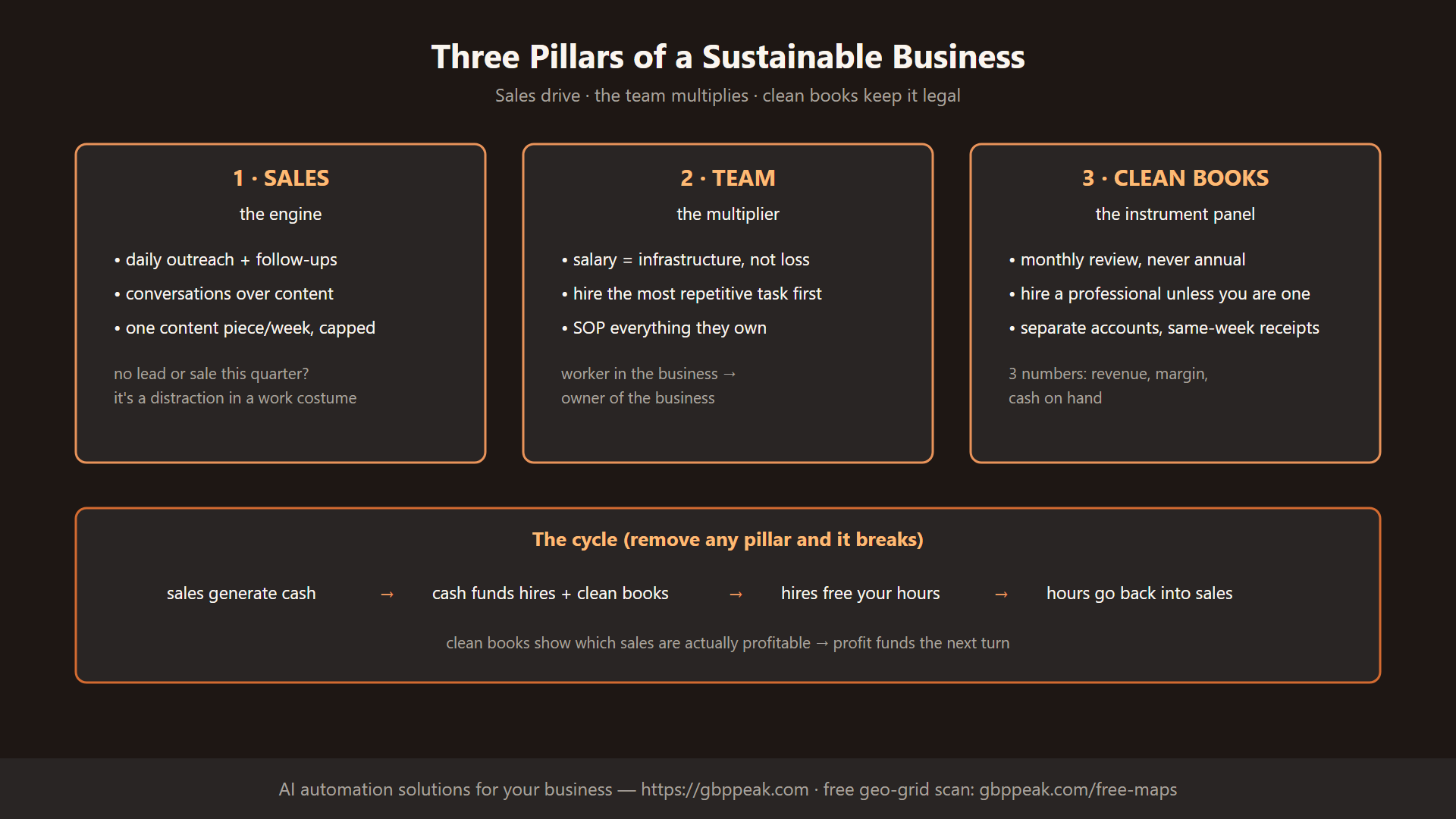
A sustainable business rests on three fundamentals. First, sales: prioritize lead generation and direct outreach over brand-building until revenue is consistent, because cash flow buys you the right to work on everything else. Second, leverage: reinvest profit into a team and systems so the business stops depending on your hours. Third, clean books: professional-grade accounting and tax preparation, reviewed monthly, protect your margins, your decisions, and your legal standing. Community and brand identity then grow naturally out of served customers.
Pillar 1: Sales Before Everything
Early-stage businesses die from a shortage of customers, not a shortage of logos. Yet the natural instinct is the opposite — polish the newsletter, film more content, "be everywhere" — because those activities feel productive without requiring the scary part: asking someone to buy.
Use the engine test. Sales is the engine; social media, branding, and community are the body of the car. A beautiful body with no engine goes nowhere. And apply it ruthlessly: if a marketing activity cannot plausibly produce a lead or a sale this quarter, it is a distraction wearing a work costume.
| Activity | Engine or body? | Do when |
|---|---|---|
| Direct outreach / follow-ups | Engine | Daily |
| Talking to prospective clients | Engine | Most of your week |
| Local events and networking | Engine (slow-burn) | Monthly |
| One useful content piece a week | Body that attracts | Weekly, capped |
| Perfecting the logo again | Neither | After revenue |
| Building a community from zero | Neither, yet | After happy customers exist |
The streamlined version of "be everywhere" that actually works:
early_marketing_stack:
  home_base: "one site with a clear contact path"
  content: "one piece per week — blog or newsletter, no more"
  social: "rotate presence; don't chase every platform"
  outreach: "the majority of working hours — conversations, calls, events"
  rule: "revenue first earns the right to visionary later"
Notice what is missing: community building. Communities form naturally around businesses that serve customers well — word of mouth is downstream of delivery, not a substitute for it. That sequencing is the same one behind the flywheel in the agency-directory-media model.
Pillar 2: Hire to Build Leverage
The solopreneur trap feels rational: doing everything yourself keeps costs low and quality high. But time is finite, and a business that runs on your hours has a revenue ceiling exactly equal to your calendar — the freelancer wall we walked through in building the team that replaces you.
The mental unlock is to stop seeing a salary as lost profit and start seeing it as infrastructure investment:
- Training a team member = a process that no longer needs you, documented once (the SOP discipline from scalable systems).
- Hiring outside your zone of genius = buying back the hours only you can spend on sales and strategy.
- Building systems = converting knowledge that lives in your head into an asset that lives in the business.
reinvest ladder (once personal needs are covered):
  profit → hire for the most repetitive task
        → document what they do (SOP)
        → freed hours → more sales
        → more profit → next hire
  direction of travel: worker in the business → owner of the business
Each rung converts cash into time, and time into more cash. That loop is leverage — the only reliable kind.
Pillar 3: Books You Can Trust
Bookkeeping is the pillar everyone postpones, because it feels like paperwork rather than business. In reality it is the instrument panel: without accurate numbers you are flying on vibes, and the ground eventually invoices you.
What neglected books actually cost:
- Surprise tax bills — filing errors compound into debts that arrive at the worst moment.
- Invisible margins — without true per-service margins, you cannot know which clients make you money and which quietly drain it.
- Legal exposure and stress — inaccurate records put your standing at risk and rent space in your head year-round.
The rules that prevent all of it:
bookkeeping_minimums:
  frequency: "monthly review — never a tax-season surprise"
  ownership: "a professional bookkeeper/accountant unless you ARE one"
  separation: "business + personal accounts, always"
  receipts: "captured same-week, not shoeboxed"
  dashboard: "3 numbers monthly: revenue, margin, cash on hand"
The "expert rule" is simple: unless you are an expert in tax law and accounting, hire one. The fee buys compliance, clean data for decisions, and the sleep that comes from knowing the paperwork is genuinely handled.
How the Three Pillars Interlock
The pillars are not a checklist; they are a cycle that reinforces itself:
sales generate cash
  → cash funds hires and clean books
    → hires free your hours back
      → freed hours go into more sales
        → clean books show which sales are actually profitable
          → profit funds the next turn of the cycle
Remove any pillar and the cycle breaks. No sales: nothing to fund. No team: you are the ceiling. No books: you optimize the wrong things and the tax authority optimizes you. This is the same durable-systems logic we applied to boring business models — the fundamentals are unglamorous precisely because they are structural.
FAQs
Should I focus on social media or sales early on?
Sales. Social media builds awareness, but it is a long-term asset that pays over quarters — and you run out of capital long before a following can sustain you. Do one useful content piece a week to keep the channel warm, and spend the majority of your hours in direct conversations that can convert this month.
When should I hire my first employee?
When the pattern is visible: repetitive tasks consuming most of your week, or growth stalling because your hours are full. Hire for the most repeatable work, document it as an SOP, and use the freed time for sales. Waiting until you are drowning produces desperation hires; hiring on a visible pattern produces a system.
How often should I review my financials?
Monthly, with a professional if you are not one yourself. A monthly review catches problems while they are small, keeps tax estimates honest, and gives you three live numbers — revenue, margin, cash — to steer by. Annual-only reviews turn bookkeeping errors into emergencies.
Can't I just do the accounting myself with an app?
Software records; it does not judge. Apps are fine for capturing transactions, but classification, local tax rules, and legitimate deductions are where expertise pays for itself — an error there is invisible until it is expensive. Use the app for capture and a professional for judgment.
Build the Skeleton First
Vision is the fun part, and it matters — it is why you started. But vision is a passenger, not an engine. Sales drives, the team multiplies, and clean books keep the whole machine street-legal. Get those three running this quarter and the rewards compound: word-of-mouth community, a brand people recognize, and a business that survives its owner's bad month. Start with the engine — and if the engine is local visibility, see where you actually stand with a free geo-grid scan at gbppeak.com/free-maps.