
Attention Is Not Demand: Validating a Digital Product Idea Before You Build
Compliments are free; waitlists prove interest; only payment proves demand. The evidence ladder, non-leading interviews, the MVO, and a 7-day decision sprint.
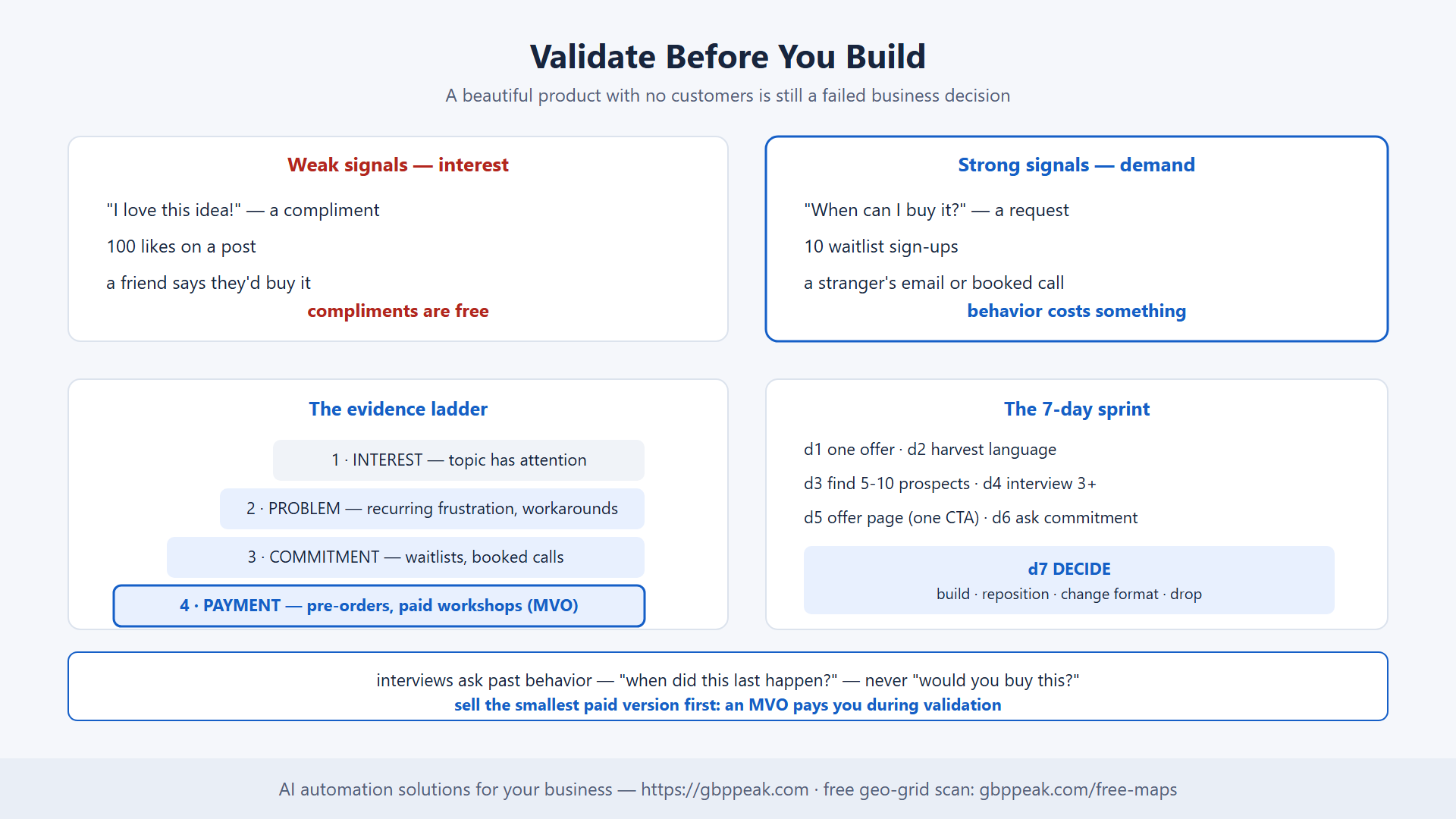
A creator spends four months building a 12-module course — recording, editing, designing workbooks. Launch week: eleven sales, nine from friends. The autopsy is always the same: nobody checked whether anyone wanted it before building it. A beautiful product with no customers is still a failed business decision, however productive the building felt.
Validation is the discipline that prevents that: moving from guessing to knowing by collecting evidence of behavior — from real people — before the big investment. Here is the complete system: the signals that matter, the evidence ladder, and a 7-day sprint that ends in a decision.
Validate a digital product idea by collecting evidence of behavior, not encouragement. Climb the evidence ladder — interest signals (search volume, existing products), problem signals (recurring frustrations and workarounds), commitment signals (waitlist sign-ups, booked calls), and payment signals (pre-orders, paid workshops). Interview 5–15 prospects about past behavior, never "would you buy this?"; build a one-sentence offer page; and sell a Minimum Viable Offer — the smallest paid version — before the full product. A 7-day sprint ends with one decision: build, reposition, change format, or drop.
Attention Is Not Demand
The first distinction protects everything after it:
| Weak signal (interest) | Strong signal (demand) |
|---|---|
| "I love this idea!" | "When can I buy it?" |
| 100 likes on a post | 10 waitlist sign-ups |
| A friend says they'd buy | A stranger gives an email or books a call |
Validation is not seeking encouragement; it is collecting evidence of behavior. Compliments are free; emails, bookings, and payments are not.
The Evidence Ladder
Each rung demands more commitment — and proves more:
LEVEL 1 · INTEREST      search suggestions · marketplace products ·
                        community questions     → topic has attention
LEVEL 2 · PROBLEM       same frustration repeated · clunky workarounds ·
                        "current tools too complex/expensive"
                        → topic is a business opportunity
LEVEL 3 · COMMITMENT    waitlist joins · detailed replies · booked calls
                        → people will act, not just nod
LEVEL 4 · PAYMENT       pre-orders · deposits · paid workshop / MVO
                        → demand, proven with money
Most creators stop at level 1 and build. The rule: never build the full product on evidence below the rung you'd need to bet months on — climb to at least level 3, ideally 4, per AI-assisted product research.
Start with the Problem, Not the Format
"I want to make a 10-part video course" is a format looking for a problem. A strong idea contains five elements, in order: specific audience → painful/costly problem → desired outcome → format that fits → reason to choose yours.
The problem dictates the format: "I need this done fast" calls for a checklist, not a video series. Get the problem right and the format nearly chooses itself — the same sequencing as the five filters.
Research Demand Early (You Don't Need a Following)
- Search signals — People Also Ask for live questions; competitor reviews for gaps ("no support," "too advanced") you can fill.
- Conversation signals — Reddit, Discord, niche forums: don't just find mentions, harvest the exact words people use for their frustration — that language becomes your offer.
- Competitor gaps — existing products that are outdated, bloated, or wrong-leveled. You don't reinvent; you make the better-fit version for one group, the recon habit from owning your market.
Interview Without Leading
"What did you think this helped you do?" — the politeness trap kills bad research. Ask about past behavior only:
the five non-leading questions:
  "What are you trying to achieve right now?"
  "What's making that difficult?"
  "When did this problem last happen?"
  "What have you already tried?"
  "What is it costing you — time or money?"
listen for: repeated pain + specific words = evidence
5–15 quality conversations surface the patterns; 200 average opinions don't.
Test the Promise, Not the Product
Condense into one sentence: "I help [audience] achieve [outcome] without [frustration] using [method]." Then a simple offer page — headline, problem, result, a mockup or sample, one call to action ("Join the waitlist"). Not a marketing site; a measurement device. Test one offer at a time — three audiences and three prices simultaneously teaches you nothing about which part worked.
The Strongest Test: The Minimum Viable Offer
The smallest paid version of your solution:
| Full product (build first) | MVO (sell first) |
|---|---|
| 12-module course | 90-minute live workshop |
| Complete system | One focused dashboard |
| Membership site | Paid group sprint, one task |
An MVO moves evidence to level 4 — and pays you during validation, so even a "failed" test returns money and learning, the profitable-failure logic of the 7-day first product.
The 7-Day Validation Sprint
day_1: "ONE audience · ONE problem · ONE result → one-sentence offer"
day_2: "harvest evidence + exact language (Reddit, YouTube, reviews)"
day_3: "identify 5-10 prospects with the problem; reach out"
day_4: "interview at least 3 — past-behavior questions only"
day_5: "build the simple offer page (headline + one CTA)"
day_6: "share it; count sign-ups, emails, pre-orders"
day_7: "DECIDE:"
        build        - clear demand
        reposition   - want solution, not this offer
        change_format- want a workshop, not a PDF
        drop         - nobody moved
FAQs
How do I validate a digital product idea?
Define one specific audience and one painful problem, gather behavioral evidence — search patterns, 5–15 interviews about past behavior — then publish a one-sentence offer page and sell a Minimum Viable Offer. Demand is proven by commitment and payment, not compliments.
Should I build the product before validating?
No. Build only what tests the promise: the offer page, a mockup, or the small paid version. A full product before validation is a months-long bet placed on zero evidence — the exact risk validation exists to remove.
How many interviews do I need?
Five to fifteen genuine conversations. You are hunting for repeating pain and exact language, not statistical significance — three people describing the same recurring frustration is a stronger signal than a hundred survey clicks.
Is a waitlist enough to call an idea validated?
It's a start, not a verdict. Waitlists prove interest (level 3); only payment proves demand (level 4). Push waitlist members toward a small commitment — a pre-order, a deposit, a paid workshop — before committing to the full build.
Can AI validate the idea for me?
AI can analyze interview transcripts, cluster review complaints, and sharpen your offer wording — a genuine research accelerator. But it cannot supply real-world evidence: only a human spending money or time on your offer validates anything.
Know Before You Build
Validation is risk reduction, pure and simple: problem before format, behavior before belief, payment before production. Run the seven-day sprint — offer page live by Friday, decision by Sunday — and the next time you sit down to build, it will be for people already waiting to buy. And if your market is local, see where it already stands with a free geo-grid scan at gbppeak.com/free-maps.