
Answer the Question: Optimizing Content for AI Search
A broad overview gives the AI nothing to grab; a specific answer gets cited. Questions over topics, answers up front, proof points as the moat.
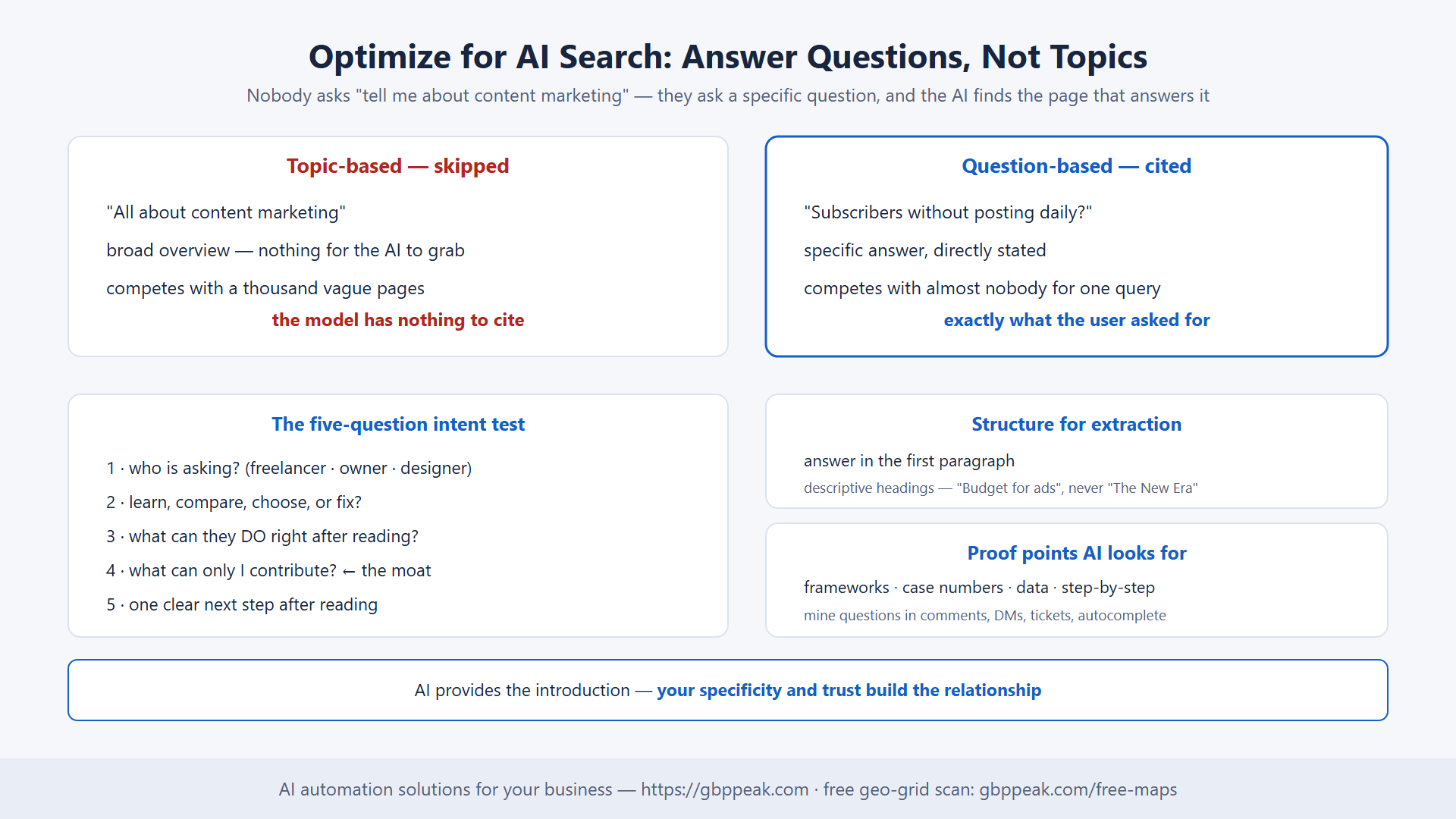
Nobody asks an AI "tell me about content marketing." They ask "how do I get more subscribers without posting every day?" — and the AI, acting as middleman, goes looking for the one page that answers that. If your article is a broad overview, the model has nothing to grab; if it is a specific, high-value answer, it gets cited. That single shift — topics to questions — is most of AI search optimization.
The rest is structure and proof. Here is the complete playbook for making content that both humans and AI systems can find, understand, and trust.
Optimize content for AI search by writing for specific questions, not broad topics. Answer directly in the first paragraph so AI models can extract clean snippets, use descriptive headings that state exactly what each section contains, and include authority proof points AI systems look for — original frameworks, case studies with real numbers, and step-by-step instructions. Mine real conversations (comments, DMs, support tickets, autocomplete) for question anchors, pass every draft through the five-question intent test, and remember: AI provides the introduction; your specificity and trustworthiness build the relationship.
Topics vs Questions
| Topic-based (skipped) | Question-based (cited) |
|---|---|
| "All about content marketing" | "How to get subscribers without posting daily" |
| "Digital products guide" | "How to verify a product idea before building" |
| "Websites for consultants" | "What a consultant's homepage must include" |
| General overview — nothing to grab | Specific answer — exactly what the user asked |
The logic: AI models select the resource that best answers the actual question. A broad article competes with a thousand others for vague attention; a specific answer competes with almost nobody for one clear query — the same intent discipline as keywords that attract customers and content that ranks.
The Five-Question Intent Test
Before publishing, run every draft through this:
intent_test:
  1_who:          "who asks this? freelancer · owner · designer"
  2_goal:         "learn, compare, choose, or fix?"
  3_next_action:  "what can they DO immediately after reading?"
  4_unique:       "framework, personal mistake, or data only I have?"
  5_after_reading: "checklist download · guide · signup — one step"
fail_any: "the topic is too broad — narrow and retry"
Question 4 is the moat: AI can summarize common knowledge endlessly, which makes common knowledge worthless. Your framework, your case study numbers, your scar tissue — that is what gets cited, the same differentiation rule from surviving the AI content flood.
Structure: Write for Humans, Let Robots Read
You do not write for the robot — you structure so the robot can serve your writing to humans.
- Direct answer first — the primary answer in the opening paragraphs, extractable as a snippet, per answer engine optimization.
- Descriptive headings — "How to budget for social ads," never "The New Era" or "Looking Ahead"; the AI navigates by headers exactly like a skimming human.
- High-value elements — the authority evidence models look for before citing:
proof points AI looks for:
  · original frameworks (a named, repeatable way of thinking)
  · case studies with real numbers and outcomes
  · data and statistics that support each claim
  · step-by-step numbered instructions for any process
Mine Real Conversations for Questions
Stop guessing what people ask; collect it. The gold mines:
- Social comments — questions under your posts and in community groups.
- Direct messages — the same question from three followers is three articles' worth of demand.
- Support tickets — problems customers pay you to solve.
- Autocomplete — what search engines know people type.
One real comment — "How do I track my traffic from AI tools?" — unpacks into three specific, citable articles: identifying AI-driven referral traffic, optimizing metadata for AI discovery, and what a "chatgpt.com" referral actually means for your business. That multiplication habit comes straight from AI-assisted content workflows.
Trust Is the Conversion Layer
AI search introduces readers; it does not keep them. What turns an AI-sent visitor into a follower is the same as always: answers that hold up, proof that is real, a next step that respects their time. AI discovery raises the ceiling of your reach; trust decides how much of it lands — the SEO-to-GEO consensus at the page level.
FAQs
Can I guarantee that an AI will link to my site?
No — nobody can guarantee a specific citation. What you can control is the likelihood: structured, specific, authoritative content is dramatically more likely to be judged "useful enough to include." Optimization increases the odds; it does not purchase the outcome.
Should I use special "AI-friendly" keywords?
No — optimize for human intent instead. Use the natural language people actually type and speak, answer real questions directly, and the AI's language understanding does the matching. Content that satisfies a human almost always satisfies the model reading the same page.
How do I make my expertise visible to AI systems?
Through proof points: cite your years of experience, name specific results you've achieved, and include original insights that aren't restatements of common knowledge. Frameworks, case data, and named processes are the artifacts that signal "this author has done the work."
Is AI search optimization different from regular SEO?
They overlap heavily — clarity, structure, and authority serve both. The main difference is extraction: traditional SEO ranks your page, AI search lifts passages out of it, so direct answers near the top and quotable, self-contained sections matter even more.
Answer the Question, Earn the Reader
The playbook compresses to one sentence: write the answer to a real person's real question, structure it so machines can serve it, and prove it with what only you know. Run the five-question test on your next draft, rewrite one vague heading into its literal content, and move your best answer into the first paragraph. Then check both sides of your discovery — the AI answers and the map — with a free geo-grid scan at gbppeak.com/free-maps.