Clarity, Then Leverage: Digital Growth for New and Underperforming Sites
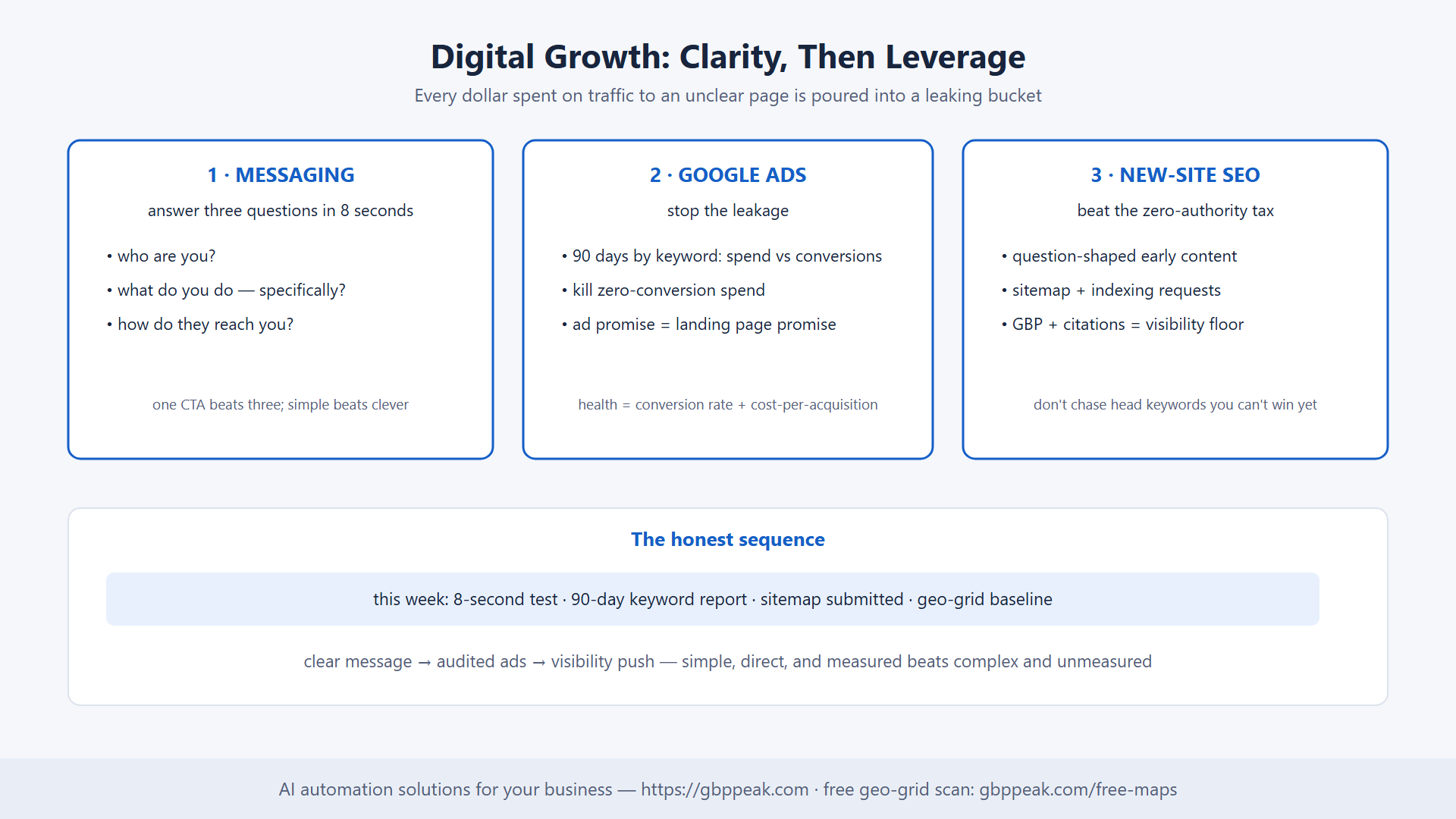
Three pillars: a homepage that answers who/what/contact in 8 seconds, Google Ads audited for leakage, and visibility tactics that beat the new-site zero-authority tax.
A visitor lands on a business homepage, reads for eight seconds, and leaves — not because the design was bad, but because after eight seconds they still could not answer three questions: who is this, what do they do, and how do I contact them? Every marketing dollar spent sending people to a page that cannot answer those questions is money poured into a leaking bucket.
Digital growth stands on three pillars that fix this end to end: clear messaging (identity), efficient paid search (Google Ads without leakage), and new-website visibility tactics (getting found before you have authority). Here is each, with the moves that matter.
Grow a digital presence with three pillars. First, messaging: your homepage must instantly answer who you are, what you do, and how to contact you — clarity outperforms clever funnels. Second, advertising: audit Google Ads accounts for leakage (spend on keywords that never convert), keep the winners, cut the waste, and track cost-per-acquisition honestly. Third, new-site visibility: websites under a year old lack authority, so they need targeted early content, indexing boosts, and consistent activity signals to be found at all. Simple, direct, and audited beats complex and unmeasured.
The Three Pillars
| Pillar | Fixes | Health check | Typical leak |
|---|---|---|---|
| Messaging | "They don't get us" | 8-second test: who/what/contact clear? | Vague homepage |
| Paid search | "Ads cost too much" | Conversion rate + cost-per-acquisition | Spend on non-converting keywords |
| New-site SEO | "Nobody finds us" | Indexed? ranking for brand name? | Waiting for organic that can't come yet |
Pillar 1: Messaging — Answer Three Questions
Before any channel matters, the destination page must answer, within seconds of arrival:
- Who are you? — a name, a face, a place.
- What do you do? — specifically, in the customer's words, not your industry's.
- How do I reach you? — phone, form, or booking, visible without scrolling.
the 8-second test (run as a stranger, on a phone):
  land on the homepage
  at 8 seconds, answer out loud: who? what? contact?
  any hesitation = a paying customer's hesitation
vague fix list:
  "solutions for your business" → name the actual service
  "contact us" → "Get a free quote in 24 hours"
  three competing CTAs → one
Simplicity is the strategy. A clear page creates a "shaker" effect — it disturbs the customer's status quo and makes the next step obvious — and simple paths convert more consistently than elaborate funnels, the same lesson as conversion quick wins and offer clarity.
Pillar 2: Google Ads Without Leakage
Ads are the fastest engine and the fastest way to burn money. Most accounts leak: budget flows to keywords and placements that produce clicks but never customers.
A proper review (yours or a professional's) covers four moves:
# ads audit (90 minutes, quarterly):
1. pull 90 days by keyword: spend vs tracked conversions
2. kill everything with spend and zero conversions
3. check ad promise vs landing page — mismatched promises bleed
4. verify the conversion tracker fires (test lead, end to end)
5. reallocate the saved budget to the top 2 performers
The health metrics are conversion rate and cost-per-acquisition — if a customer costs more than they're worth, the account is leaking regardless of how busy it looks. And step 3 matters more than people expect: an ad promising "free consultation" landing on a page selling "premium packages" converts nobody, at full click price — the ad-audit logic from the four-layer marketing stack.
Pillar 3: New Websites — Beating the "Nobody Knows You" Tax
A site under a year old starts with zero authority. Search engines have no history with it, no links point to it, and standard tactics ("publish great content") take months to pay. New sites need visibility tactics aimed at the starting line, not the middle of the race:
- Targeted early content — write for your first hundred customers' exact questions, not for broad competitive terms you cannot win yet.
- Indexing boosts — submit the sitemap, request indexing for key pages, make sure the site is technically crawlable; being found requires being read first.
- Activity signals — regular updates, fresh content, an active profile — evidence that the site is alive, the cadence principle from sustainable local SEO.
- Local shortcuts — a complete Google Business Profile and local citations give a new site a visibility floor that organic alone won't, per the five visibility pillars.
new_site_first_90_days:
  week_1: "sitemap submitted, GBP claimed, NAP citations (10)"
  weeks_2-8: "2 posts/week answering real customer questions"
  weeks_9-12: "review rank for brand + long-tail terms → adjust"
  avoid: "chasing head keywords you cannot win yet"
Supporting Cast
Three supporting resources multiply all three pillars: backlink management (a curated list of quality link targets builds the authority new sites lack — the ten backlink types); AI content assistance (draft faster, but a human verifies every fact); and community engagement (peers flag what's changing while you're busy executing — the growth resource kit).
FAQs
What is the most important first step for a new website?
Establishing clear identity. Before any traffic source matters, a visitor must immediately understand who you are, what you offer, and how to contact you. Clarity converts the traffic you earn; vagueness wastes it — and it costs nothing but an afternoon of rewriting.
How can I tell if my Google Ads are performing well?
By conversion rate and cost-per-acquisition, not clicks or impressions. If acquiring a customer costs more than they're worth, or click-through is low, the account is leaking — pull spend by keyword, cut anything converting at zero, and verify your tracking actually fires before trusting any of the numbers.
How long does it take a new website to show up on Google?
Indexing can happen in days, but ranking for competitive terms takes months because a new domain starts with zero authority. Targeted tactics — question-shaped early content, indexing requests, local profile and citations, consistent publishing — build the foundation that waiting alone never will.
Should a new business run ads or focus on SEO first?
Both, with different jobs. Ads buy immediate leads while authority builds; SEO compounds into free traffic later. Run small, tightly-audited ads for cash flow now, and invest the margin in content and visibility that lowers tomorrow's cost per customer.
Clarity, Then Leverage
Growth compounds when the sequence is honest: make the message clear, stop the ad leakage, and give the new site the visibility push it cannot generate alone. Run the 8-second test this week, pull the 90-day keyword report, and submit that sitemap — and for the local side of visibility, start with the free baseline: a geo-grid scan at gbppeak.com/free-maps showing exactly where you stand, district by district.