
Fifty Fresh Reviews Beat Two Hundred Stale Ones: Five Local Rank Systems
Freshness beats totals: an automated review pipeline, multi-platform proof, a complete GBP, AI-found citations, and weekly public answers — five systems, one rhythm.
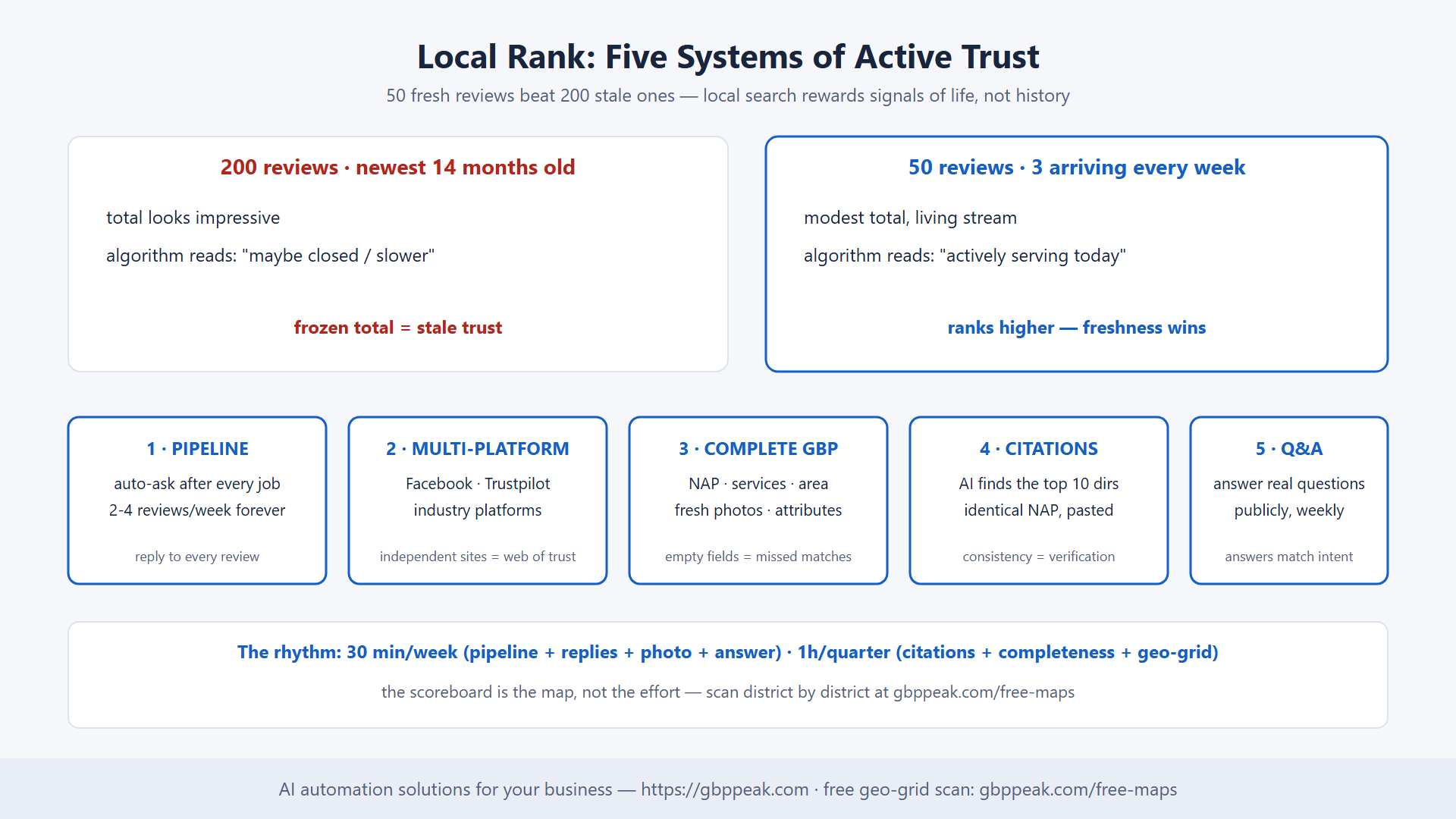
Two electricians serve the same district. One has 200 Google reviews — the newest from fourteen months ago. The other has 50, with three arriving every week. When a customer searches "electrician near me," the second one ranks higher, because the algorithm reads review freshness as proof the business is alive and serving today.
Local search rewards signals of active trust, not accumulated history. Five strategies generate those signals — reviews that keep coming, a profile that never rots, citations that verify you, answers that match real questions, and a review presence across the whole web. Here is each one, as a system.
Improve local search rankings with five systems: automate review requests after every job so Google reviews arrive steadily (freshness beats total volume — 50 recent reviews outrank 200 stale ones); collect reviews on third-party platforms like Facebook and Trustpilot so independent sites confirm your credibility; keep your Google Business Profile fully complete (accurate NAP, services, area, fresh photos, attributes); build consistent citations across the top local directories, which verifies your location and earns backlinks; and answer real customer questions on social media, creating content that matches "how-to" and "where-to" search intent.
The Five Strategies
| Strategy | Signal it sends | Cadence |
|---|---|---|
| Review pipeline | Actively serving, trusted today | Every job |
| Multi-platform reviews | Independently verified | Ongoing |
| Complete GBP | Legitimate, current, local | Weekly touch |
| Citations | Location verified everywhere | Quarterly audit |
| Social Q&A | Real expertise, matching intent | 1–2 answers/week |
Strategy 1: The Review Pipeline
Regularity beats volume. Fifty recent reviews outperform two hundred with the last one a year old — Google reads the ongoing stream as a business that is alive, while a frozen total reads as "maybe closed."
The fix is automation, not memory:
review_pipeline:
  trigger: "job marked complete"
  action:  "same-day email/SMS: thanks + direct link
            to the Google review page"
  follow:  "gentle reminder after 3 days, one time"
  target:  "2-4 new reviews/week, forever"
  bonus:   "reply to every review — active management
            is itself a signal"
Sporadic asking produces sporadic reviews; a pipeline produces a rhythm the algorithm can read, per the sustainable local SEO cycle.
Strategy 2: Reviews Beyond Google
Your local ranking is influenced by reputation across the whole web. Facebook reviews, Trustpilot, and industry-specific platforms each add an independent confirmation — and increasingly, AI-driven search tools use exactly these platforms to verify a business is legitimate before recommending it, per tracking your AI visibility.
Practical move: your review pipeline should offer a platform choice (Google first, an industry platform second). When several independent sites agree you are good, that web of trust does what a single pile of Google reviews cannot — the consensus effect from SEO to GEO.
Strategy 3: The Complete Profile
The Google Business Profile is your digital storefront and the gatekeeper of the Local Pack — the box of three businesses at the top of results. Completeness is the whole game:
- Accurate NAP — name, address, phone identical everywhere on the web (citations and NAP).
- Services + service area — listed specifically, in the words customers search.
- Fresh photos — real work, team, and location, refreshed monthly; the posting rhythm from GBP content types.
- Every attribute filled — accessibility, appointment requirements, payment options; empty fields are missed matches.
Strategy 4: Citations That Verify
A citation — your NAP listed on a directory — is how search engines confirm your location and relevance. Many consistent citations build authority; contradictory ones destroy it (one mismatch costs more than ten matches earn).
Start with AI doing the prospecting:
ask an AI tool:
  "list the top 10 business citation websites
   for [your country] and [your industry]"
→ verify each is real and relevant
→ one canonical NAP string, pasted everywhere
→ spreadsheet tracker, quarterly ghost audit
Each quality directory also earns a backlink — a link from their site to yours — compounding authority over time, per backlink types.
Strategy 5: Answer Questions Where Customers Ask
Social platforms are search engines now — both for customers browsing and for the algorithms matching "how-to" and "where-to" queries. Every question you answer publicly creates a searchable trail of demonstrated expertise: "How much does a standard house wiring job cost?", "Which districts do you serve?", "What should I check before calling a plumber?"
Q&A content habit (30 min/week):
  collect:   questions from jobs, calls, DMs
  answer:    one per week, publicly — Facebook, IG, GBP post
  shape:     question as the headline, direct answer first
  effect:    matches long-tail intent + feeds AI answers
Answers match intent; ads don't. That is why this quiet habit outperforms promotional posting — the same evidence as guerilla local SEO.
The Weekly Rhythm
All five compress into a manageable routine:
weekly_30min:
  - "check review pipeline fired for every completed job"
  - "reply to all new reviews (both platforms)"
  - "one photo drop or post on the GBP"
  - "one public Q&A answer on social"
quarterly_1h:
  - "citation audit + 3 new directories"
  - "profile completeness re-check"
  - "geo-grid scan → where did rank move?"
That last line is the scoreboard — a free geo-grid scan at gbppeak.com/free-maps shows your rank district by district, so the five strategies get judged by map movement rather than effort.
FAQs
Why do regular reviews matter more than a high total count?
Freshness. Search engines weight recent review activity as evidence a business is actively serving customers right now, while a large but stale total may not reflect current quality. A steady stream of new reviews also keeps your star rating honest and your profile visibly alive.
What are citations and why are they important?
Citations are mentions of your business name, address, and phone on directory and community sites. They verify your location and legitimacy to search engines — consistent listings across many sites build ranking authority, while mismatches create doubt that suppresses local results.
Do Facebook or Trustpilot reviews help my Google ranking?
Indirectly but meaningfully. They are not counted like Google reviews, but a strong multi-platform footprint confirms to both traditional algorithms and AI search tools that you are a legitimate, well-regarded local business — the kind of independent consensus that influences who gets recommended.
How long do these strategies take to move rankings?
Reviews and profile fixes can show effects in weeks; citations and Q&A content compound over a few months. The rhythm matters more than any sprint — five systems maintained steadily for a quarter will outperform any one-time optimization push.
Trust, Compounded
Winning local search is trust-building with two audiences at once — customers and algorithms — and the five strategies feed both: fresh reviews, cross-platform confirmation, a complete profile, verified citations, public answers. Set the pipeline running this week, then let the rhythm carry it. Your scoreboard: a free geo-grid scan at gbppeak.com/free-maps, district by district.