The Essential Guide to Local SEO: Get Found in Your Community
Two doors — the map pack and organic — three ranking factors (relevance, distance, prominence), one NAP, steady reviews, and a website that answers fast.
Two bakeries sit three streets apart. When someone nearby searches "bakery near me," one appears on the map with photos, reviews, and hours; the other is invisible. Same quality flour, same ovens — the difference is that one treated its online presence as part of the business and the other didn't. Local SEO is not a secret hack; it is the discipline of being findable, consistent, and trusted within your own community.
This is the complete guide: how local ranking actually works, how to run the profile, the website, and the reputation — and how to know it's working.
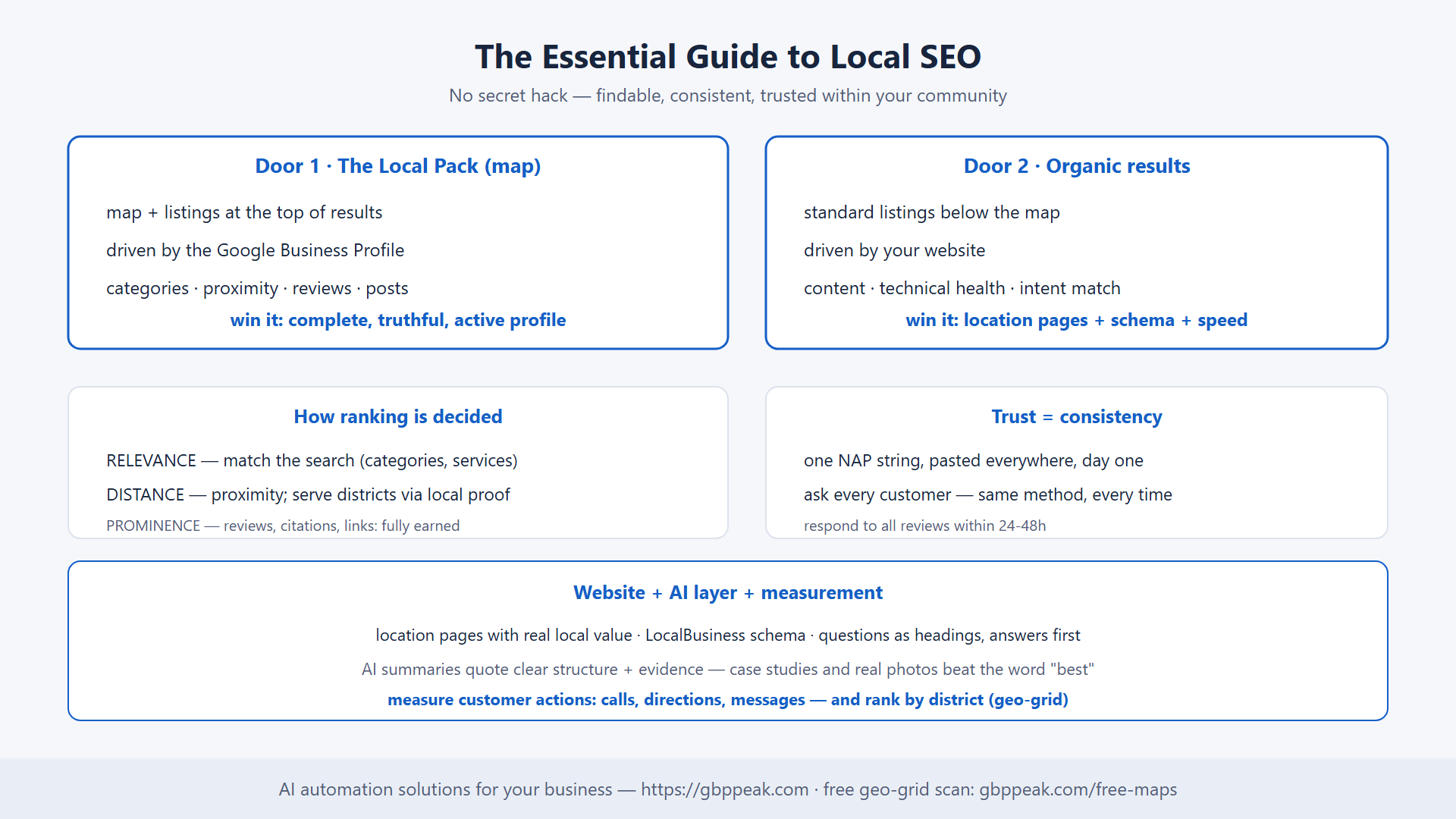
Local SEO optimizes your online presence so nearby customers find you in map results and local search. Ranking is driven by three factors: relevance (how well your profile matches the search), distance (proximity to the searcher), and prominence (how established and trusted you are). Win all three by maintaining a complete, accurate Google Business Profile; keeping your name, address, and phone identical across every directory; earning a steady stream of detailed reviews; and building a website with location-specific pages, fast mobile performance, LocalBusiness schema, and direct answers to real customer questions.
The Two Doors of Local Search
| Local Pack (map) | Organic results | |
|---|---|---|
| Where | Top of results, map + listings | Below the map |
| Driven by | Google Business Profile | Your website |
| Depends on | Categories, proximity, reviews | Content, technical health, intent match |
The winning strategy makes both tell the same story: a great profile wins the map, but a weak website caps organic growth — and vice versa. Neglect either door and you leak customers through it.
How Ranking Is Decided: Three Factors
- Relevance — does your business match what was searched? Accurate categories, complete services, a clear description.
- Distance — how close are you to the searcher? You can't move your shop, but you can rank across districts by proving you serve them — service-area pages, local content, and citations.
- Prominence — how established and trusted are you? Reviews (steady, detailed, recent), citations, links, and how well known you are offline and on.
Distance you partially control; relevance and prominence are almost entirely earned.
Running the Google Business Profile
The free rules that matter:
- Claim, don't duplicate. If a listing already exists, claim it — duplicates split your reviews and confuse the map.
- Specific categories. "Emergency Plumber" beats "Plumber" if that's your focus — specificity wins relevance.
- Real name. Your storefront name, not keyword-stuffed variations — stuffing violates guidelines and erodes trust.
- Real local number. One customers can actually call, identical everywhere else.
- Hours that are actually true — holiday updates included; a customer at a closed door is a review you'll regret.
- Description in natural language — who you serve and what you offer, not a keyword string.
- Detailed service entries — each core service gets its own entry (the catalog approach).
- Photos + weekly updates — real team, product, and location shots; the posts feature keeps the profile alive (the content cadence).
Consistency: NAP and Reviews
Three phone numbers on three sites read as three different businesses — to customers and to algorithms. One canonical Name-Address-Phone string, pasted identically everywhere: site, social, every directory. Hunt duplicates, merge old listings, and update every platform the day your details change (citation mechanics).
Reviews drive prominence:
review_routine:
  ask:       "every customer, same method — follow-up text
              or counter QR code"
  respond:   "all reviews within 24-48h — thanks for praise,
              professionalism for complaints"
  quality:   "steady drip of detailed reviews beats a burst;
              'fixed our bakery cold room same day' teaches
              the map what you're known for"
The Website: Hub of the Operation
- Location pages with real local value — neighborhood specifics, local project photos, area advice. Never the same template with the city swapped; thin duplicates are the classic penalty trap (common local mistakes).
- Fast and mobile-easy — most local searches happen on phones.
- LocalBusiness schema — code that states hours, location, and services unambiguously to machines (discoverability gates).
- Questions as headings, answers first — the customer question becomes the subheading; the first sentence answers it. Serves humans and AI summaries alike (AEO structure).
The AI Layer
AI Overviews and Perplexity summarize the web when recommending businesses. To be quotable: clear headings, the answer stated immediately, and evidence instead of adjectives — case studies, credentials, real photos beat the word "best" every time (the consensus effect).
Measuring Progress
Rank is a proxy; customer actions are the point:
- Search Console — the actual queries people type and the pages they click.
- Profile actions — direction requests, calls, messages from the listing.
- Review health — average rating + frequency, so prominence stays provable.
- The map itself — rank district by district with a free geo-grid scan at gbppeak.com/free-maps, since visibility is neighborhood-shaped, not a single number.
FAQs
What is the difference between local SEO and regular SEO?
Local SEO captures customers in a specific geographic area — map results, "near me" searches, proximity signals — while standard SEO competes for broader terms on content authority. Local leans on the Google Business Profile, citations, and reviews; standard leans on site content and backlinks.
How long until local SEO shows results?
Profile fixes (hours, categories) can matter within days; meaningful ranking growth typically takes three to six months of consistent reviews, citations, and content. The compounding is the reward — unlike ads, every review and citation keeps working after it's earned.
Do I need a storefront to rank locally?
No — service-area businesses (plumbers, mobile groomers) rank without one, but you still need a real base of operations and a defined, verifiable service area declared honestly in your profile.
How many reviews do I need to rank well?
No fixed number — prominence rewards a steady flow of recent, detailed, positive reviews. Twenty specific reviews from this quarter outweigh a hundred stale one-word ratings from two years ago.
Be the Obvious Local Choice
Local SEO has no secret button: a complete truthful profile, one NAP everywhere, a steady review rhythm, a website that answers real questions fast, and patient quarterly measurement. Do that consistently and your community's searches start ending at your door. Start by seeing where you stand — the free geo-grid scan at gbppeak.com/free-maps shows which neighborhoods can find you today.